

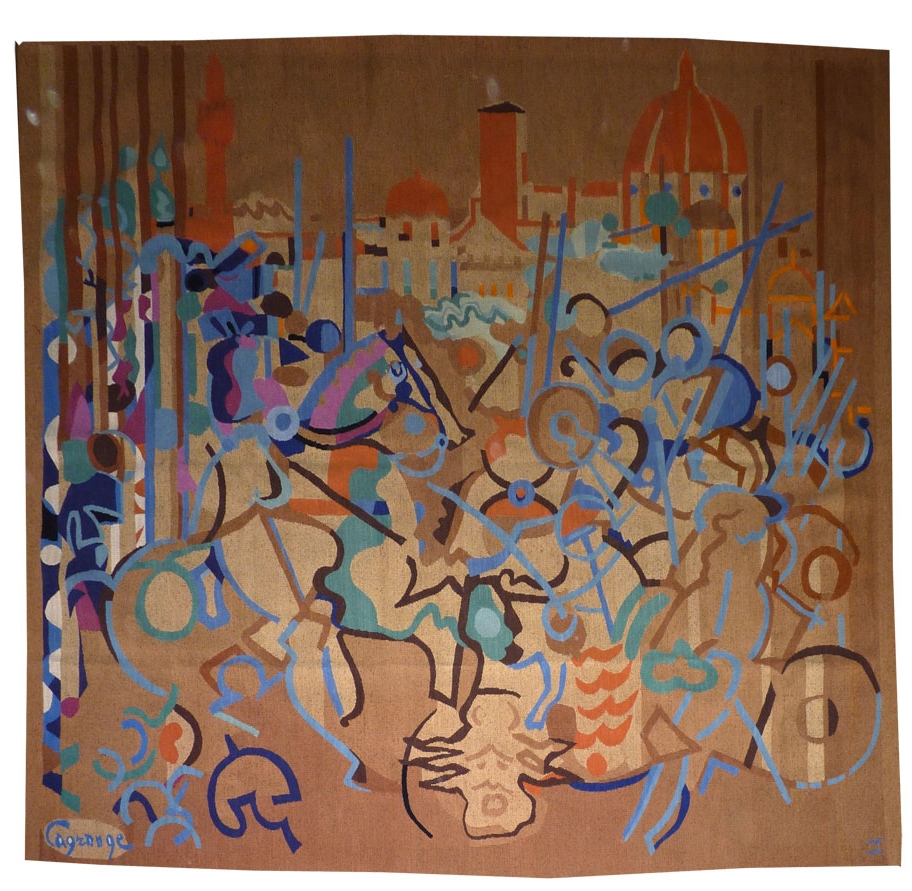


Battle before Florence
Aubusson tapestry woven by the Goubely-Gatien workshop.
With its label partially erased.
1966.
Enthusiastic about mural art since 1937 (he participated in the International Exhibition), Lagrange drew his first cartoons in 1945, and became one of the founding members of the A.P.C.T. Initially expressionist (like Matégot or Tourlière), his cartoons (from his collaboration with Pierre Baudouin) evolved towards a stylization that would lead in the 70s to cartoons made of purified signs in pure tones. Moreover, beyond his role in the revival of tapestry (and related public commissions), Lagrange was a Professor at the National School of Fine Arts, but also a regular collaborator of Jacques Tati, a designer of monumental sets, and finally a recognized painter, close to Estève or Lapicque.
In the 60s, the artist will decline on large surfaces the medieval theme of battles and tournaments, in a stylized and geometric vein, whose peak will be the "Homage to Paolo Uccello" (280 x 680 cm, of which a copy is kept at the Faculty of Science in Besançon).
Still figurative, Lagrange illustrates here, in front of Florence, whose archetypal monuments can be distinguished (the Duomo, the campanile of the Palazzo Vecchio,…), a battle scene in a frieze effectively inspired by the paintings of Uccello, where lances, horses and knights intermingle. Note that the beige and brown chiné background on which they stand out is unique to Lagrange, and will be little used by his peers.
Bibliography :
Cat. Exp. Lagrange tapestries, La demeure Gallery, 1968, n°4 (reproduced)
Cat. Exp. Aubusson Tapestries, Municipal Art Gallery, Luxembourg, n°4 of the catalog (not reproduced)
Robert Guinot, Jacques Lagrange, the colors of life, Lucien Souny editor, 2005, n°40, reproduced (with dimensions 226 x 268 cm)
J.J. and B. Wattel, Jacques Lagrange and his canvases : paintings, tapestries, cinema, Louvre Victoire Editions, 2020


