


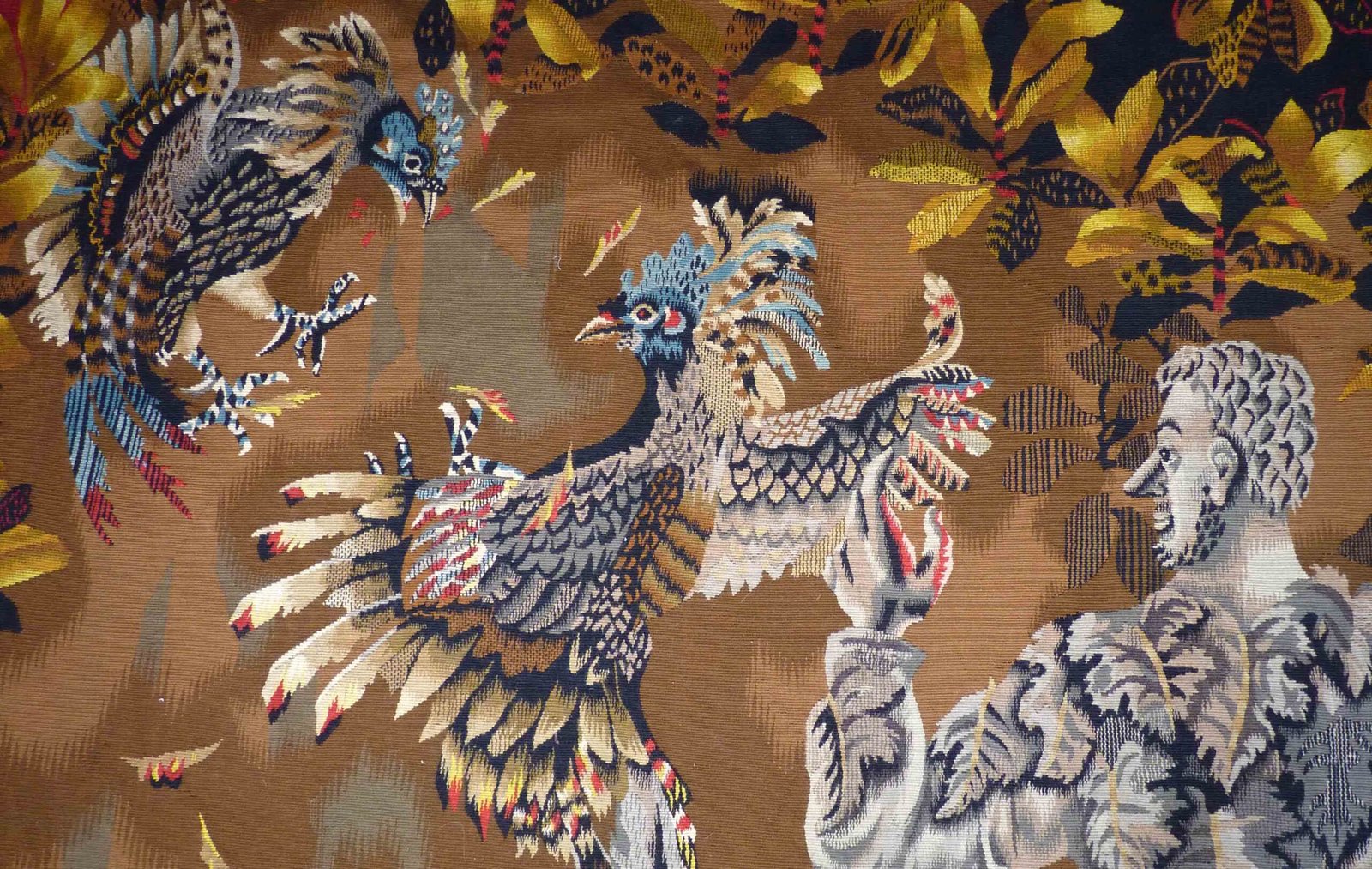
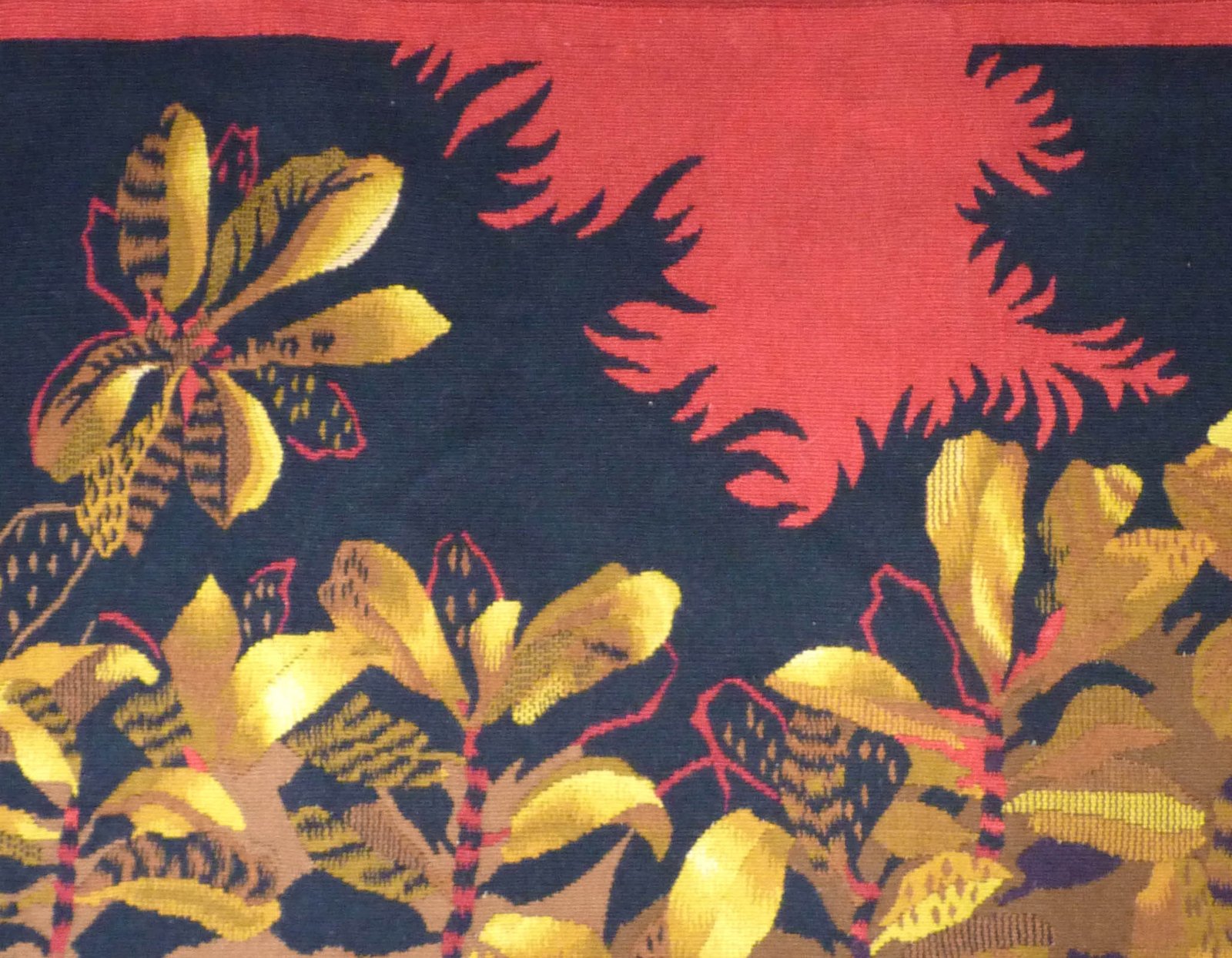
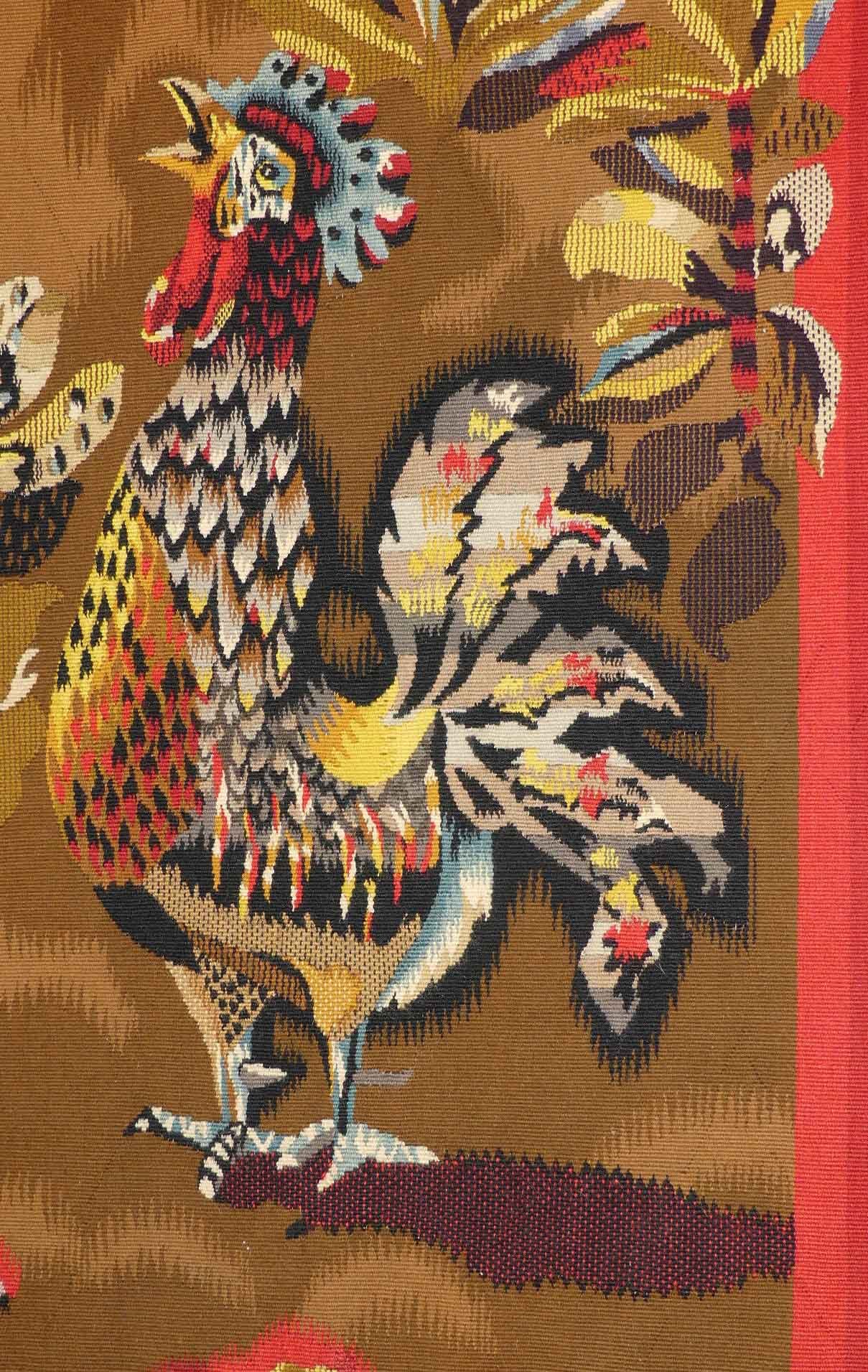


Cock Fight
Aubusson tapestry woven by the Tabard workshop.
1940.
Lurçat's work is immense: however, it is his role in the renovation of the art of tapestry that earned him a place in posterity. From 1917, he began with canvas works, then, in the 1920s and 1930s, he worked with Marie Cuttoli. His first collaboration with the Gobelins dates back to 1937, when he simultaneously discovered the Apocalypse tapestry of Angers, which definitively encouraged him to devote himself to tapestry. He will first tackle technical questions with François Tabard, then on the occasion of his installation in Aubusson during the war, he will define his system: large stitch, counted tones, numbered drawn cartoons.
A gigantic production begins then (more than 1000 cartoons), amplified by the desire to involve his painter friends, the creation of the A.P.C.T. (Association of Painter-Cartoonists of Tapestry) and collaboration with the La Demeure gallery and Denise Majorel, then by his role as tireless promoter of the medium around the World.
His woven work demonstrates a specifically decorative art of imagery, in a very personal, cosmogonic symbolic iconography (sun, planets, zodiac, 4 elements...), stylized vegetation, animals (goats, roosters, butterflies, chimeras...), standing out against a background without perspective (deliberately distant from painting), and intended, in his most ambitious cartoons, to share a vision that is both poetic (he sometimes enlivens these tapestries with quotations) and philosophical (the major themes are addressed from the war onwards: freedom, resistance, brotherhood, truth... ) and whose culminating point will be the "Song of the World" ( Jean Lurçat Museum, former Saint-Jean hospital, Angers) , unfinished at his death.
Man is the central theme of Lurçat's first tapestries, he will become rarer afterwards; the rooster, on the other hand, will remain omnipresent, but with a significant evolution of the motif. At the dawn of his work as a cartoonnier, this association makes it possible to see what roles are then assigned to them: at this time (the beginnings of what will be called the "Tapestry Renaissance"), man, primitive, is an element of nature (dressed in leaves, he evolves in an autumnal environment with muted hues), which strives to domesticate roosters still very realistic, far from the symbolic dimension they will acquire later in Lurçat's imagination; a Lurçat here still bucolic inspiration.
A copy of "Cockfight" (and its counterpart "Cock Garden") are kept at the National Museum of Modern Art, in Paris, pieces acquired by the State from 1940.
Bibliography:
Tapisseries de Jean Lurçat 1939-1957, Pierre Vorms Editeur, 1957
Exhibition Catalog. Lurçat, 10 ans après, Musée d’Art moderne de la ville de Paris, 1976
Exhibition Catalog. Les domaines de Jean Lurçat, Angers, Musée Jean Lurçat et de la tapisserie contemporaine, 1986
Exhibition Catalog. Jean Lurçat, le combat et la victoire, centenaire, Aubusson, Musée départemental de la Tapisserie 1992, ill. p.36
Symposium Jean Lurçat and the renaissance of tapestry in Aubusson, Aubusson, Departmental Museum of Tapestry, 1992, ill.6 p.69 (detail)
Exhibition Catalog. Dialogues avec Lurçat, Musées de Basse-Normandie, 1992
Exhibition Catalog. Jean Lurçat, Donation Simone Lurçat, Académie des Beaux-Arts 2004
Gérard Denizeau, Jean Lurçat, Liénart, 2013
Exhibition Catalog. Jean Lurçat au seul bruit du soleil, Paris, galerie des Gobelins, 2016


