





The harp of the seas
Aubusson tapestry woven by the Berthaut workshop.
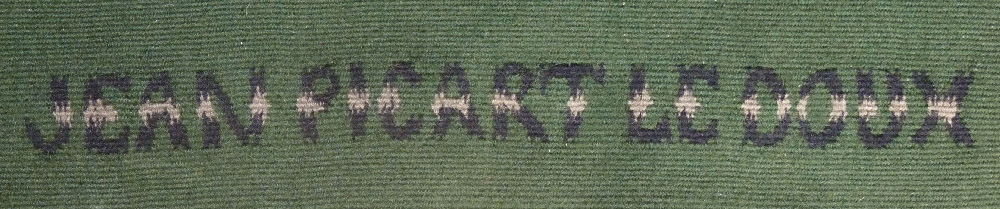
With its label signed by the artist.
1954.
Jean Picart le Doux is one of the major figures in the revival of tapestry. His beginnings in the field date back to 1943: he created cartoons for the liner 'la Marseillaise'. Close to Lurçat, whose theories he adopted (limited tones, numbered cartoons,…), he is a founding member of the A.P.C.T. (Association of Cartoonists-Tapestry Artists) and soon became a professor at the National Higher School of Decorative Arts. The State commissioned numerous cartoons from him, most of which were woven in Aubusson, and some at the Gobelins: the most spectacular ones were for the University of Caen, the Mans Theatre, the France liner, or the Creuse Prefecture,…. If Picart le Doux's conceptions are close to those of Lurçat, his sources of inspiration and themes are also similar, but in a more decorative than symbolic register, where stars (the sun, the moon, the stars…), elements, nature (wheat, vine, fish, birds…), man, and texts coexist,….
“The Harp of the Seas” (Bruzeau no. 60), just like its counterpart, “the Harp of the Forests”, of the same format, is part of a series of cartoons by Picart le Doux centered around the themes of the lyre and the harp: the geometric rigor and the graphic power of the parallelism of the strings particularly inspired him. Here, Music and nature are intimately linked (cf. “the lyre-tree” of 1953), and “Orpheus” (cartoon of 1952) is the singular figure that embodies this assimilation.
Bibliography :
Maurice Bruzeau, Jean Picart le Doux, Walls of sun, Editions Cercle d’art, 1972
Cat. Exp. Jean Picart le Doux, Post Museum, 1980


