

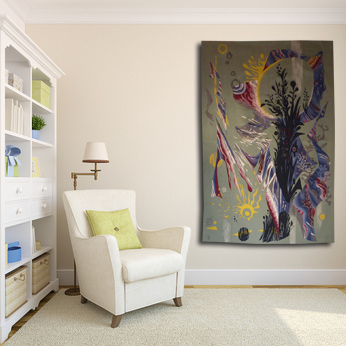
Ornaments
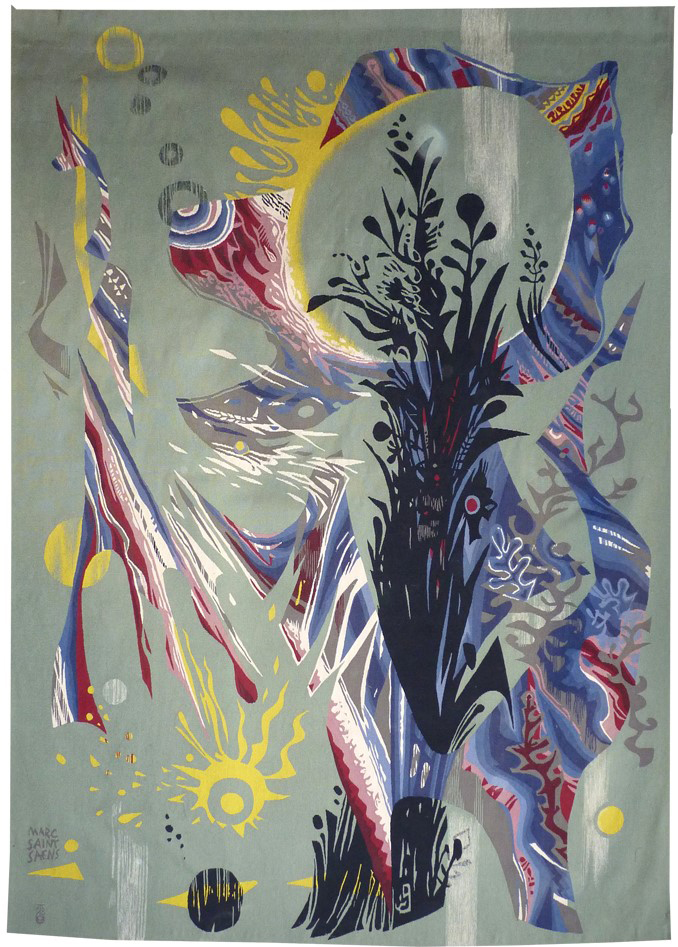
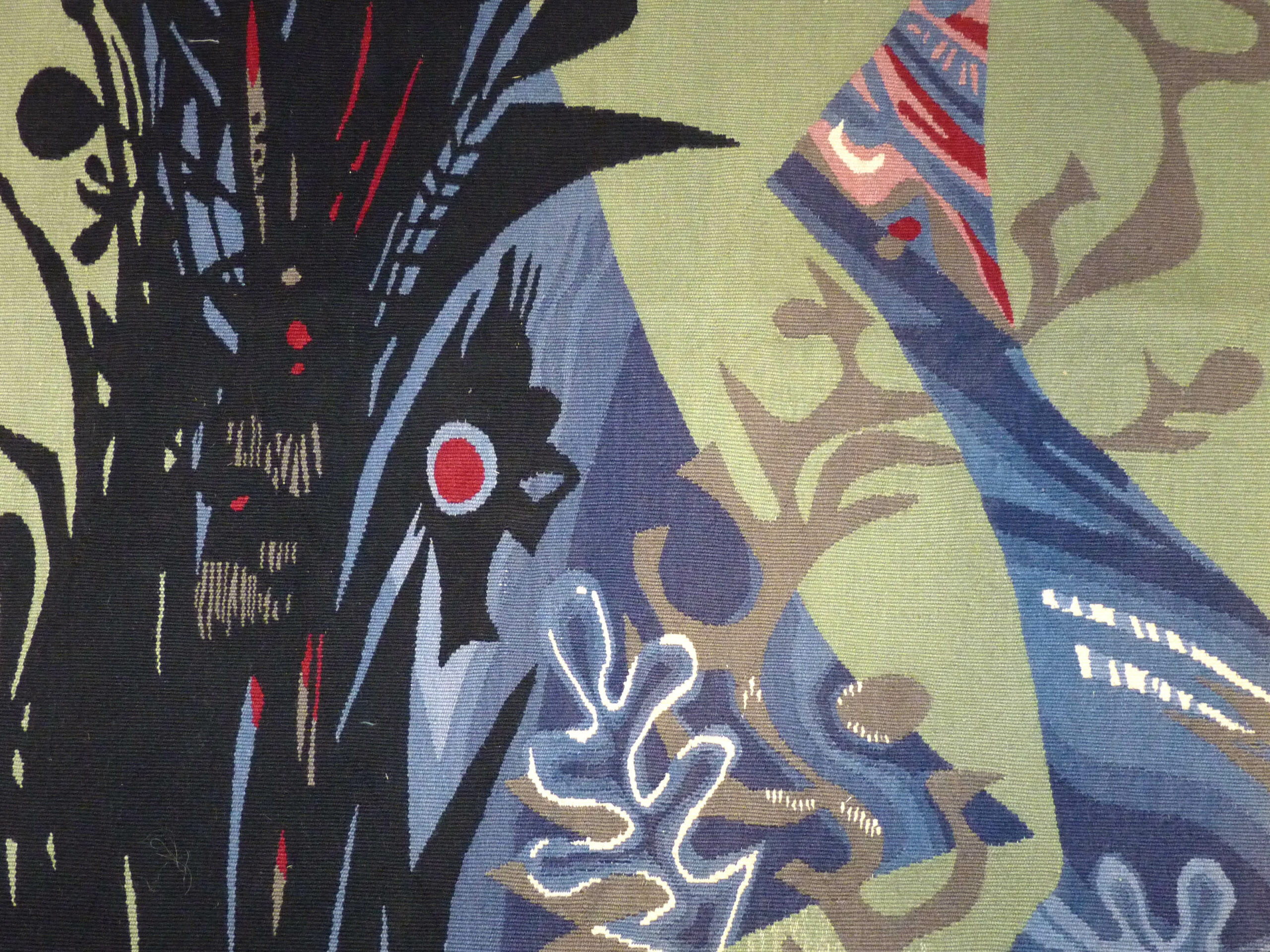
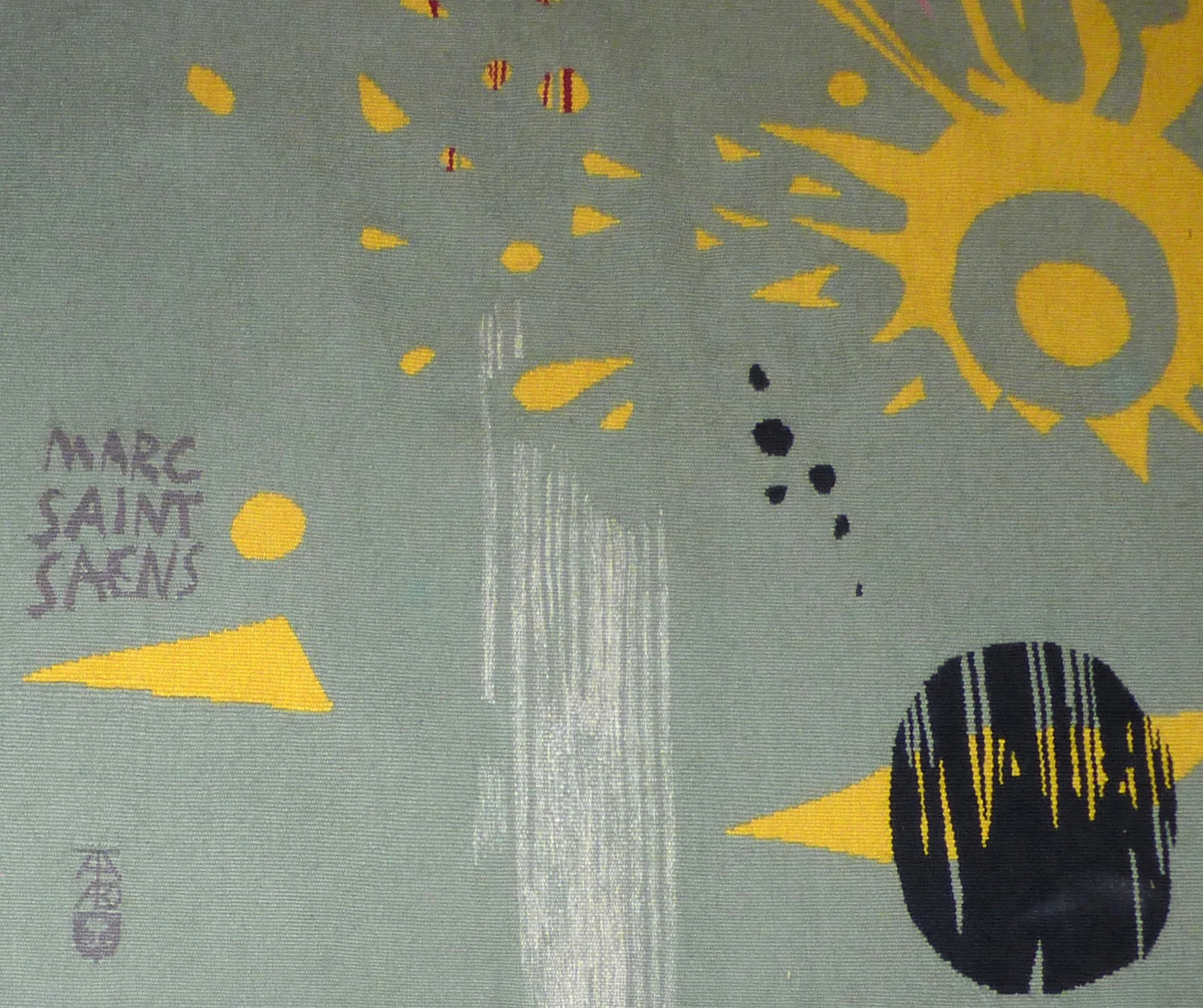
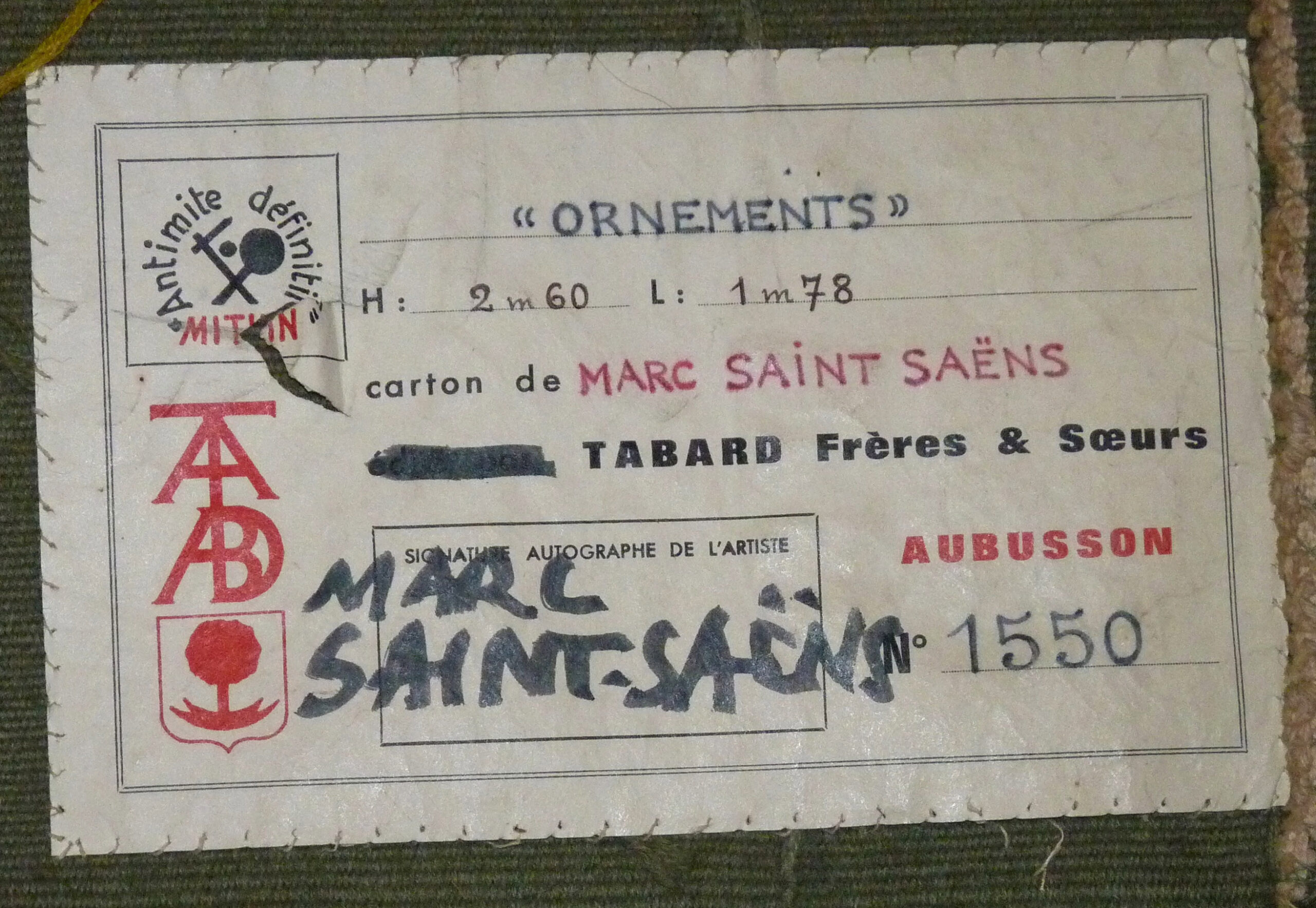
Aubusson tapestry woven by the Tabard workshop.
With its label signed by the artist, No. 4.
1963.
Lurçat solicited Saint-Saëns, initially a fresco painter, from 1940 onwards. And, during the war, he produced his first allegorical masterpieces, tapestries of indignation, combat, and resistance: 'the Foolish Virgins', 'Theseus and the Minotaur'. After the war, he naturally joined Lurçat, with whom he shared convictions (on the numbered cartoon and counted tones, on the specific writing required for tapestry, ...) within the A.P.C.T. (Association of Tapestry Cartoonists). His universe, where the human figure, stretched and elongated, holds a considerable place (compared in particular to the place it occupies among his colleagues Lurçat and Picart le Doux), revolves around traditional themes: woman, Commedia dell'arte, Greek myths, ... sublimated by the brilliance of the colours and the simplification of the layout. He then evolved, in the 1960s, towards more lyrical, almost abstract cartoons, where cosmic elements and forces dominate.
This cartoon is precisely in line with this vein. Let us quote the 1987 catalog (p.37): "Ornaments, a purely decorative tapestry, is akin to Daedalus, Biology (preserved at the CNRS Directorate) Bel Canto, due to its ample, unbound, lyrical style, very close to the brush studies in which Saint-Saëns indulged in the joy of freely spread color ». This cartoon was woven in 5 copies.
Bibliography :
Cat. Expo. Contemporary tapestries high warp-low warp, 1945-1979, Paris, Annex office of the 19th arrondissement, 1979 (reproduced p.29)
Cat. Expo. Saint-Saëns, woven work, Aubusson, Departmental Museum of Tapestry, 1987 (tapestry exhibited, but not reproduced in the catalog)
Cat. Expo. Marc Saint-Saëns, tapestries, 1935-1979, Angers, Jean Lurçat Museum and Contemporary Tapestry, 1997-1998 (reproduced p.22)
Cat. Expo. Marc Saint-Saëns, Moulins gallery, PAD 2010 (reproduced p.16)


