The alarm clock

Tapestry woven by the Baudonnet workshop.
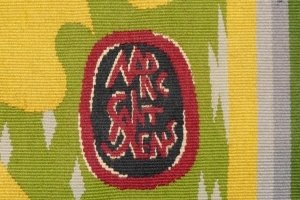
With signed label.
1959.

Lurçat approached Saint-Saëns, initially a fresco painter, as early as 1940. During the war, Saint-Saëns produced his first allegorical masterpieces, tapestries of indignation, struggle, and resistance: “The Foolish Virgins,” “Theseus and the Minotaur.” After the war, he naturally joined Lurçat, whose convictions he shared (regarding numbered cartoons and limited tones, the specific style required for tapestry, etc.), within the APCT (Association of Tapestry Cartoon Painters). His world, where the elongated, stretched human figure holds considerable prominence (especially compared to the role it plays in the work of his contemporaries Lurçat or Picart le Doux), revolves around traditional themes: woman, the Commedia dell'arte, Greek myths, etc., all sublimated by the brilliance of the colors and the simplification of the layout. In the 1960s, he would later move towards more lyrical, almost abstract designs, dominated by cosmic elements and forces.

“Saint-Saens who produced a series of birds in 1949 only rarely represented the cock, a recurrent subject for Lurçat. In this piece the cock has no symbolic value but merely announces with gales of crowing and colour the arrival of the new day.” (Exhibition Catalogue Sain-Saëns, œuvre tissé, Aubusson, Musée départemental de la Tapisserie, 1987 p.48)

Bibliography:
Exhibition catalog, Saint-Saëns, La Demeure gallery, 1970
; Exhibition catalog, Saint-Saëns, oeuvre tissé, Aubusson, Musée départemental de la Tapisserie, 1987, ill. p.49;
Exhibition catalog, Marc Saint-Saëns, tapestries, 1935-1979, Angers, Musée Jean Lurçat et de la Tapisserie Contemporaine, 1997-1998