


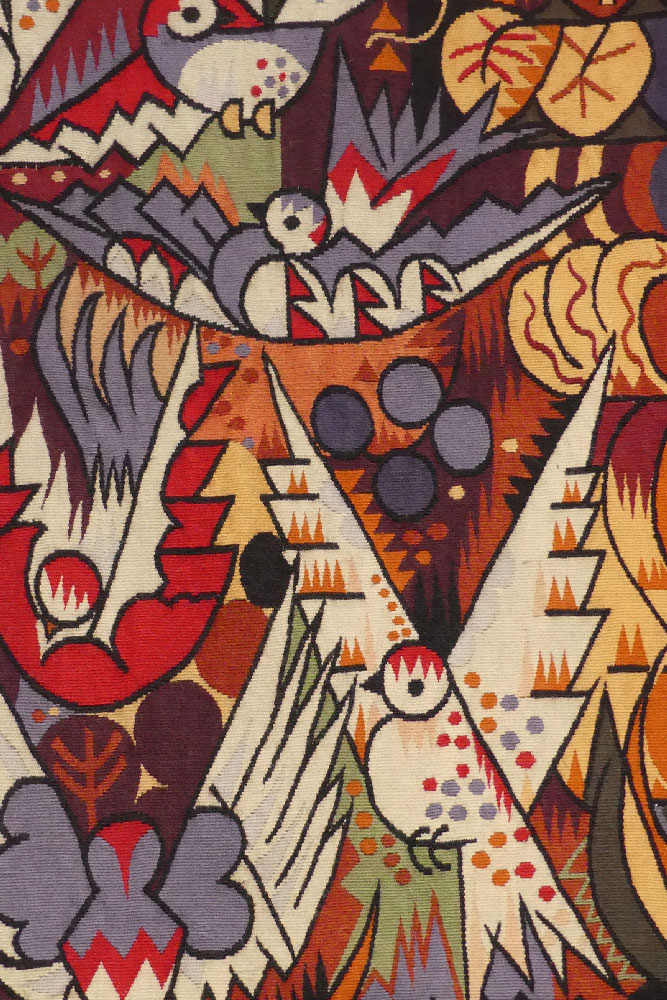


The Bird Pond
Aubusson tapestry woven by the Goubely workshop.
No.II.
1941.
Gromaire's woven work is modest: 11 cartoons, designed between 1938 and 1944, most of them in Aubusson itself. "His rigorous constructions, his simplifications, his taste for grand composition and fundamental ideas, his knowledge as a colorist and to sum it up his supreme quality as a master and craftsman, all of this made him one of the most perfect tapestry makers of his time", Jean Cassou said (Cat. Expo. Marcel Gromaire, Paris, Musée National d'art moderne, 1963).
It was Guillaume Janneau, head of the Mobilier National, who called upon him in 1938, convinced that his style (simplification of forms, geometric design outlined in black, influence of Cubism, limited palette...) would advantageously address the new aesthetic problems that tapestry must solve to be reborn (simplified color ranges, synthetic cartoons,...): first with a commission on the theme of the four elements, followed by another ("the Seasons"), intended to be executed in Aubusson. Gromaire joined Lurçat and Dubreuil there in 1940. Working alone, meticulously (many drawings are preparatory to the cartoon, painted, and not numbered as with Lurçat), in close collaboration with Suzanne Goubely, who wove all his cartoons, he spent 4 years in Aubusson, devoting all his creative energy to tapestry. At the end of the war, he left Creuse and would no longer produce cartoons, leaving Lurçat the place of the great initiator of the tapestry revival.
“The bird pond” is symptomatic of Gromaire’s woven aesthetic, with its extremely decorative and quasi-oneiric character (far removed from his graphic works), with the choice of subject being both animal and vegetal (and even architectural), and strongly inspired by the Creuse region. What strikes one most is the extraordinary density, the abundance, the profusion, ... which make Gromaire’s woven work so inimitable.
This tapestry was featured in the exhibition “French Tapestry from the Middle Ages to the present day” held at the Museum of Modern Art in 1946.
Bibliography :
Le Point, Aubusson and the revival of tapestry, March 1946, reproduced p.34
Muraille et laine, éditions pierre Tisné, 1946, ill. n°51
André Lejard (dir.), French Tapestry, Paul Elek publishers, 1946, reproduced p.103
Cat Expo., Aubusson Tapestries, Luxembourg, Municipal Art Gallery, 1982, n°3
Cat. Expo., Gromaire, woven work, Aubusson, Tapestry Museum, 1995, reproduced p.51
Cat. Expo. The Gobelins Manufactory in the first half of the 20th century, Beauvais, National Tapestry Gallery, 1999


