Procyon


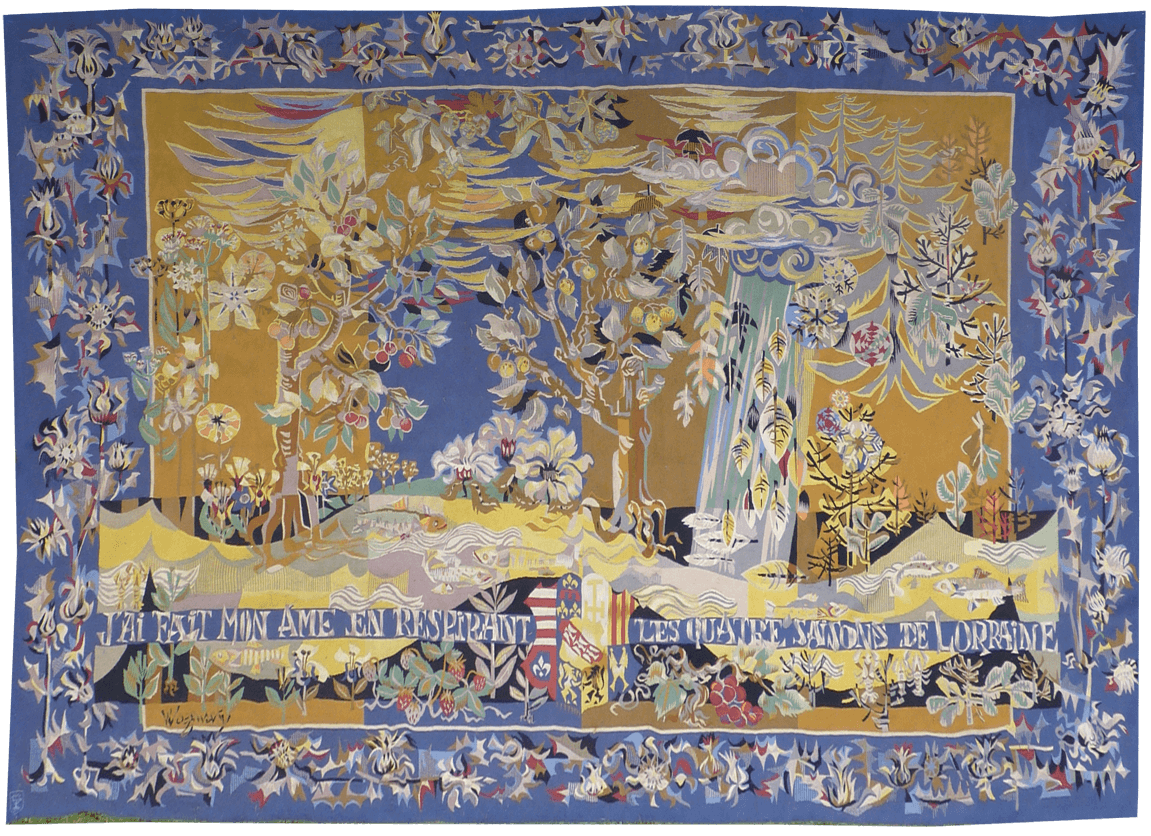
Aubusson tapestry woven by the Legoueix workshop.
With its signed label, No. 3/4.
1968.


Member of the A.P.C.T. (Association of Cartoonists for Tapestry), Wogensky is one of the many artists who devoted themselves to tapestry following Lurçat, in the immediate post-war period. Initially influenced by him, Wogensky's work (159 cartoons according to the 1989 exhibition catalog) subsequently evolved in the 1960s towards a lyrical abstraction that was not always fully assumed, from cosmic-astronomical themes to decomposed and moving bird forms, towards more refined and less dense cartoons. Although he always proclaimed himself a painter, the artist's reflection on tapestry is very accomplished: "Creating a mural cartoon…. is thinking in terms of a space that no longer belongs to us, by its dimensions, its scale, it is also the requirement of a broad gesture that transforms and accentuates our presence".


“Procyon” belongs to Wogensky's “cosmic” vein (its title itself is proof), which runs throughout the 1960s, and of which “Cosmos” (1968, University of Strasbourg), and “Galaxy” (1970, Senate, Luxembourg Palace) will be the highlight. Shaded (ubiquitous) and flat areas coexist in nuanced color harmonies, in a curious, unknown world, as close to very small cells seen under a microscope as to the infinitely large.

An identical tapestry is preserved at the Jean Lurçat Museum and Contemporary Tapestry in Angers.


Bibliography:
Cat. Expo. Robert Wogensky, the woven work, Aubusson, Departmental Museum of Tapestry, 1989
Cat. Expo. Robert Wogensky, Angers, Jean Lurçat Museum and Contemporary Tapestry, 1989
Cat. Expo. Weavings from workshops, weavings from artists, 10 years of enrichment of Collections, Angers, Jean Lurçat Museum and Contemporary Tapestry, 2004, reproduced p.101
Cat. Expo. Collections! Collections!, Angers, Jean Lurçat Museum and Contemporary Tapestry, 2019-2020, reproduced p.11