



The Lyre
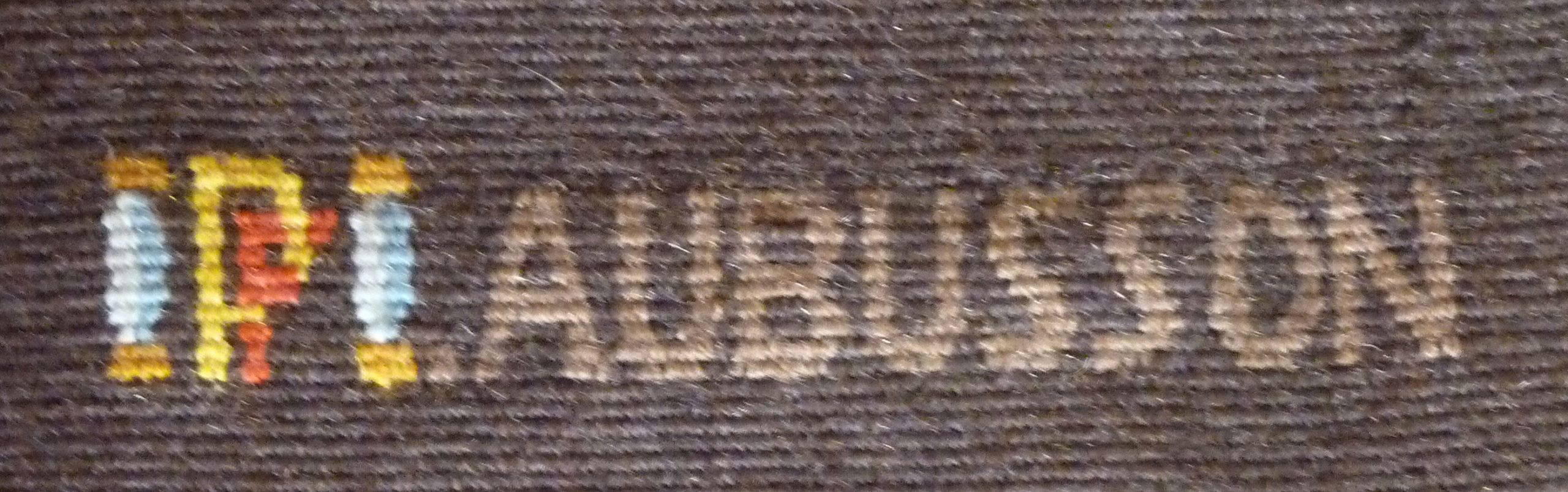
Aubusson tapestry woven by the Pinton workshop.
Circa 1960.
Jean Picart le Doux is one of the foremost figures in the renaissance of the art of tapestry. His earliest contributions to the field date back to 1943 when he designed cartoons for the passenger ship “la Marseillaise”. A close associate of Lurçat, whose theories he would adopt (limited palette, numbered cartoons…), he was a founding member of the A.P.C.T. (Association des Peintres-cartonniers de Tapisserie), and soon after, a teacher at the Ecole Nationale Supérieure des Arts Décoratifs. The state gave him several commissions most of them at the Aubusson workshop, and some at the Gobelins : the most spectacular of these being for the University of Caen, the Theatre in Le Mans, the passenger ship France or the Prefecture of the Creuse département … In as much as Picart le Doux’s aesthetic is close to that of Lurçat, so also is his insipiration and his subject matter, although in a register which is more decorative than symbolic, where he brings together heavenly bodies (the sun, the moon, the stars…), the elements, nature (wheat, vines, fish, birds…), man, literary quotation …
The image of the lyre, and also that of the harp, is one of the leitmotivs of the artist. Representative of Apollo, the lyre regularly appears with the sun (cf for example “Soleil-lyre”; Bruzeau n°82), but also as a symbol of the passing of time (similar to the use of the pendulum in the XVIIIth century, interestingly one of the artist’s cartoons is titled “the Pendulum”, auction in Lille 17.06.01 n°464) : “les Phases du temps” (the phases of time, cf Armelle Bouchet Mazas, le paquebot France, Editions Norma, 2006, p.72) which adorned the 1st class smoking room on the France.
Strangely enough, our tapestry does not figure in Bruzeau’s book : possibly because it was specially commissioned for a scientific or industrial organisation, if one considers the form which appears with the lyre.
Bibliography :
Maurice Bruzeau, Jean Picart le Doux, Murs de soleil, Editions Cercle d’art 1972
Armelle Bouchet Mazas, le paquebot France, Editions Norma, 2006


