


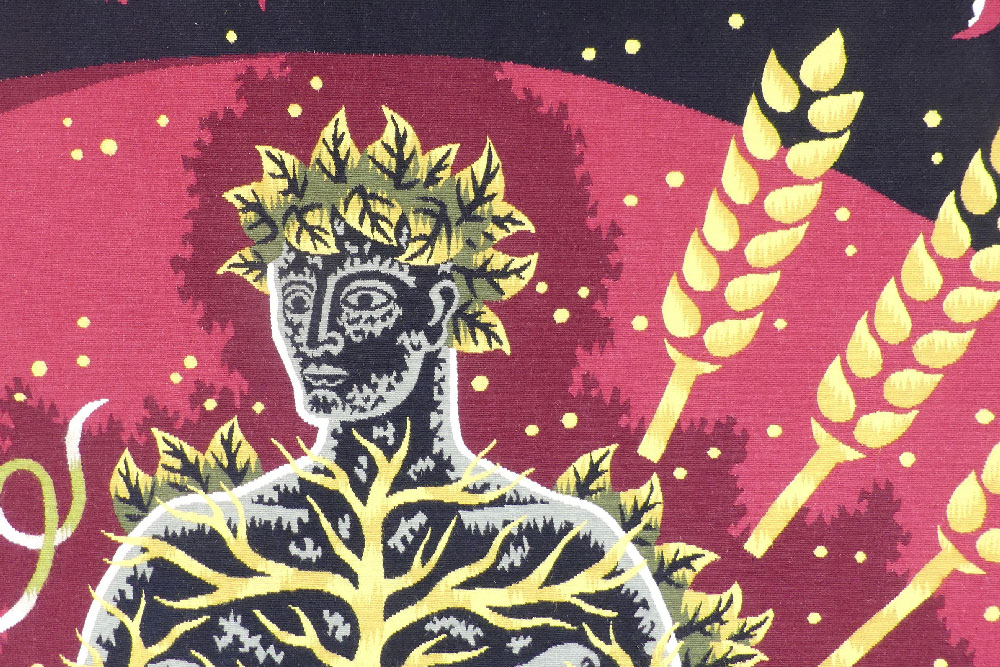


“L’Homme et la Terre”
An Aubusson tapestry woven by the Hamot workshop. 1962.
Jean Picart le Doux was one of the leading figures in the revival of tapestry. His beginnings in the field date back to 1943: he then produced cartoons for the ocean liner “la Marseillaise”. Close to Lurçat, whom he adopted in full with his theories (limited tones, numbered cartoons,…), he was a founding member of the A.P.C.T. (Association des Peintres-cartonniers de Tapisserie), and soon became a professor at the École Nationale Supérieure des Arts décoratifs. The State commissioned him to produce numerous cartoons, most of them woven in Aubusson and some at the Gobelins: the most spectacular were for the University of Caen, the Théâtre du Mans, the ocean liner France, or the Préfecture of the Creuse,…. Although Picart le Doux’s designs were close to those of Lurçat, his sources of inspiration and themes were too, but in a more decorative than symbolic register, where the astres (the sun, the moon, the stars…), the elements, nature (wheat, vines, fish, birds…), humankind, texts,… sit side by side. Around the turn of the 1960s, Picart le Doux designed a series of large cartoons (“le Temps”, “Galaxie”, “l’Homme et la Mer”,…), spectacular allegories centered on Humankind, at the heart of Creation. In our succinct “L’Homme et la Terre”, the vocabulary—of vine tendrils, wheat ears, human bodies irrigated with veins,…—draws from other earlier cartoons by the artist. Bibliography : Maurice Bruzeau, Jean Picart le Doux, Murs de soleil, Editions Cercle d’art, 1972, ill. n°132 Cat. Exp. Jean Picart le Doux, tapisseries, Musée de Saint-Denis, 1976 Cat. Exp. Jean Picart le Doux, Musée de la Poste, 1980


