




The Garden of Love
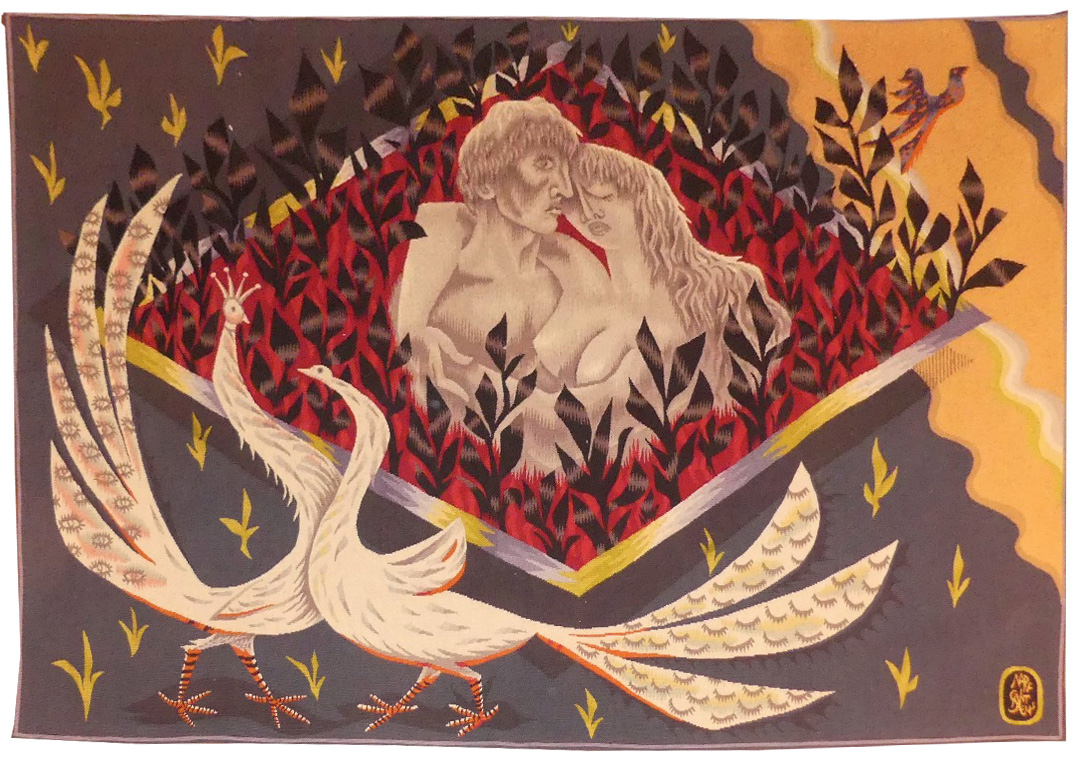
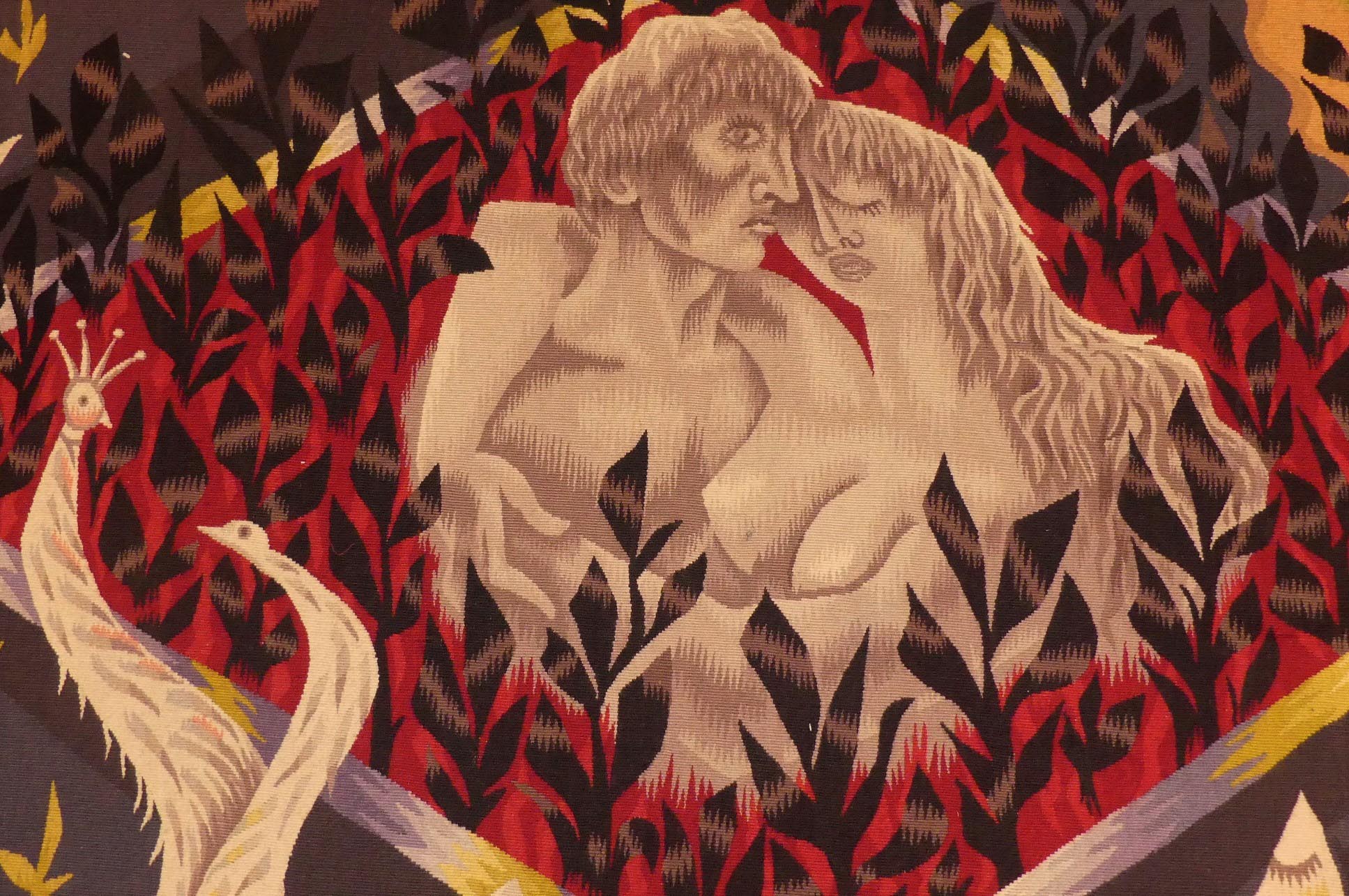
Tapestry, probably from Aubusson. 1947. Lurçat urged Saint-Saëns—first as a fresco painter, from 1940 onward. And, during the war, he produced his first allegorical masterpieces: tapestries of indignation, of combat, of resistance: “the mad Virgins”, “Theseus and the Minotaur”. At the end of the war, he naturally joined Lurçat, sharing his convictions (about the Numbered Cartoon and the counted tones, about the specific writing required by tapestry,…) within the A.P.C.T. (Association of Painter-cartoonists of Tapestry). His world, in which the human figure—stretched, elongated—takes up a considerable place (compared in particular to the place it occupies among his fellow artists Lurçat, or Picart le Doux), revolves around traditional themes: the woman, the Commedia dell’arte, Greek myths,… sublimated by the brilliance of the colors and the simplification of the layout. He would then evolve, in the 1960s, toward more lyrical, almost abstract Cartoons, where cosmic elements and forces predominate. “The garden of love”, an evocative allegory of the earthly Paradise sometimes illustrated in the Middle Ages and the Renaissance, attests to Saint-Saëns’s classical references, which the same year would lead him to conceive “Orpheus” or “The Italian Comedy”: theatre, ancient myths, or biblical references (one thinks also of “the mad Virgins”) were then ubiquitous sources of inspiration. Bibliography : Cat. Expo. Saint-Saëns, oeuvre tissé, Aubusson, Musée départemental de la Tapisserie, 1987 Cat. Expo. Marc Saint-Saëns, tapisseries, 1935-1979, Angers, Musée Jean Lurçat et de la Tapisserie Contemporaine, 1997-1998


