





The 12 months
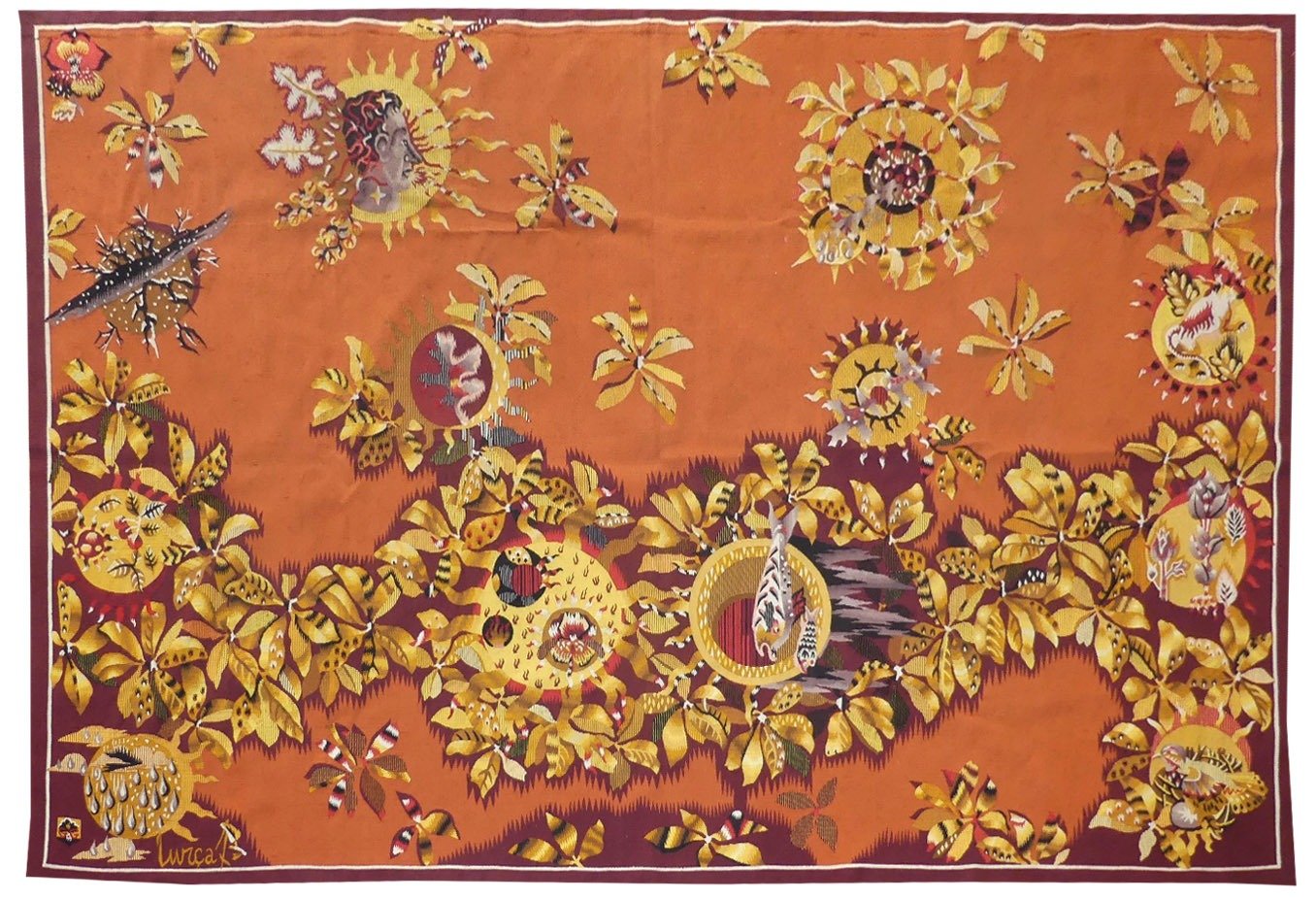
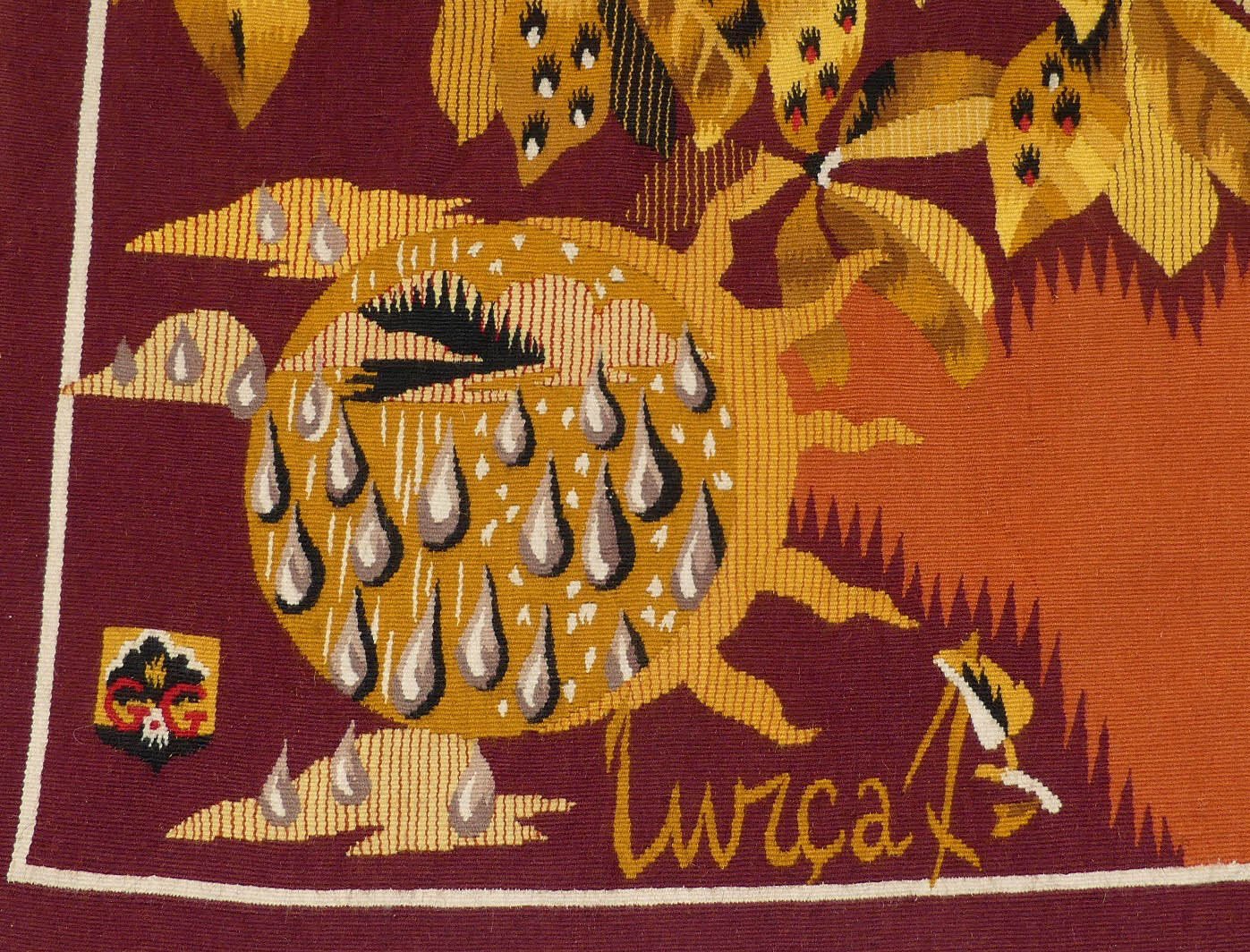
Aubusson tapestry woven by the Atelier Goubely.
Circa 1940.
The work of Lurçat was immense; however, it was his role in the renewal of the art of tapestry that earned him lasting renown. As early as 1917, he began with canvas-woven works, and then, in the 1920s and 1930s, he worked with Marie Cuttoli. His first collaboration with the Gobelins dates from 1937, when he simultaneously discovered the Apocalypse tapestry cycle at Angers, which permanently led him to devote himself to tapestry. He approached technical questions first with François Tabard, and then, during his installation in Aubusson during the war, he defined his system: coarse point, counted tones, drawn Cartoons, Numbered. A gigantic production then began (more than 1,000 Cartoons), amplified by his desire to involve his painter friends, the creation of the A.P.C.T. (Association des Peintres-Cartonniers de Tapisserie), and his collaboration with the gallery La Demeure and Denise Majorel, and then through his tireless role as a promoter of the medium throughout the world.
A gigantic production then began (more than 1,000 Cartoons), amplified by his desire to involve his painter friends, the creation of the A.P.C.T. (Association des Peintres-Cartonniers de Tapisserie), and his collaboration with the gallery La Demeure and Denise Majorel, and then through his tireless role as a promoter of the medium throughout the world.
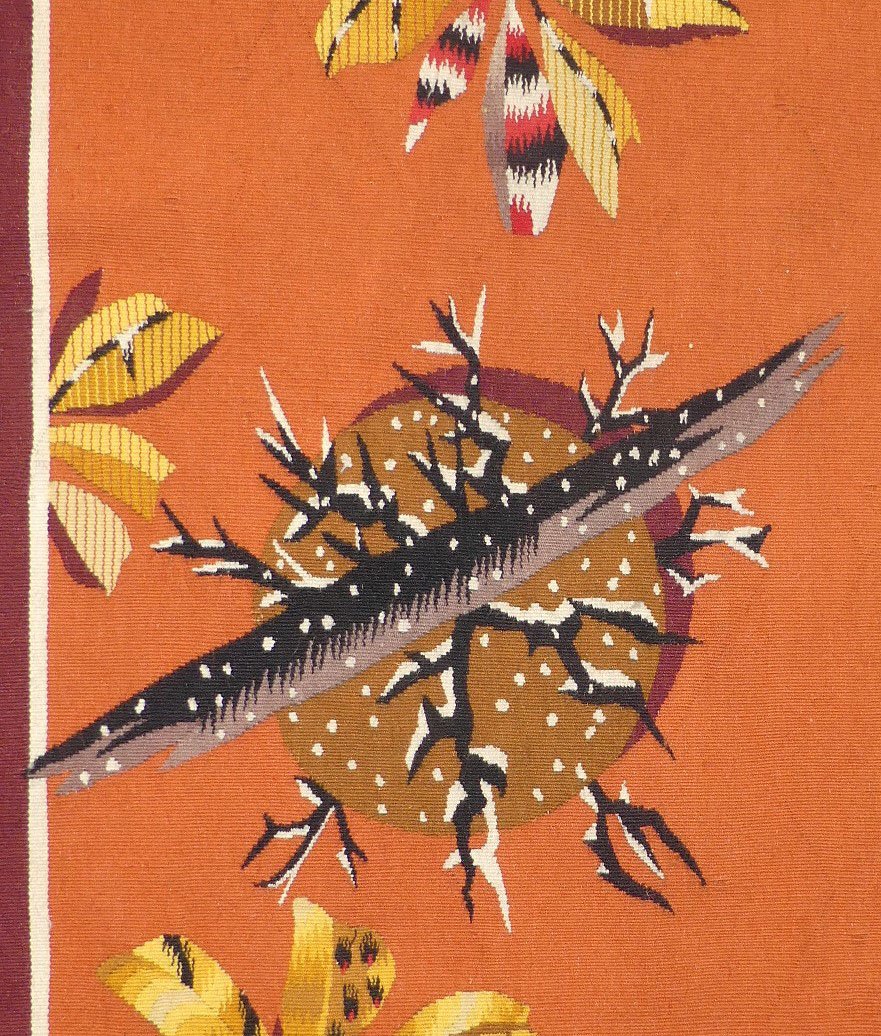
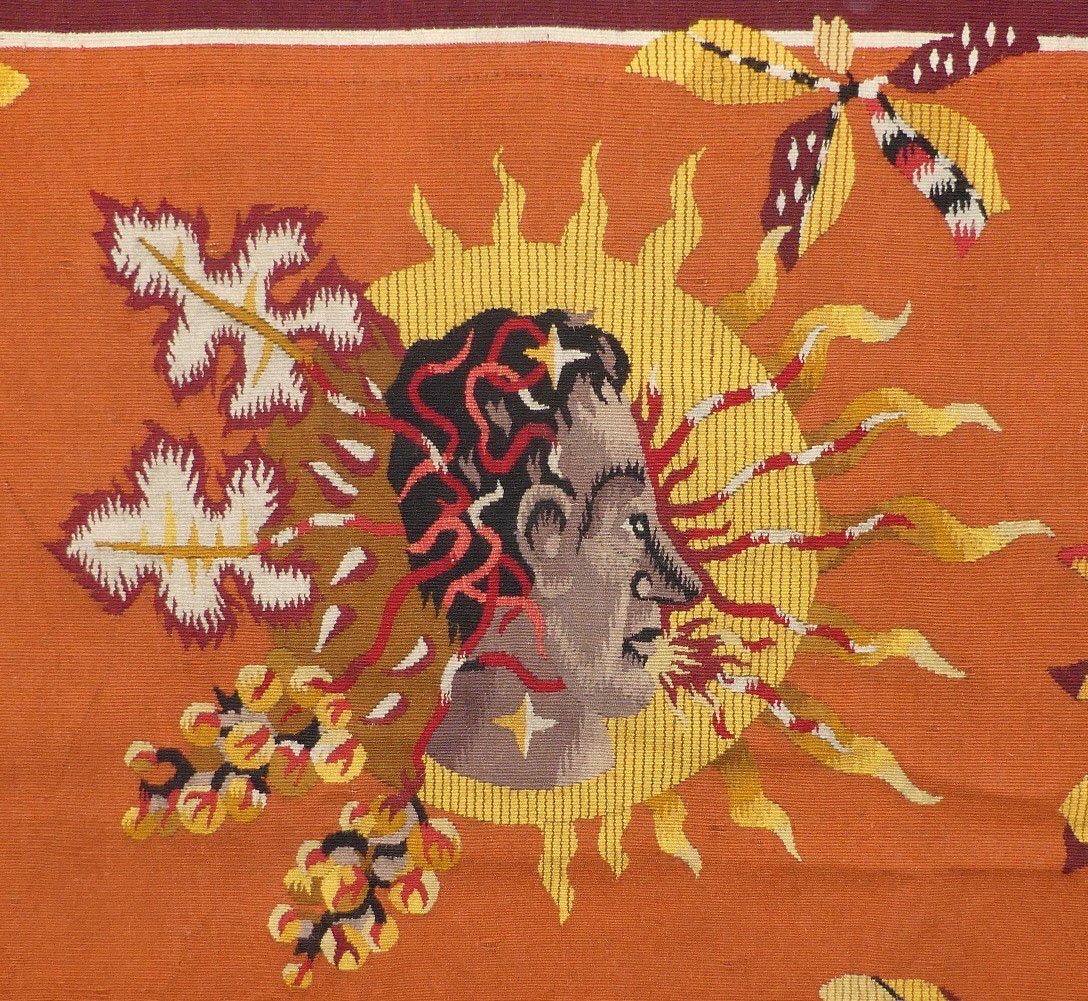
His woven work bears witness to a specifically decorative artist-imaginer’s art, with a highly personal, symbolic and cosmogonic iconography (sun, planets, zodiac, the 4 elements…), stylized vegetal forms, and animals (goats, roosters, butterflies, chimeras…) set against a background with no perspective (deliberately distanced from painting). In his most ambitious Cartoons, it was intended to share both a poetic vision (he sometimes even intersperses these tapestries with quotations) and a philosophical one (the major themes were addressed from the war on: freedom, resistance, fraternity, truth…), culminating in the “Chant du Monde” (Musée Jean Lurçat, former Saint-Jean hospital, Angers), unfinished at his death.
Its culminating achievement would be the "Chant du Monde" ( Musée Jean Lurçat, former Saint-Jean hospital, Angers), left unfinished at his death. "It is a very original version that Lurçat gives of the theme of the months, illustrated by tapestry for many centuries. Each month is symbolized by a bubble from which elements of vegetation are born, as well as sun rays.
Conçue dans le même esprit que le « De Natura solari rerum », cette pièce préfigure « Es la verdad », dans laquelle on retrouve, un peu à la façon d’une bordure, placés en fridse, les douze mois de l’année » (Martine Mathias in Cat. Expo. Jean Lurçat, le combat et la victoire, centenaire, Aubusson, Musée départemental de la Tapisserie, 1992, p.43)
Bibliography:
Tapestries by Jean Lurçat 1939–1957, Pierre Vorms Editeur, 1957
Exhibition cat. Lurçat, 10 years later, Musée d’Art moderne de la ville de Paris, 1976
Cat. Expo. Les domaines de Jean Lurçat, Angers, Musée Jean Lurçat et de la tapisserie contemporaine, 1986
Cat. Expo. Jean Lurçat, le combat et la victoire, centenaire, Aubusson, Musée départemental de la Tapisserie, 1992, ill. p.43
Colloque Jean Lurçat et la renaissance de la tapisserie à Aubusson, Aubusson, Musée départemental de la Tapisserie, 1992
Exhibition cat. Dialogues with Lurçat, Musées de Basse-Normandie, 1992
Exhibition cat. Jean Lurçat, Donation Simone Lurçat, Académie des Beaux-Arts, 2004
Gérard Denizeau, Jean Lurçat, Liénart, 2013
Exhibition cat. Jean Lurçat au seul bruit du soleil, Paris, galerie des Gobelins, 2016


