

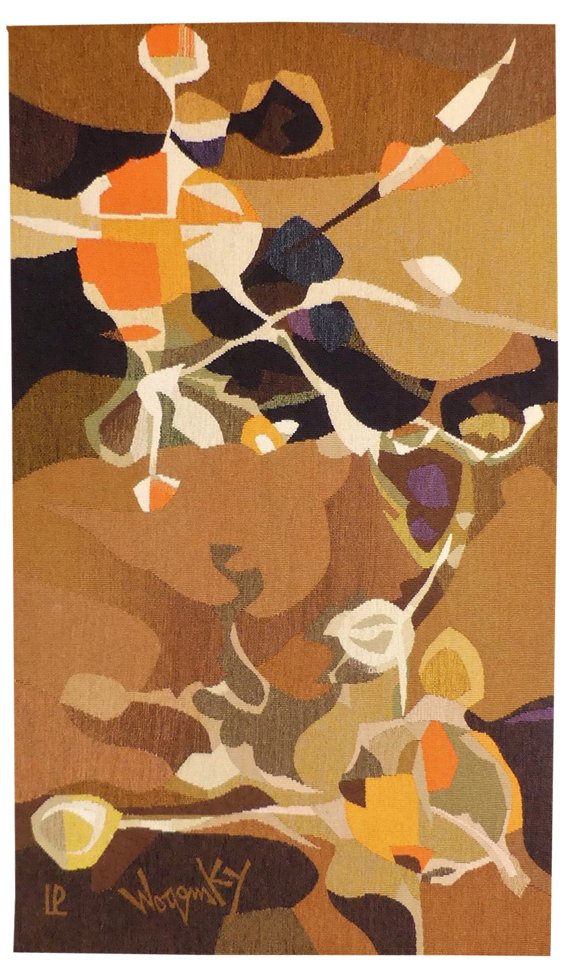
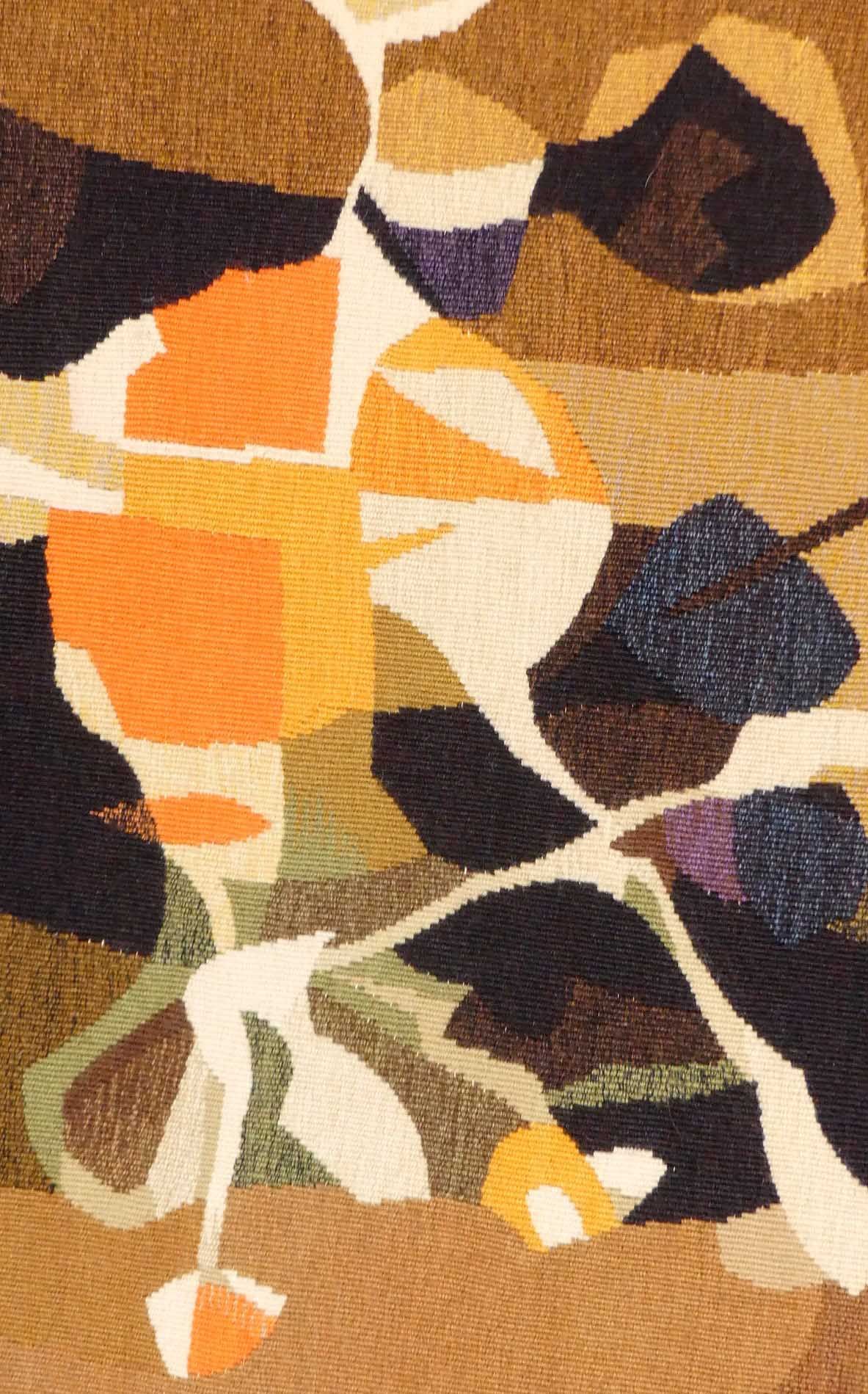

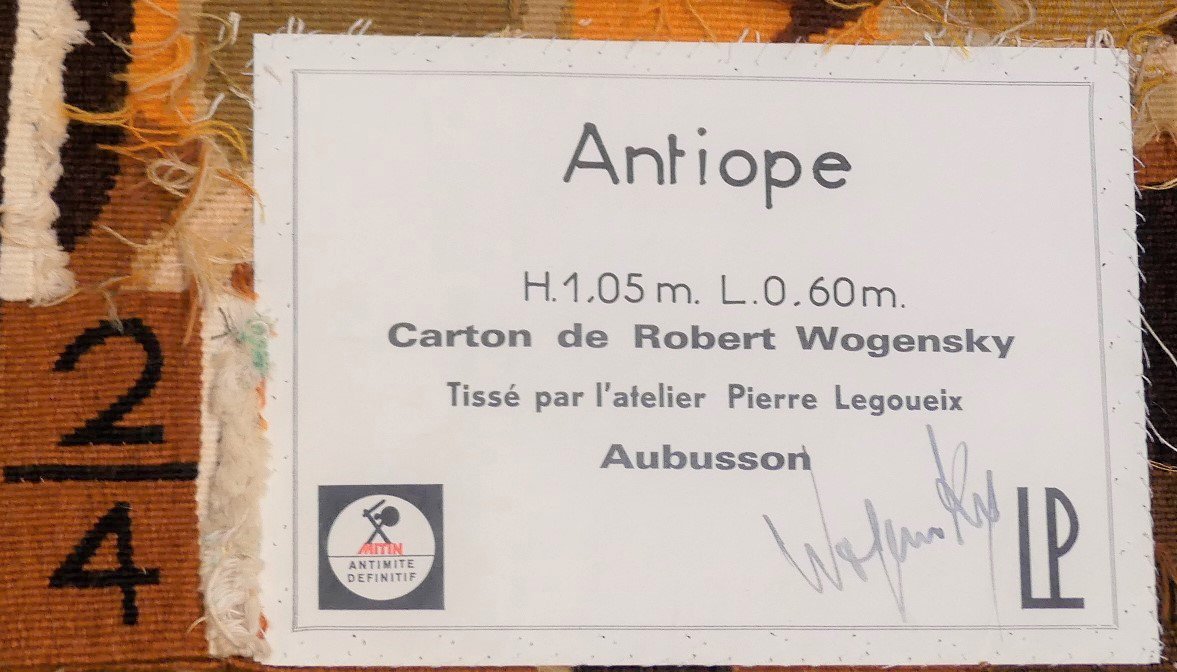

Antiope
Aubusson tapestry woven by the Atelier Legoueix.
With its signed bolduc, n°2/4.
1968.
Member of the A.P.C.T. (Association des Peintres-Cartonniers de Tapisserie), Wogensky was one of the many artists who devoted themselves to tapestry following Lurçat, in the immediate post-war period. First influenced by him, Wogensky’s oeuvre (159 cartoons after the 1989 exhibition catalogue) later evolved in the 1960s toward a lyrical abstraction, sometimes not fully embraced—ranging from cosmic-astronomical themes to decomposed, moving forms of birds—toward cartoons that were more pared down and less dense. Although he always declared himself to be a painter, the artist’s thinking about tapestry was highly developed: “Creating a wall cartoon…. is to think according to an environment that no longer belongs to us, through its dimensions, its scale; it is also the requirement of a broad gesture that transforms and heightens our presence.”
More than to mythology, « Antiope » probably refers to astronomy: this asteroid thus fits into Wogensky’s dominant inspiration in the 1960s, for which « Cosmos » (1968, Université de Strasbourg) and « Galaxie » (1970, Sénat, palais du Luxembourg) will represent the high points. Here, paradoxically, Wogensky is seen attempting to convey the immensity of Space in a very small format.
Bibliography:
Cat. Expo. Robert Wogensky, l’oeuvre tissé, Aubusson, Musée départemental de la tapisserie, 1989
Cat. Expo. Robert Wogensky, Angers, Musée Jean Lurçat et de la Tapisserie Contemporaine, 1989


