

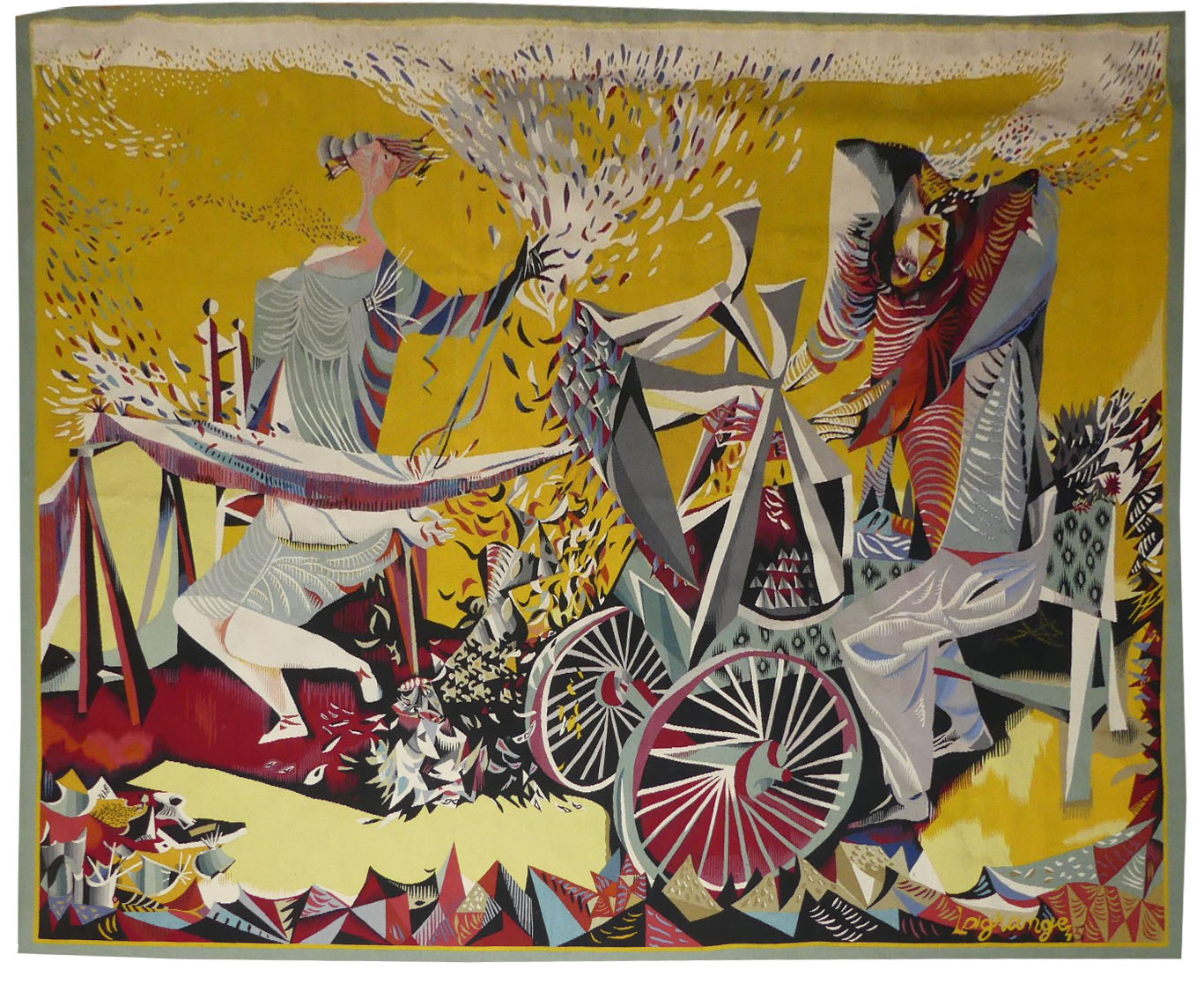


Banlieue (Suburbs)
Aubusson tapestry woven in the Goubely workshop.
With signed label.
1945.
An enthusiastic mural artist as early as 1937 (he participated in the Exposition Internationale), Lagrange designed his first cartoons in 1945, and became one of the founding members of the A.P.C.T. His early cartoons were expressionist (like Matégot and Tourlière), then his work evolved towards a stylisation (dating from his collaboration with Pierre Baudouin) which would bring him in the 1970’s to a highly refined style using very pure colours. As well as his important rôle in the tapestry renaissance movement of the period (and the state commissions that went with it), Lagrange would become a teacher at the Ecole Nationale des Beaux-Arts, a regular collaborator with Jacques Tati, a designer of monumental elements incorporated in various architectural projects and a recognised painter close to Estève and Lapicque.
« Banlieue » the first of my tapestries woven in Aubusson, pictures the work of travelling mattress carders using a curious contraption to comb wool which flies around the streets” explained the artist. In his early works Lagrange in a realistic, almost expressionist, vein deals in themes of life in the suburbs, the people who plied their trades (here in an amusing mise en abyme about working with wool) in daily life (cf also Guignebert “le marché aux puces” “flea market” which is contemporary) in a completely different style from Lurçat’s cosmology.
The tapestry was featured in the 1946 exhibition and two other copies are conserved at the Musée de la Chaux-de-Fonds and the Museum du Pays d’Ussel.
Bibliography :
Multi-authored, Muraille et laine, Editions Pierre Tisné, 1946, ill. n°58
Madeleine Jarry, La tapisserie, art du XXe siècle, Office du livre, 1974, ill. n°69
Exhibition Catalogue Lagrange, Angers, Musée Jean Lurçat et de la tapisserie contemporaine, 1987, ill.p.16-17
Exhibition catalogue, Jean Lurçat, compagnons de route et passants considérables, Felletin, Eglise du château, 1992, ill. p.29
Robert Guinot, Jacques Lagrange, les couleurs de la vie, Lucien Souny editeur, 2005, n°28, illustrated
Gérard Denizeau, Denise Majorel, une vie pour la tapisserie, Aubusson, Musée départemental de la tapisserie, ill. p.73


