



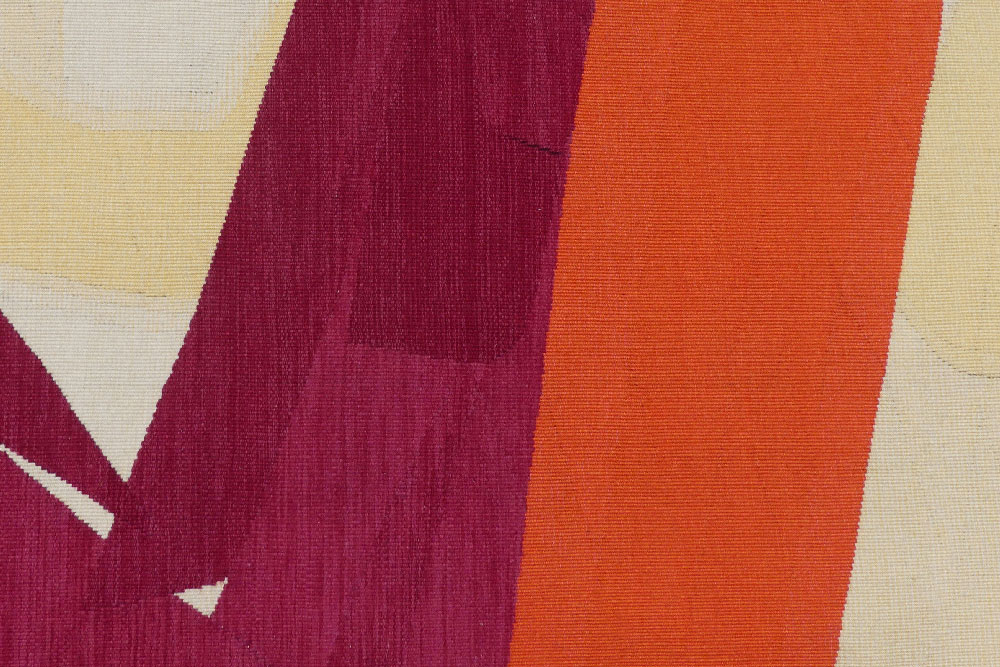


Composition
Aubusson tapestry woven by the Pinton workshop.
With label, n°1/1.
1974.
Jean Bazaine, like many of his contemporaries, was a prolific mural artist particularly for large scale edifices. Although he is above all recognised as a designer of stained glass windows and mosaics, he was also making tapestry cartoons as early as the 1930’s. These pieces formed part of the renewal of religious art of which Bazaine would be one of the principal protagonists, particularly after the war.
However, Bazaine’s designs are not all destined to be displayed in a religious context. His mastery of mural art is revealed by commissions for mosaics for the UNESCO building and also for the Maison de la Radio as well as tapestries for the Manufactures Nationales or for Aubusson, for the Palais de Justice in Lille or the Hotel de Ville in Strasbourg.
This is the context for a commission for this widely recognised, indeed almost official, artist (Grand Prix National des Arts in 1964, an exhibition at the Musée National d’Art Moderne in 1965) from the Federation Française du Bâtiment for its head office, at the beginning of the 1970’s. His response would be this vast, lyrical and rythmic composition in a homogeneous colour scheme. Unfortunately, the illegibility of the certificate of origin leaves us without a title for this work whose creator did not see himself as an abstract artist.
Origin : The Head Office of the Federation Francaise du Bâtiment.


