

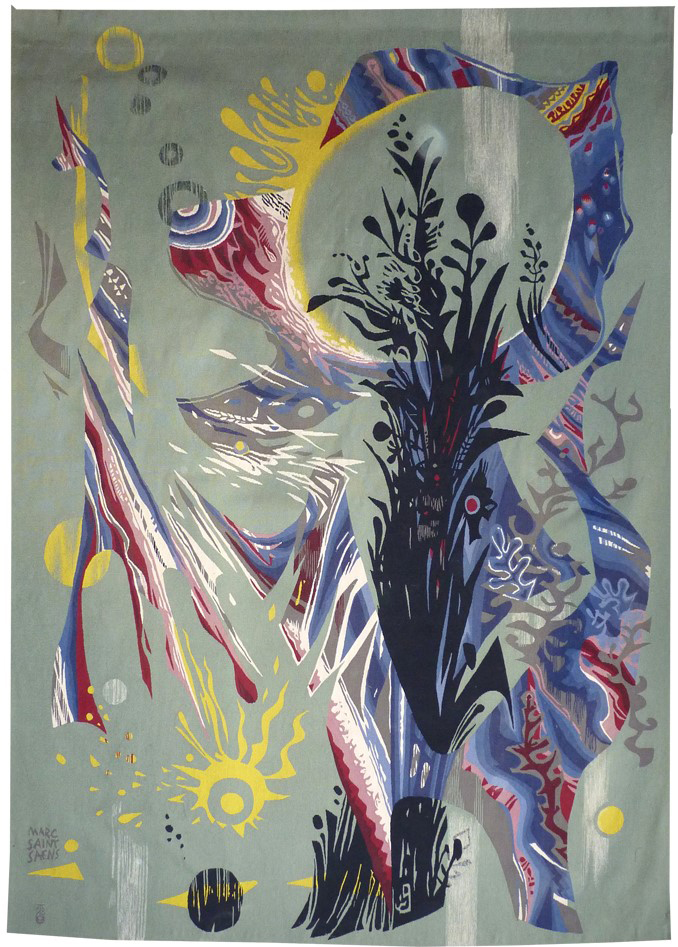
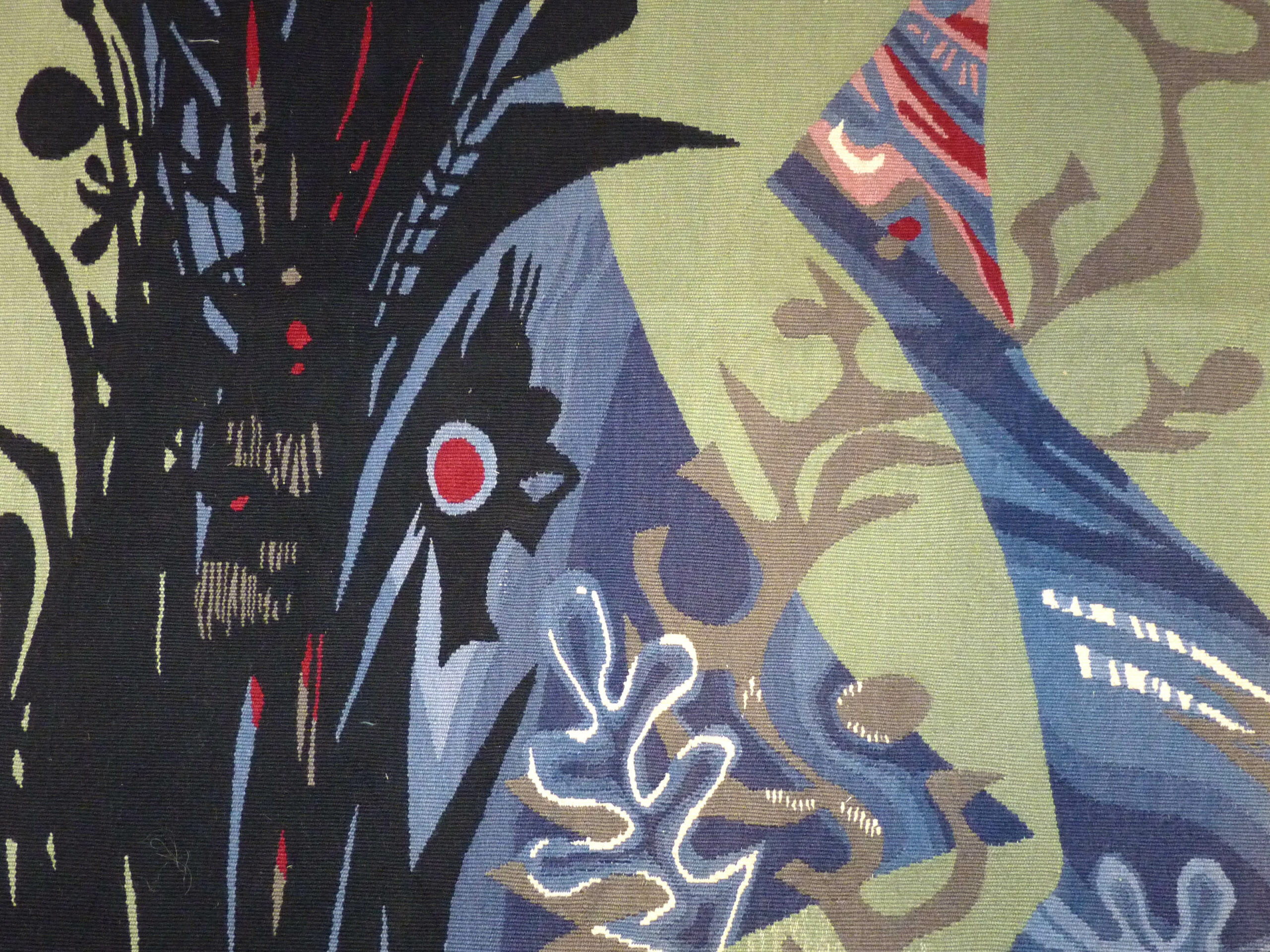
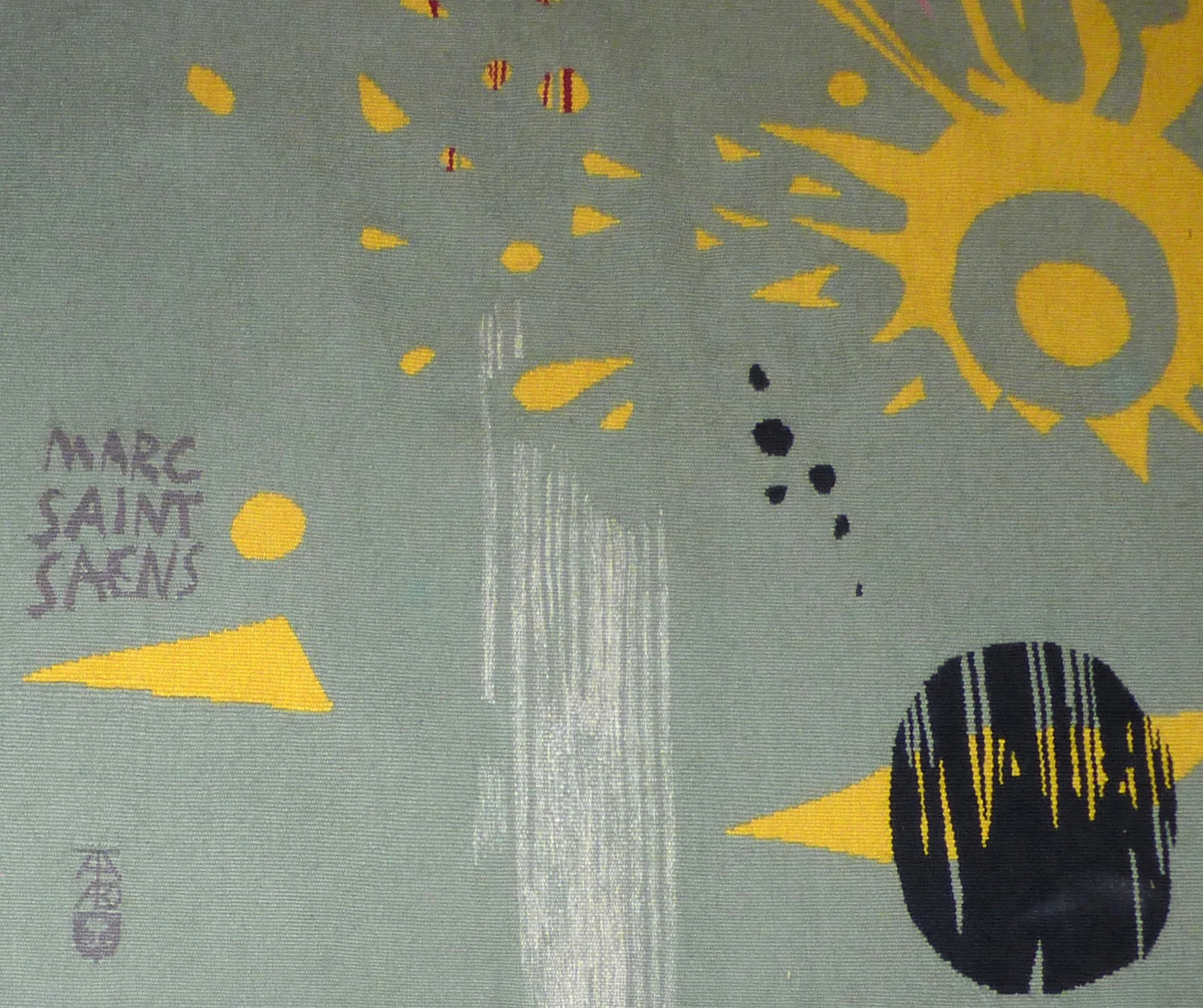
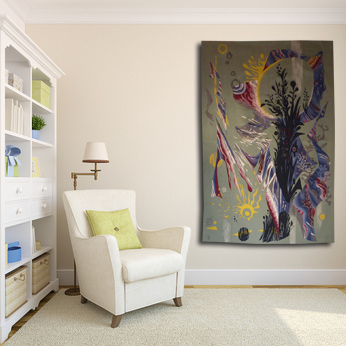
Ornements (Ornaments)
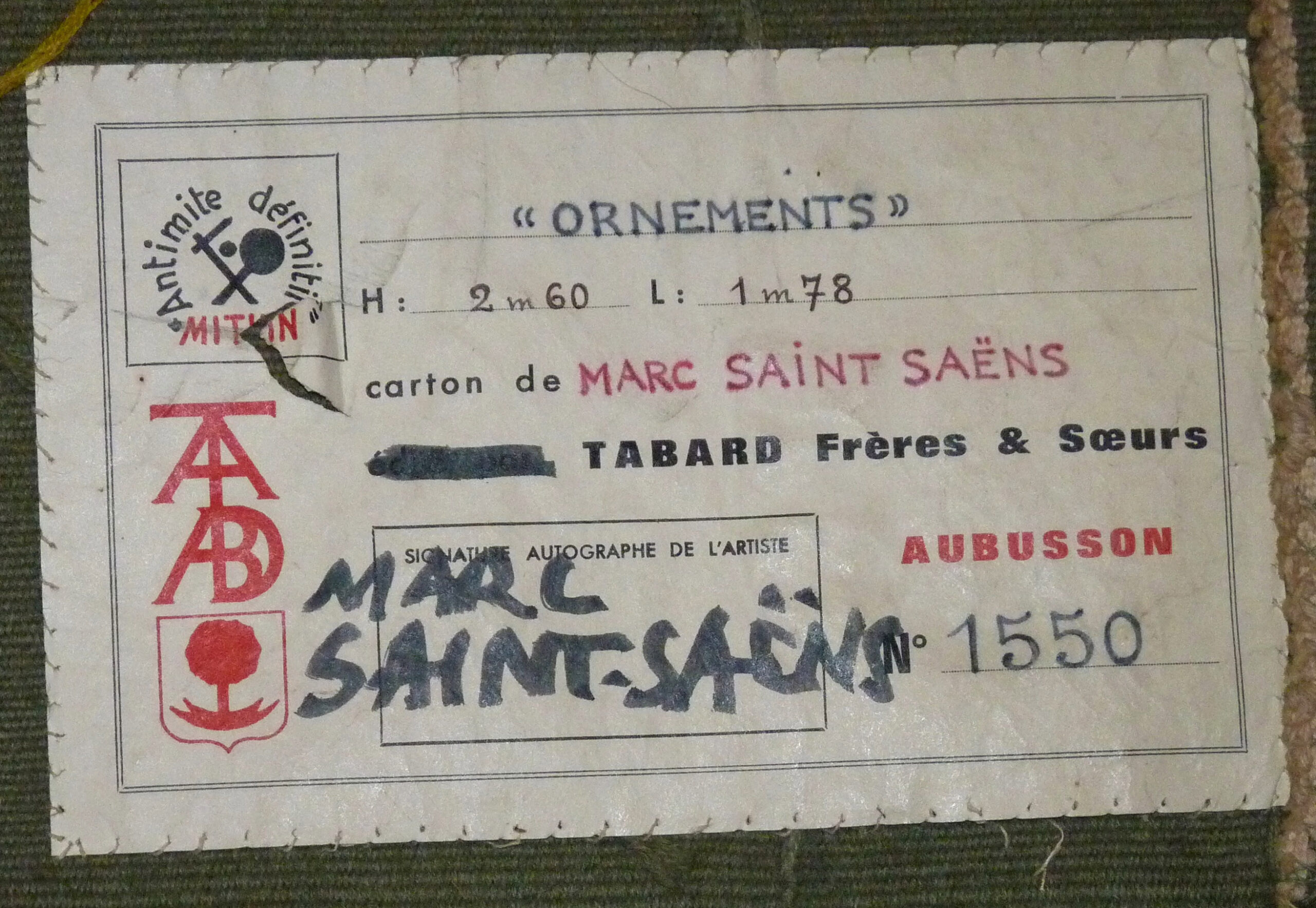
Aubusson tapestry woven by the Tabard workshop.
With signed label, no. 4.
1963.
Lurçat approached Saint-Saëns, originally a painter of murals, in 1940. And during the war the latter produced the first of his allegorical masterpieces, tapestries reflecting indignation, combat, resistance : “les Vierges folles (the foolish virgins), “Thésée et le Minotaure” (Theseus and the Minotaur). At the end of the war, as a natural development he joined up with Lurçat, whose convictions he shared (concerning a simplified palette, outlined cartoons with colours indicated by pre-ordained numbers, and the specific nature of tapestry design…) at the A.P.C.T. (Association des Peintres-cartonniers de Tapisserie). His universe, where the human figure, stretched, elongated, ooccupies an important place (particularly when compared to his companions Lurçat or Picart le Doux), pivots around traditional themes : woman, the Commedia dell’arte, Greek mythology… refined by the brilliance of the colours and the simplification of the layout. His work would evolve later, in the 1960’s, towards cartoons of a more lyrical design, almost abstract where elemental and cosmic forces would dominate.
This cartoon can be seen as belonging to this particular style. Here is an extract from the 1987 catalogue of his works (p37) : “Ornements, a purely decorative tapestry, resembles Dédale, Biologie (property of the Head office of the CNRS), Bel Canto, in its pure and ample style, flowing and lyrical, very close to the painted studies where Saint-Saëns loosed his passion for freely spread colour.” This cartoon was produced in a series of 5.
Bibliography :
Exhibition catalogue Saint-Saëns, the tapestries, Aubusson, Musée départemental de la Tapisserie, 1987 (tapestry included in the exhibition but not illustrated in the catalogue)
Exhibition catalogue Marc Saint-Saëns, tapestries, 1935-1979, Angers, Musée Jean Lurçat et de la Tapisserie Contemporaine 1997-1998 (ill.p 22)
Exhibition Catalogue Marc Saint-Saëns, galerie Moulins, PAD 2010 (ill. p.16)


