
-
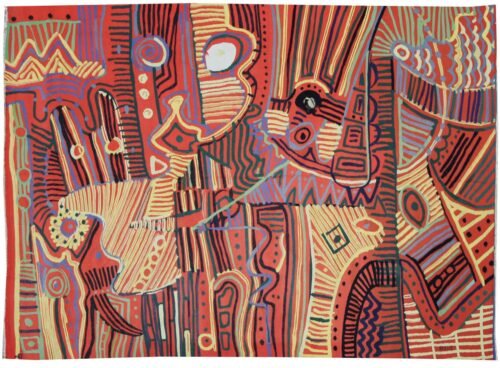
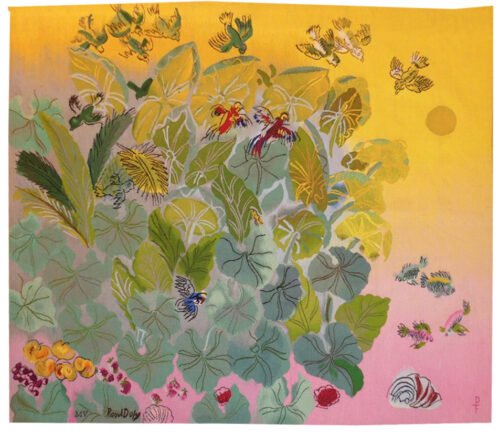
Maternity
Aubusson tapestry woven by the Four workshop. With its signed label, No. 5/6. Circa 2000. The Four Manufactory commissioned various living artists (including Toffoli and Lartigaud) to weave them: a new dimension is thus given to the pictorial production of Raya-Sorkine, with strong lyrical expressiveness and vibrant colors. Bibliography: R. Guinot, Aubusson and Felletin tapestry, Lucien Souny, 2009, ill. p.161 -
Floor Mat
Carpet/Tapestry from Aubusson woven by the Goubely workshop. 1959.Trained from the outset in Bissière's studio with mural art (decorations at the 1937 Exhibition), and then in applied arts, particularly in connection with sacred art (stained glass cartoons, liturgical ornaments,…), Manessier created his first cartoon in 1947. Disappointed by the initial results, too dry and precise, he turned in the 1950s to the Plasse le Caisne studio. Using a different technique that allows for contrast of points, texture play, relief differences,… and greater latitude of interpretation for the weaver, in a very rich dialogue with the cartoonist, Plasse le Caisne wove most of Manessier's tapestries, sometimes of very large dimensions (« Gregorian Chant » for the Maison de la Radio,…), sometimes forming a cycle (the 12 « Spiritual Canticles of Saint John of the Cross »),…. A very unique work by Manessier: by its function, a rug, but woven in the Aubusson stitch at the Goubely studio (their only collaboration); a one-off piece, commissioned by Myriam Prévot, co-director of the Galerie de France, which then presented most of the non-figurative and lyrical abstraction painters (and devoted 7 personal exhibitions to Manessier), for the decoration of her apartment on Quai d'Anjou: a testament to the closeness between the artist and the gallerist who supported him. Bibliography: Cat. Expo. Manessier, woven work, Church of the Château de Felletin, 1993 (reproduced p.39) -
Rock Flower
Aubusson tapestry woven by the Legoueix workshop. n°2/4. Circa 1970.Initially a sculptor, using a wide variety of materials (steel, concrete, ceramics,…), Borderie discovered his passion for tapestry in the 1950s, having his first cartoon woven in 1957. Encouraged by Denise Majorel, he received the Grand National Tapestry Prize in 1962. In 1974, he was appointed director of the National School of Decorative Arts in Aubusson, from which he resigned very quickly. He produced nearly 500 painted, abstract cartoons, with simple shapes, degraded in a reduced colour range, with large-stitch weavings. Dynamic abstraction, chromatic range between orange and brown, abstract models playing on the plastic effects of light through colour: a classic cartoon by André Borderie. Bibliography: Cat. Expo. André Borderie “pour l’homme simplement”, Angers, Jean Lurçat Museum and Contemporary Tapestry, 1998 J.J. and B. Wattel, André Borderie and the Aubusson tapestry, Editions Louvre Victoire, 2018, reproduced p.22 -
Sandstorm
Aubusson tapestry woven by the Legoueix workshop. With its ribbon signed by the artist, No. EA/2. Circa 1970.Initially a sculptor, using a wide variety of materials (steel, concrete, ceramics,…), Borderie discovered his passion for tapestry in the 1950s, having his first cartoon woven in 1957. Encouraged by Denise Majorel, he received the Grand National Prize for Tapestry in 1962. In 1974, he was appointed director of the National School of Decorative Arts in Aubusson, from which he resigned very quickly. He produced nearly 500 painted, abstract cartoons, with simple shapes, graduated in a reduced colour range, with large-stitch weavings. Dynamic abstraction, chromatic range between orange and brown, abstract models playing on the plastic effects of light through colour: a classic cartoon by André Borderie. Bibliography: Cat. Expo. André Borderie “pour l’homme simplement”, Angers, Jean Lurçat Museum and Contemporary Tapestry, 1998 J.J. and B. Wattel, André Borderie and the Aubusson Tapestry, Editions Louvre Victoire, 2018 -
Of gold and shadow
Initially a sculptor, using a wide variety of materials (steel, concrete, ceramics,…), Borderie discovered his passion for tapestry in the 1950s, having his first cartoon woven in 1957. Encouraged by Denise Majorel, he received the National Grand Prix for Tapestry in 1962. In 1974, he was appointed director of the National School of Decorative Arts in Aubusson, from which he resigned very quickly. He created nearly 500 painted, abstract cartoons, with simple shapes, degraded in a reduced color range, with large-stitch weavings. Here, we find the same concerns about light (and shadow) as in 'les armes de la lumière' (and as in Matégot's work). Borderie's tapestries were also woven by other workshops besides Legoueix in Aubusson, Rado, Daquin, and, more discreetly, Chartron in Angers (which notably wove Jorj Morin's works). Bibliography: Cat. Expo. André Borderie 'pour l'homme simplement', Angers, Jean Lurçat Museum and Contemporary Tapestry, 1998 Cat. Expo. André Borderie and the Aubusson Tapestry, Aubusson, Manufacture Saint-Jean, 2018Tapestry woven by the Cartron workshop. With its label signed by the artist, No. 1/1. Circa 1970. -
Sun Thief
First a sculptor, using the most diverse materials (steel, concrete, ceramics, ...), Borderie discovered a passion for tapestry in the 50s, having his first cartoon woven in 1957. Encouraged by Denise Majorel, he received the Grand National Prize for Tapestry in 1962. In 1974, he was appointed director of the National School of Decorative Arts in Aubusson, from which he resigned very quickly. He produced nearly 500 painted, abstract cartoons, with simple shapes, degraded in a reduced color range, with coarse stitching. Dynamic abstraction, chromatic range between orange and brown, same concerns around light (and shadow) as in 'les armes de la lumière' (and as in Matégot): a classic cartoon by André Borderie. Bibliography: Cat. Expo. André Borderie 'pour l'homme simplement', Angers, Jean Lurçat Museum and Contemporary Tapestry, 1998 Cat. Expo. André Borderie et la tapisserie d'Aubusson, Aubusson, Manufacture Saint-Jean, 2018Aubusson tapestry woven by the Legoueix workshop. With its ribbon signed by the artist, no. 5/6. Circa 1970. -
Living Waters
Aubusson tapestry woven by the Legoueix workshop. With its label signed by the artist, No. 1/6. Circa 1970.First a sculptor, using the most diverse materials (steel, concrete, ceramics,…), Borderie discovered a passion for tapestry in the 50s, having his first cartoon woven in 1957. Encouraged by Denise Majorel, he received the National Grand Prize for Tapestry in 1962. In 1974, he was appointed director of the National School of Decorative Arts of Aubusson, from which he resigned very quickly. He produced nearly 500 painted, abstract cartoons, with simple shapes, degraded in a reduced color range, with large-stitch weavings. Despite its warm colors and lyrical shapes (notably this vertical brace, like aquatic swirls), "Eaux vives" remains unique in Borderie's work: the usual chromatic homogeneity is altered by this striking central red oval. Bibliography: Cat. Expo. André Borderie “pour l'homme simplement”, Angers, Jean Lurçat Museum and Contemporary Tapestry, 1998 J.J. and B. Wattel, André Borderie and the Aubusson tapestry, Editions Louvre Victoire, 2018 -
Composition
Tapestry, probably from Aubusson. Circa 1970.If Lanskoy's transition to abstraction took place from the 1940s onwards, his first cartoons date back to the 1950s: they were therefore all abstract. Initially woven in Aubusson at Picaud's, he then gave most of his cartoons to Maurice Chassagne (none of whose studio marks or labels ever appeared on the tapestries he wove), but it was also woven at the Manufactures Nationales, and 'Consolation' adorned the liner 'France', proof of the artist's place in the history of French art. A major protagonist of lyrical abstraction, championed by the leading galleries of the time (Jeanne Bucher, Louis Carré), Lanskoy, whose exuberant painting sometimes blossoms into colourful fantasies (pinks, mauves, oranges... are regularly granted citizenship) manages to dispense with his characteristic impastos when it comes to being woven. Similarly, the lyricism of the forms often appears more restrained here. -
Nymphs and Hunters
Aubusson tapestry woven by the Pinton workshop for the Compagnie des Arts Français. 1941.André Planson's place in the history of tapestry is linked to the role that Jacques Adnet wanted to give it within the framework of the synthesis of the arts promoted within the Compagnie des Arts Français, of which he was director. From 1941, Adnet solicited several painters (Brianchon, Vera,…. and Planson) to create tapestry cartoons, in connection with furniture and interior architecture: “we wanted to demonstrate that contemporary tapestry finds its place in a whole and can effectively help the atmosphere of a room” (L. Chéronnet, Jacques Adnet, Art et Industrie, 1948). The Compagnie des Arts Français organized throughout the 1940s tapestry exhibitions in its premises. These decorative aspirations, important for the renewal of Tapestry, remain however far from the concerns of Lurçat and his followers. The pleasant and joyful style (one thinks of the contemporary achievements of Lurçat or Gromaire) of the Compagnie appears fully in this 1941 cartoon, which updates the traditional themes of tapestry, halfway between hunting scene and rustic pleasures, in a desire to renew the great decorative taste. While some technical innovations of the Lurçat school are already assimilated (counted tones, thick stitch,…), it is noted that this decorative will is still influenced by pictorial technique (use of perspective, shading in the flesh,…) -
Composition
Unfortunately, the painter is somewhat forgotten today, although he was one of the first Lebanese abstract artists, Assem Stétié (he is the brother of the better-known poet and critic Saleh Stétié, himself close to many artists) carried out a personal work that was both lyrical and controlled, made up of signs of pure colours, a form of personal calligraphy, particularly in the 1970s, from which we can date our tapestry.Aubusson tapestry woven by the Caron workshop. Circa 1970. -
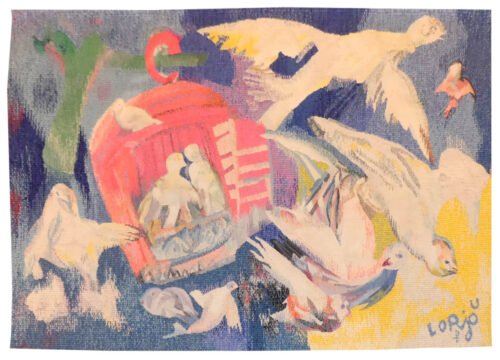
The Birdcage
Aubusson tapestry woven in the Pinton workshops. With its ribbon, No. 1/6. Circa 1980.Although a designer of silk fabrics in his youth, and a designer of large-format paintings used as manifestos during exhibitions ("the plague in Beauce" from 1953 measured, for example, 250 x 360 cm), Lorjou's interest in tapestry was late: perhaps he considered the harshness and robustness of his style inappropriate for weaving (his close associates, moreover, Rebeyrolle, Mottet, Sébire, ... were themselves never woven). In the 1970s, his style became more oneiric and less expressionist: it was then that he provided cartoons for the Pinton workshop. The chromatic range, the bird motifs, are characteristic of Lorjou's 1970s work; the texture of the paintings is rendered in tapestry through differences in weaving techniques. -
The Firebird
Aubusson tapestry woven in the Pinton workshops. With its signed ribbon. 1963.Attracted by large surfaces, under the influence of Untersteller at the School of Fine Arts, Hilaire executed numerous murals. Logically, he produced, from 1949, at the same time as many artists, stimulated by Lurçat (he will be part of the A.P.C.T., Association of Tapestry Cartoonists), many cartoons (a few dozen), some of which were woven in Beauvais or at the Gobelins. "The Firebird" demonstrates a fairly rare dynamic vein in Hilaire, whose greenhouses or forests are better known: his fractured, kaleidoscopic style lends itself admirably to the expression of movement. Bibliography: Cat. Expo., Hilaire, woven work, Verrière gallery, 1970, ill. Cat. Expo. Hilaire, from line to light, Georges de la Tour Departmental Museum, Vic-sur-Seille, 2010. -
Serenade
Aubusson tapestry woven in the Pinton workshops. Circa 1950.Attracted by large surfaces, under the influence of Untersteller at the School of Fine Arts, Hilaire executed numerous murals. Logically, he produced, from 1949, at the same time as many artists, stimulated by Lurçat (he will be part of the A.P.C.T., Association of Cartoonists for Tapestry, alongside him), many cartoons (a few dozen), some of which were woven in Beauvais or at the Gobelins. Our tapestry is probably one of Hilaire's first cartoons, at a time when the human figure was still omnipresent (before it almost completely disappeared around 1960), and when he was responding to many public commissions: our pastoral serenade refers to the 'Quartet', a 1950 cartoon woven by Pinton for the Mobilier National. Bibliography: Cat. Expo., Hilaire, woven work, Verrière gallery, 1970 Cat. Expo. Hilaire, from line to light, Georges de la Tour Departmental Museum in Vic-sur-Seille, 2010. -
Camargue
Aubusson tapestry woven in the Pinton workshops. Label signed by the artist, n°4/6. 1963.Attracted by large surfaces, under the influence of Untersteller at the School of Fine Arts, Hilaire executed numerous murals. Logically, he produced, from 1949, at the same time as many artists, stimulated by Lurçat (he will be part of the A.P.C.T., Association of Cartoonists of Tapestry, alongside him), numerous cartoons (a few dozen), some of which were woven in Beauvais or at the Gobelins. We find his figurative, cubist style (which sometimes borders on abstraction) in his tapestry cartoons: in ours, but also for example in the one produced for the Fontainebleau Salon of the Paquebot France, 'Sous-bois' (190 x 988 cm, Pinton weaving, reproduced in Armelle Bouchet Mazas, the paquebot France, Paris, 2006, p.169), where shapes and colors are fragmented in a kaleidoscopic way. 'Camargue' is reproduced in the 'Tapisserie d'Aubusson' binder published by the Chamber of Commerce and Industry of Guéret in the early 80s to illustrate the know-how of the Aubusson workshops.Bibliography: Cat. Expo., Hilaire, woven work, Verrière gallery, 1970 (reproduced) Cat. Expo. Hilaire, from line to light, Georges de la Tour Departmental Museum in Vic-sur-Seille, 2010. -
Arbors
Aubusson tapestry woven by the Pinton workshop for Leleu. With its label. 1964.Attracted by large surfaces, under the influence of Untersteller at the School of Fine Arts, Hilaire executed numerous murals. Logically, he produced, from 1949, at the same time as many artists, stimulated by Lurçat (he will be part of the A.P.C.T., Association of Cartoonists of Tapestry, alongside him), many cartoons (a few dozen), some of which were woven in Beauvais or at the Gobelins. Our tapestry was featured in the dining room of the Médy Roc villa, at Cap d'Antibes, whose furnishing and decor were carried out by the Leleu house, from 1957; on this occasion, pursuing Jacques Adnet's research on the interconnections between architecture, furniture and tapestry, articulated under the guidance of a designer, it was desired, at Leleu, to maintain the tradition of a great 'French style', magnified by the know-how of the best representatives of the decorative arts of the time. It is in this avowed lineage that was first placed, by the same Hilaire, a 'French Garden' in the dining room, before our tapestry joined it in 1964, combining traditional trellises with birds largely imbued with exoticism. The 2 tapestries appear in 'les seins de glace', a film by Lautner with Delon, Brasseur and Mireille Darc, shot on location. Provenance: Médy Roc villa, Cap d'Antibes Bibliography: Cat. Expo., Hilaire, woven work, Verrière gallery, 1970 Cat. Expo. Hilaire, from line to light, Georges de la Tour Departmental Museum in Vic-sur-Seille, 2010. -
The water lilies
Aubusson tapestry woven in the Pinton workshops for the Verrière gallery. With its label, No. 4/6. 1968.Attracted by large surfaces, under the influence of Untersteller at the School of Fine Arts, Hilaire executed numerous murals. Logically, he produced, from 1949, at the same time as many artists, stimulated by Lurçat (he will be part of the A.P.C.T., Association of Cartoonists of Tapestry, alongside him), many cartoons (a few dozen), some of which were woven in Beauvais or at the Gobelins. Hilaire appropriates the subject, pre-empted by Monet, in his usual cubist style (and tending towards abstraction), made up of lines and circular shapes with an exalted blue and green chromatic range. His passion for horticulture, to which he was destined in his youth, is here like an echo of Monet's at Giverny.Bibliography: Cat. Expo., Hilaire, woven work, Verrière gallery, 1970, ill. Cat. Expo. Hilaire, from line to light, Georges de la Tour Departmental Museum in Vic-sur-Seille, 2010. -
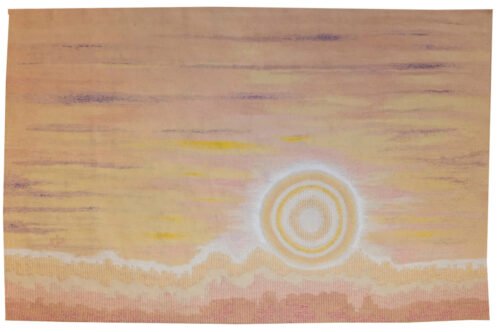
Rising Sun
Woven tapestry by the Saint-Cyr's workshop. With its label signed, No. I/VI. Circa 1970. -
Pastoral Concert
Tapestry in petit point. Circa 1965.“It will now be understood that after having founded a painting on the love of tapestry, it was relatively easy for me, and very tempting, to build a tapestry that is faithful to my painting” the artist will say in the exhibition catalog of Galerie Verrière in 1970. It was not until 1961 that he began to create cartoons (more than fifty), both for the high-warp tapestry (in Aubusson, but also at the Mobilier National, sometimes with the collaboration of Pierre Baudouin), but also for the technique of the petit point. We find in these cartoons the very audacious palette of the artist made of primary colors or here, based on a very raw pink, with a narration scattered between the main concert and the hunting scene, in the background. Provenance: Elmina Auger Collection Bibliography: Cat. Expo. Lapicque Tapestries, Villand & Galanis gallery, 1964-1965 Cat. Expo.Lapicque, Lyon, Galerie Verrière, 1970 -
Pastoral Concert
Aubusson tapestry woven in the Picaud workshop, for the Verrière gallery in Lyon. With its certificate signed by the artist; No. 1/4. Circa 1970.“It will now be understood that after having founded a painting on the love of tapestry, it was relatively easy for me, and very tempting, to build a tapestry that is faithful to my painting” the artist will say in the exhibition catalog of the Galerie Verrière in 1970. It was not until 1961 that he began to create cartoons (more than fifty), both for the high-warp tapestry (in Aubusson, but also at the Mobilier National, sometimes with the collaboration of Pierre Baudouin), but also for the technique of the petit point. We find in these cartoons the very audacious palette of the artist made of primary colors or here, based on a very raw pink, with a narration scattered between the main concert and the hunting scene, in the background. Bibliography: Cat. Expo.Lapicque, Lyon, Galerie Verrière, 1970 -
The night
Claire Rado designs and weaves her first tapestry in 1964, in her workshop in Suresnes, which she then exhibits at the Galerie La Demeure. She weaves her own cartoons, but, like Daquin or Coffinet for example, also transposes the works of others (Soulages in particular, concerning Claire Rado). Her first abstract tapestries will be followed by monumental woven figures while the warp, around, is left apparent. Tapestry from the artist's early days, where the design is at the service of her technical mastery.Tapestry woven by the Claire Rado workshop. With its signed label by the artist. Circa 1965. -
Composition
Claude Bleynie discovered tapestry with Jean Picart le Doux in 1952. He then exhibited at the La Demeure gallery (from 1958) and participated in the main exhibitions dedicated to mural art. His woven work represents more than 300 cartoons, mainly published by the Andraud workshops. Bleynie, in a more abstract vein (which is sometimes also found in tapestry), notably designed carpet cartoons for the luxury apartment 'Ile de France' on the 'France' ocean liner. Also a theatre designer, Bleynie designed numerous cartoons inspired by Dance, and animated by masked and winged figures, in a fairy-tale spirit.Aubusson tapestry woven by the Andraud workshop. Circa 1960. -
Composition
Close to Bertholle and Le Normand, with whom he created frescoes in the 1940s, Idoux produced his first cartoon in 1946, and joined the A.P.C.T. in 1951. His tapestries, with harmoniously rhythmic geometric and optical resonances (we are only at the beginning of the 1950s!) are an echo of his achievements in the field of stained glass (at Notre-Dame de Royan for example). If Idoux's journey in tapestry is meteoric (around twenty cartoons in a decade), it will nevertheless reach an official peak with "Magic Garden" and "Fée Mirabelle" woven for the first-class lounge of the liner "France" ("Magic Garden" is now preserved at the Saint-Nazaire Ecomuseum).Aubusson tapestry woven by the Rivière des Borderies workshop. Circa 1950. -
Argos
Aubusson tapestry woven by the Picaud workshop. With its label signed by the artist, no. 1/4. 1971.Loewer created his first cartoon in 1953; his works are initially figurative before he moves (like Matégot) towards abstraction, exclusively geometric in Loewer's case. He will compose more than 180 cartoons, most of which were woven by his friend Raymond Picaud. Around 1971-1972, Loewer's style becomes more refined, with fewer squares, and more vivid and varied colors. As is often the case with Loewer, our weaving is unique. Bibliography: Claude Loewer, l'évasion calculée: works from 1939 to 1993, catalogue raisonné of tapestries from 1953 to 1974, Sylvio Acatos, Charlotte Hug, Walter Tschopp and Marc-Olivier Wahler, Artcatos, 1994, no. 128 -
Galatea
Aubusson tapestry woven by the Picaud workshop. With its ribbon signed by the artist, no. 1/4. 1970.Loewer created his first cartoon in 1953; his creations were initially figurative before he moved (like Matégot) towards abstraction, exclusively geometric with Loewer. He composed more than 180 cartoons, most of which were woven by his friend Raymond Picaud. Woven in a single copy according to the catalogue raisonné, "Galathée" is representative of the artist's style around 1970, whose recurring plastic sign becomes the square, used in superimpositions. Bibliography: Claude Loewer, l'évasion calculée: works from 1939 to 1993, catalogue raisonné of tapestries from 1953 to 1974, Sylvio Acatos, Charlotte Hug, Walter Tschopp and Marc-Olivier Wahler, Artcatos, 1994, n°120 -
Jewel
Tapestry woven by the Braquenié workshop. With its label, no. 1. Circa 1975.Rare example of the artist's woven production: we find his typical complicated formal arrangements. -
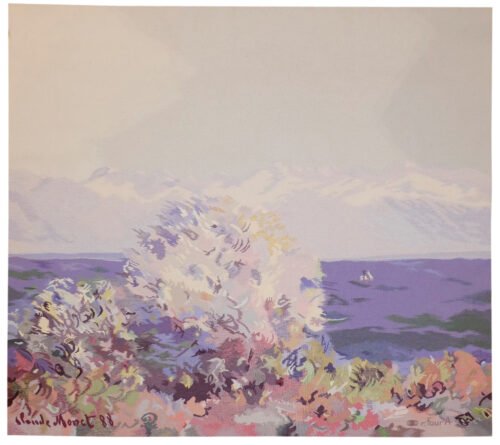
Cap d'Antibes, mistral
The Four manufactory reproduces in tapestry, hand-woven, some of the great works of painting: thus Klee, Modigliani, Macke or, here, Monet have been transcribed into wool, reproducing the nuances of materials and touches of the artists.Aubusson tapestry woven by the Four workshop. With its ribbon, No. EA2/2. Based on a work by the artist from 1888, preserved at the Museum of Fine Arts, Boston. -
The Parrots
Aubusson tapestry woven by Pinton workshop for Moulin de Vauboyen. No. 4/8. Circa 1970. -
The blue bird
Aubusson tapestry woven by the wall of the nomad. With its label, no. EA. -
Olive trees with yellow sky and sun
The Four manufactory reproduces in tapestry, hand-woven, some of the great works of painting: thus Klee, Modigliani, Macke or, here, van Gogh have been transcribed into wool, reproducing the nuances of materials and touches of the artists.Aubusson tapestry woven by the Four workshop. With its label, no. 6/6. Based on a work by the artist from 1889, preserved at the Minneapolis Institute of Arts. -
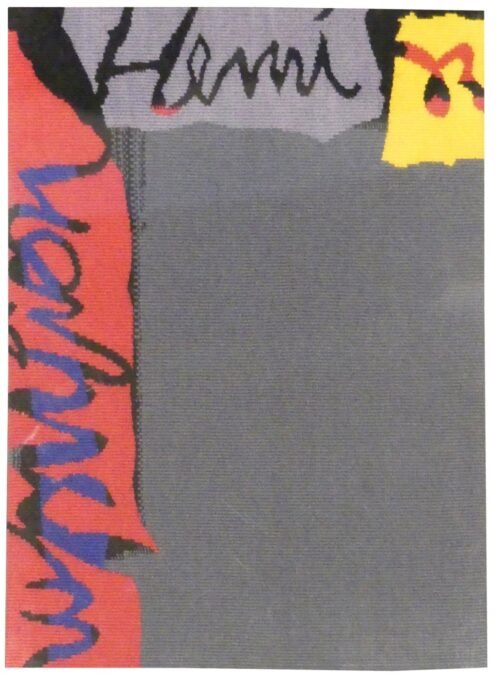
Henri, detail of "cartoon 28"
In the 80s, the Aubusson tapestry was losing momentum. The public authorities then developed a plan to revive the Tapestry, of which Daniel Riberzani was one of the beneficiaries, being the first scholarship holder of the National Center for Plastic Arts for tapestry: in Aubusson, at the ENAD, he discovered the medium, adopted, at the beginning, the numbered cartoon, forged links in the workshops...; he then received public commissions, for the Gobelins, for the Carpeaux space in Courbevoie ("Music and Dance", a 160 m2 tapestry!),... Thematic series, in line with his pictorial work, followed one another: "landscape-events", "intimate paintings", "writings", "painted cartoons", .... The latter, glued and painted papers in 1993-1994, were designed for a possible textile translation (into tapestries, into carpets, as the case may be); "Cartoon 28", from 1993, consists of colored pinned words, serving as a border to a central neutral gray background and, if there was no "Tapis or Tapisserie 28", the artist had details woven, where "Henri" rubs shoulders, fragmentary, "eruption" and "sulfur": a tapestry of the margins. Bibliography: Cat. Expo. History of a tapestry or the meeting of the cannibal and the carnivores, Aubusson, Departmental Museum of Tapestry, 1984 Cat. Expo. Tapestries - painted Cartoons, Riberzani with Bezard, Brandon, Four, Gachon, Scioria, Avallon, Collegiate Saint-Lazare, 1995 Gérard Denizeau, Riberzani intimate paintings 1989-1999, Inard Editions, 1999, repro. no. 3, p.159 Daniel Riberzani Works, 2014Tapestry woven in Aubusson by the Legoueix workshop. With its certificate signed by the artist, no. 1/6. 1993-1996. -
Composition
Close to Matégot, Danielle Moser began, following him, a collaboration with the Portalegre Tapestry Manufacture from 1969. Her cartoons, whose titles often refer to her travels, are close to those of Matégot in the early 1970s, with stripped-down chromatic harmonies (browns, oranges, khakis…) but she never went as far as geometry.Tapestry woven by the Fino workshop in Portalegre. With its border from the Suzy Langlois gallery, no. 1/6. Circa 1980. -
The red hoopoe
Aubusson tapestry woven by the Picaud workshop. With its ribbon signed by the artist, no. 3/6. Circa 1970.Of Limousin origin (and daughter of master glassmaker François Chigot), Delphine Bureau-Chigot devoted a significant part of her creative energy (she was also a painter and pastelist) to creating cartoons for tapestries (over a hundred) essentially woven by the Picaud workshop, often with oneiric inspiration, where animals (notably birds) can play a significant role. -
Cosmic Vision
Aubusson tapestry woven by the Pinton Frères workshops. Label. Circa 1970.Holger was a student at the National School of Decorative Arts in Aubusson, and worked with Lurçat before his death in 1966. He created many oneiric cartoons woven in Aubusson. Based in the United States, he remains a tireless advocate and witness to modern tapestry, organizing exhibitions and conferences on the subject. -
Sun Vision (Soleils-Vision)
Tapestry woven by the Münchener Gobelin Manufaktur. With its border signed by the artist. 1975.Holger was a student at the National School of Decorative Art in Aubusson, and worked with Lurçat before his death in 1966. He created many dreamlike cartoons woven in Aubusson. Based in the United States, he remains a tireless defender and witness to modern tapestry, organizing exhibitions and conferences on the subject. Some of his cartoons were woven in the 2 active manufacturing facilities in Germany, in Nuremberg and Munich, at the Aubusson workshop. -
Fire and Water
Tapestry woven by the Münchener Gobelin Manufaktur. With its label signed by the artist. Circa 1970. Holger was a student at the Ecole Nationale d'Art Décoratif d'Aubusson, and worked with Lurçat before his death in 1966. He created many oneiric cartoons woven in Aubusson. Established in the United States, he remains a tireless defender and witness of modern tapestry, organizing exhibitions and conferences on the subject. Some of his cartoons were woven in the 2 active manufactories in Germany, in Nuremberg and Munich, at the Aubusson workshop. -
Fire for Law
Aubusson tapestry woven by the Pinton Frères workshops. With its signed label, No. 1/6. Circa 1970.Holger was a student at the National School of Decorative Arts in Aubusson, and worked with Lurçat before his death in 1966. He created many oneiric cartoons woven in Aubusson. Based in the United States, he remains a tireless advocate and witness to modern tapestry, organizing exhibitions and conferences on the subject. -
Moon and Water (Lune et eau)
Tapestry woven by the Münchener Gobelin Manufaktur. Circa 1970.Holger was a student at the National School of Decorative Art in Aubusson, and worked with Lurçat before his death in 1966. He created many oneiric cartoons woven in Aubusson. Established in the United States, he remains a tireless defender and witness to modern tapestry, organizing exhibitions and conferences on the subject. Some of his cartoons were woven in the 2 active manufacturing facilities in Germany, in Nuremberg and Munich, at the Aubusson workshop. -
Sun for Maria Pia
Aubusson tapestry woven by the Pinton brothers workshops. With its label, No. 1/3. Circa 1970. Holger was a student at the National School of Decorative Art in Aubusson, and worked with Lurçat before his death in 1966. He created many oneiric cartoons woven in Aubusson. Based in the United States, he remains a tireless defender and witness to modern tapestry, organizing exhibitions and conferences on the subject. -
Nachtsonne (Night Sun)
Tapestry woven by the Münchener Gobelin Manufaktur. With its label signed by the artist. Circa 1970.Holger was a student at the National School of Decorative Art in Aubusson, and worked with Lurçat before his death in 1966. He created many dreamlike cartoons woven in Aubusson. Based in the United States, he remains a tireless defender and witness to modern tapestry, organizing exhibitions and conferences on the subject. Some of his cartoons were woven in the 2 active manufacturing facilities in Germany, in Nuremberg and Munich, at the Aubusson workshop. -
Honeysuckles
Tapestry d’Aubusson woven in l’atelier Goubely. With its label signed by l’artiste, No.1. 1973. Benedictine monk and illuminator, Dom Robert meets Jean Lurçat in 1941 at l’abbaye d’En Calcat: without him ceasing to draw (his watercolors, taken from the motif, will serve as a formal repertoire for his tapestries), his work of cartoonnier (he is a member of l’A.P.C.T. since its creation) gains considerable magnitude (about a hundred cartoons, numbered), and enjoys an unchallenged success. His style is easily recognizable: rejection of perspective, subjects inspired by Nature (d’une nature paradisiaque) where flora and fauna treated in an illustrative manner intertwine joyfully in a flourishing exuberance, and where l’on detects the influence of medieval mille-fleurs tapestries; poetic and colorful, the cartoons of Dom Robert embody l’ascèse spirituelle of their author. Inaugurated in spring 2015, the Dom Robert museum is located in Sorèze, in the Tarn, within l'ancienne Abbaye-école. Goats and leaves in all their variety, rather than « Chèvrefeuilles », dom Robert n’ayant never hesitated on wordplay (cf. « Plein champ »). The goat motif appears precisely in this last cartoon, from 1970. Here, at a unique scale on this theme, the goats unfold in an autumnal nature, a precise reminder of « l’Automne », which concludes in 1943 his series on the Seasons. A similar tapestry is preserved at the International City of Tapestry, in Aubusson. Bibliography: Cat. Expo. Dom Robert, recent tapestries, galerie la Demeure, 1974, ill.p.15, cartoon, p.23 Collective, Dom Robert, Tapestries, Editions Juilletard, 1980, ill. p.70-71, cover detail, cartoon p.85 Collective, Dom Robert, Tapestries, Editions Siloë-Sodec, 1990, ill. p.62-67 Cat. Expo. Dom Robert, woven work, Angers, Musée Jean Lurçat et de la tapisserie contemporaine, 1990 Cat. Expo. Homage to Dom Robert, Musée départemental de la tapisserie, Aubusson, 1998 Collective, la clef des champs, Dom Robert, Editions Privat, 2003, ill. p.124 Collective, les saisons de Dom Robert, Tapestries, Editions Hazan, 2014, ill. p.164-167 B. Ythier, Visitor's Guide, Cité Internationale de la tapisserie d’Aubusson, ill. p.65 R. Guinot, special issue La Montagne, a City for the tapestry d’Aubusson, 2018, ill. p.82 Collective, la tapisserie française, Editions du Patrimoine, 2017, ill. 312-313 S. Guérin-Gasc, Dom Robert, monk and artist, éditions Hazan, 2025, ill. p.189 -
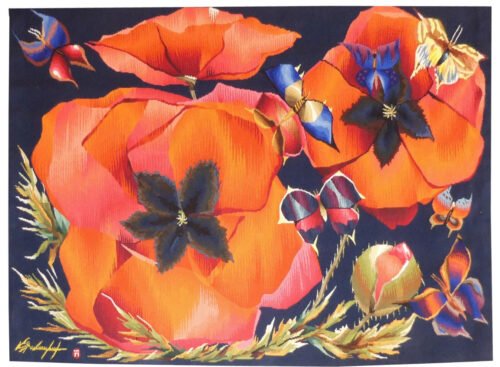
Flowers
Tapestry woven at CRECIT. With its ribbon. 1999.Edmond Dubrunfaut can be considered the great renovator of Belgian tapestry in the 20th century. He founded a weaving workshop in Tournai from 1942, then created in 1947 the Tournai Tapestry Renovation Centre . He will provide for various Belgian workshops (Chaudoir, de Wit,...) numerous cartoons intended in particular to adorn Belgian embassies around the World. Moreover, Dubrunfaut, from 1947 to 1978, teaches monumental art at the Academy of Fine Arts of Mons, then, in 1979, participated in the creation of the Foundation for tapestry, textile arts and mural arts of Tournai, a veritable conservatory of tapestry in Wallonia. His style, figurative, often using strong contrasts of color, is highly inspired by animals and nature (like Perrot, for example, the artist has a strong tropism for ornithology). Late tapestry by Dubrunfaut, with a constantly renewed decorative vein, woven at CRECIT in Tournai, where the artist provided numerous cartoons to weave. Bibliography: Exhibition catalog Dubrunfaut and the renaissance of tapestry, paintings, drawings, paintings, Museum of Fine Arts, Mons, 1982-1983. -
Summer day
Aubusson tapestry woven by the Four manufactory for publisher Jean Laurent. With its ribbon, No. EA. 1989.Edmond Dubrunfaut can be considered the great renovator of Belgian tapestry in the 20th century. He founded a weaving workshop in Tournai from 1942, then created in 1947 the Tournai Tapestry Renovation Centre . He will provide for various Belgian workshops (Chaudoir, de Wit,...) numerous cartoons intended in particular to adorn Belgian embassies around the World. Moreover, Dubrunfaut, from 1947 to 1978, teaches monumental art at the Academy of Fine Arts of Mons, then, in 1979, participated in the creation of the Foundation for tapestry, textile arts and mural arts of Tournai, a veritable conservatory of tapestry in Wallonia. His style, figurative, often using strong color contrasts, is highly inspired by animals and nature (like Perrot, for example, the artist has a strong tropism for ornithology). In this regard, this cartoon, with its very horizontal format, at bird height, but represented here in a very realistic way, is characteristic of this vein. Bibliography: Cat. Expo. Dubrunfaut and the renaissance of tapestry, paintings, drawings, paintings, Musée des Beaux-Arts de Mons, 1982-1983. -
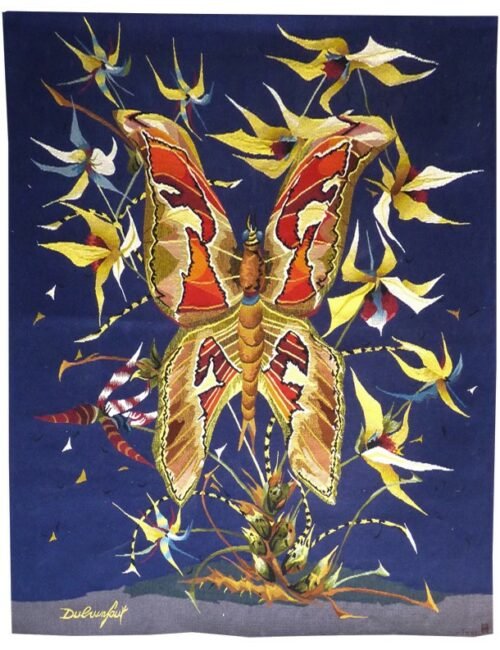
Butterfly
Aubusson tapestry woven by the Four manufacture. No. 3/6. Circa 1970.Edmond Dubrunfaut can be considered the great renovator of Belgian tapestry in the 20th century. He founded a weaving workshop in Tournai in 1942, and then created the Tournai Tapestry Renovation Centre in 1947. He provided numerous cartoons for various Belgian workshops (Chaudoir, de Wit,...), particularly intended to adorn Belgian embassies around the world. Additionally, Dubrunfaut taught monumental art at the Mons Academy of Fine Arts from 1947 to 1978, and then participated in the creation of the Tournai Foundation for Tapestry, Textile Arts, and Wall Arts in 1979, a veritable conservatory of tapestry in Wallonia. His figurative style, often using strong color contrasts, is heavily inspired by animals and nature (like Perrot, for example, the artist has a strong affinity for ornithology). Dubrunfaut, not content with being woven in Belgium, provided numerous cartoons to the Four d'Aubusson manufactory: birds and butterflies coexist with exotic flora in acidulous colors on dark blue backgrounds.Bibliography: Cat. expo. Dubrunfaut and the renaissance of tapestry, paintings, drawings, paintings, Museum of Fine Arts of Mons, 1982-1983 -
The Royal
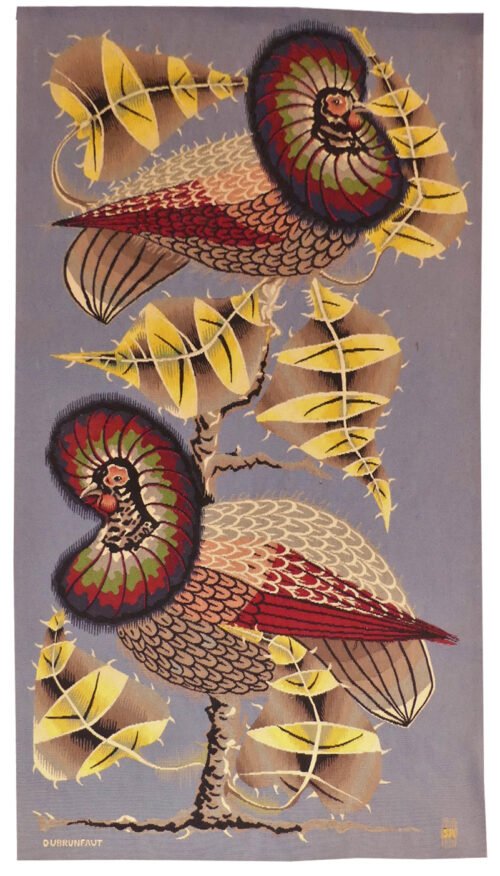
Aubusson tapestry woven in the Simone André workshop. With its signed ribbon. Circa 1965.Edmond Dubrunfaut can be considered the great renovator of Belgian tapestry in the 20th century. He founded a weaving workshop in Tournai from 1947, then created the Tournai Tapestry Renovation Centre . He supplied numerous cartoons for various Belgian workshops (Chaudoir, de Wit,...) intended to adorn Belgian embassies around the World. In addition, Dubrunfaut taught monumental art at the Mons Academy of Fine Arts from 1947 to 1978, then participated in the creation of the Tournai Tapestry, Textile Arts and Wall Arts Foundation, a veritable conservatory of tapestry in Wallonia. His figurative style, often using strong color contrasts, is highly inspired by animals and nature (like Perrot, for example, the artist has a strong affinity for ornithology). The subject, the bright blue background, are an echo to Perrot. Characteristic of Dubrunfaut are his leaf-feathers: the animal takes over the plant. -
Tropical flora
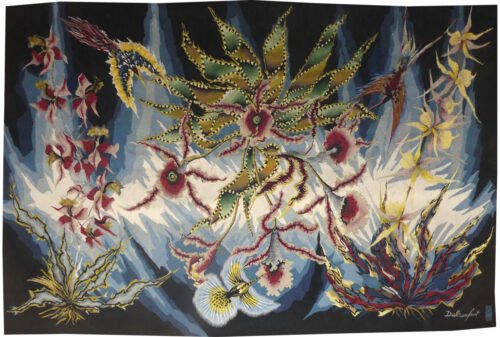
Aubusson tapestry woven in the Four workshop. With its ribbon, No. EA. Circa 1975.Edmond Dubrunfaut can be considered the great renovator of Belgian tapestry in the 20th century. He founded a weaving workshop in Tournai in 1942, then created the Tournai Tapestry Renovation Centre in 1947. He supplied numerous cartoons for various Belgian workshops (Chaudoir, de Wit,...), intended to adorn Belgian embassies around the world. Additionally, Dubrunfaut taught monumental art at the Mons Academy of Fine Arts from 1947 to 1978, and then participated in the creation of the Tournai Foundation for Tapestry, Textile Arts, and Wall Arts, a veritable conservatory of tapestry in Wallonia. His figurative style, often using strong color contrasts, is heavily inspired by animals and nature (like Perrot, for example, the artist has a strong affinity for ornithology). Towards the end of his career, Dubrunfaut expressed himself in a fantastical style (with sharp forms reminiscent of Marc Petit), and whose themes (hummingbirds and exotic plants) evoke Lurçat's work from the 1950s.Bibliography: Cat. expo. Dubrunfaut and the renaissance of tapestry, paintings, drawings, paintings, Museum of Fine Arts of Mons, 1982-1983 -
Good understanding
Tapestry woven in the DMD workshop, in Tournai. With its label. 1989.Edmond Dubrunfaut can be considered as the great renovator of Belgian tapestry in the 20th century. He founded a weaving workshop in Tournai in 1942, then created the Tournai Tapestry Renovation Centre . He will provide for various Belgian workshops (Chaudoir, de Wit,...) numerous cartoons intended in particular to adorn Belgian embassies around the World. Moreover, Dubrunfaut, from 1947 to 1978, teaches monumental art at the Academy of Fine Arts of Mons, then, in 1979, participated in the creation of the Foundation for tapestry, textile arts and mural arts of Tournai, a true conservatory of tapestry in Wallonia. His style, figurative, often using strong color contrasts, is highly inspired by animals and nature (like Perrot, for example, the artist has a strong tropism for ornithology). The title refers to the artist's concerns about social harmony: the human figure, omnipresent at the beginning, illustrates an irenic theme. Bibliography: Exhibition catalogue Dubrunfaut and the renaissance of tapestry, paintings, drawings, paintings, Museum of Fine Arts of Mons, 1982-1983. -
Double friendship
Aubusson tapestry woven in the Four workshop. With its signed label, No. EA1. 1972.Bibliography: Cat. expo. Dubrunfaut and the renaissance of tapestry, paintings, drawings, paintings, Museum of Fine Arts Mons, 1982-1983, n°239.Edmond Dubrunfaut can be considered as the great renovator of Belgian tapestry in the 20th century. He founded a weaving workshop in Tournai in 1942, then created the Tournai Tapestry Renovation Centre . He will provide for various Belgian workshops (Chaudoir, de Wit,...) numerous cartoons intended in particular to adorn Belgian embassies around the World. Moreover, Dubrunfaut, from 1947 to 1978, teaches monumental art at the Academy of Fine Arts of Mons, then, in 1979, participated in the creation of the Foundation for tapestry, textile arts and mural arts of Tournai, a veritable conservatory of tapestry in Wallonia. His style, figurative, often using strong contrasts of colors, is highly inspired by animals and nature (like Perrot, for example, the artist has a strong tropism for ornithology). Classic subject; the title nevertheless refers to an anthropomorphism of the relations between animals; thus expressing the social (utopian?) concerns of the artist. -
The 2 squirrels
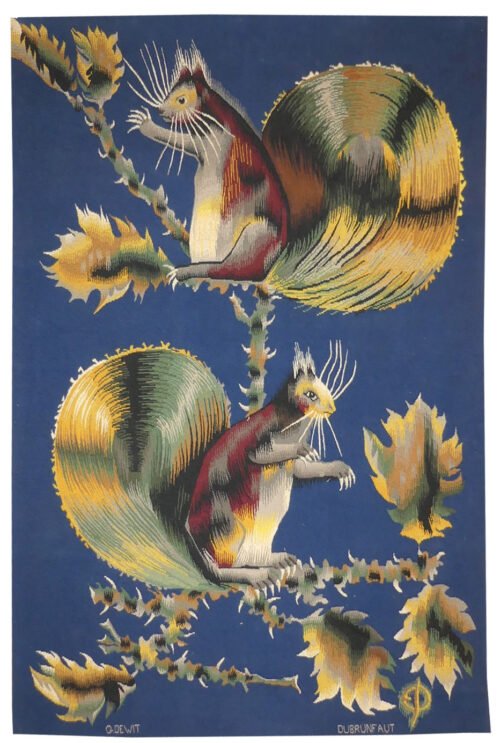
Edmond Dubrunfaut can be considered the great renovator of Belgian tapestry in the 20th century. He founded a weaving workshop in Tournai from 1942, then created in 1947 the Tournai Tapestry Renovation Centre . He will provide for various Belgian workshops (Chaudoir, de Wit,...) numerous cartoons intended in particular to adorn Belgian embassies around the World. Moreover, Dubrunfaut, from 1947 to 1978, teaches monumental art at the Academy of Fine Arts of Mons, then, in 1979, participated in the creation of the Foundation for tapestry, textile arts and mural arts of Tournai, a veritable conservatory of tapestry in Wallonia. His style, figurative, often using strong contrasts of color, is highly inspired by animals and nature (like Perrot, for example, the artist has a strong tropism for ornithology). The squirrel is one of the recurring themes in the artist's work (cf. "Evening Fires", "Squirrels and Volatiles"...): here, the tails make a decorative motif in themselves.Tapestry woven by the de Wit workshop. With its signed ribbon. Circa 1960. -
Birds
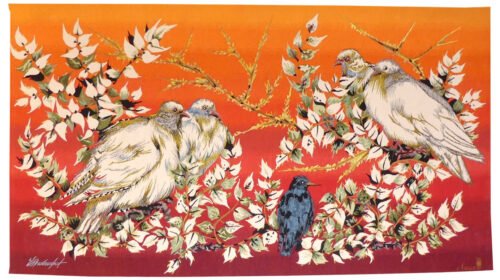
Aubusson tapestry woven in the Simone André workshop. Circa 1950.Edmond Dubrunfaut can be considered as the great renovator of Belgian tapestry in the 20th century. He founded a weaving workshop in Tournai in 1942, then created the Tournai Tapestry Renovation Centre . He will provide for various Belgian workshops (Chaudoir, de Wit,...) numerous cartoons intended in particular to adorn Belgian embassies around the World. Moreover, Dubrunfaut, from 1947 to 1978, teaches monumental art at the Academy of Fine Arts of Mons, then, in 1979, participated in the creation of the Foundation for tapestry, textile arts and mural arts of Tournai, a true conservatory of tapestry in Wallonia. His style, figurative, often using strong contrasts of color, is highly inspired by animals and nature (like Perrot for example, the artist has a strong tropism for ornithology). A classic subject, therefore, with Dubrunfaut, woven in Aubusson by Simone André in the 50s and 60s. Bibliography: Exhibition catalog Dubrunfaut and the renaissance of tapestry, paintings, drawings, paintings, Musée des Beaux-Arts de Mons, 1982-1983. -
The owls
Tapestry woven by the de Wit factory. Circa 1960.Edmond Dubrunfaut can be considered as the great renovator of Belgian tapestry in the 20th century. He founded a weaving workshop in Tournai in 1942, then created the Tournai Tapestry Renovation Centre . He will provide for various Belgian workshops (Chaudoir, de Wit,...) numerous cartoons intended in particular to adorn Belgian embassies around the World. Moreover, Dubrunfaut, from 1947 to 1978, teaches monumental art at the Academy of Fine Arts of Mons, then, in 1979, participated in the creation of the Foundation for tapestry, textile arts and mural arts of Tournai, a veritable conservatory of tapestry in Wallonia. His style, figurative, often using strong color contrasts, is highly inspired by animals and nature (like Perrot, for example, the artist has a strong tropism for ornithology). From 1955 onwards, and throughout the 1960s, the de Wit factory wove a considerable number of tapestries based on Dubrunfaut, with the human figure soon giving way to floral subjects, and, above all, birds.Bibliography: Cat. Expo. Dubrunfaut and the revival of tapestry, paintings, drawings, paintings, Museum of Fine Arts Mons, 1982-1983. -
Fish and frogs
Aubusson tapestry woven by the Picaud workshop. With its signed label, no. 1/4. Circa 1970.Elie Grekoff, close to Lurçat's aesthetic, produced more than 300 cartoons: black background, submarine, with fish and foliage, distinguished from Lurçat by the curious and amusing presence of frogs. -
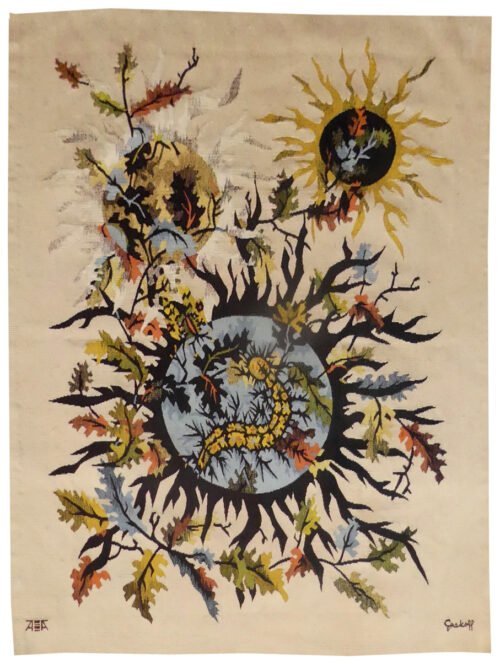
Annick
Elie Grekoff, close to l'esthetic of Lurçat, will produce more than 300 cartoons. The theme of leafy suns is a classic of l’artist; perhaps the title alludes to a litière of l’Atelier de Tapisserie d’Angers, opened that same year 1968, and where Grekoff was the first painter-cartoonnier to be woven.Tapestry woven by l’ATA (Atelier de Tapisserie d'Angers) with its label signed. 1968. -
Thistles with white butterflies
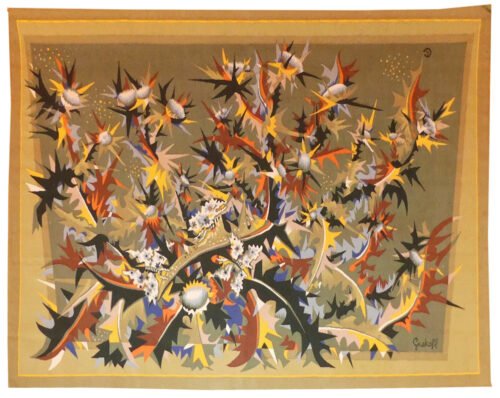
Elie Grekoff, close to Lurçat's aesthetic, will produce more than 300 cartoons until the early 80s. Here, we find the sharp forms typical of post-war tapestry. Note the amusing overflow of the border frame.Aubusson tapestry woven by the Caron workshop. With its signed ribbon, no. EA. Circa 1970. -
Two owls on blue background
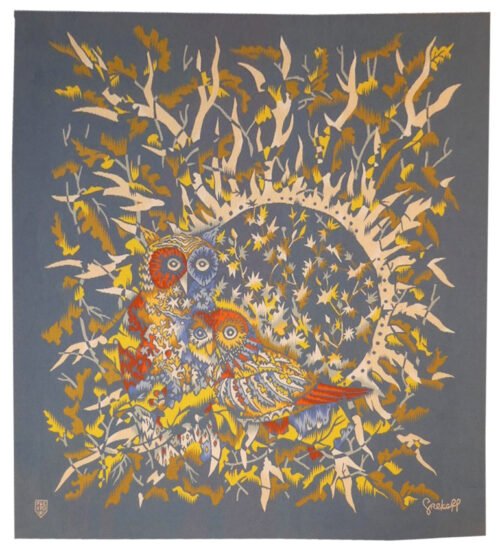
Aubusson tapestry woven by the Picaud workshop. With its label, no.3/6. Circa 1970. -
Blue landscape with butterflies
Elie Grekoff, close to Lurçat's aesthetic, produced more than 300 cartoons: ours bears witness to the artist's evolution from the 1960s onwards, with the disappearance of the human or animal figure. The theme of the celestial body (sun, moon) hidden behind foliage then becomes recurrent.Tapestry woven by the ATA (Angers Tapestry Workshop). With its signed label, no. 1/4. Circa 1970. -
Purveyor of Illusions
Elie Grekoff, close to Lurçat's aesthetic, produced more than 300 cartoons. 'Merchant of illusions' is characteristic of Grekoff's vein, where children observe each other, melancholic, in a theatrical setting, like an illustration from a tale.Aubusson tapestry woven by the Pinton workshop. With its ribbon. Circa 1955. -
The little birdcatcher
Aubusson tapestry woven by the Picaud workshop. With its label, no. 1/6. Circa 1970.Elie Grekoff, close to Lurçat's aesthetic, produced more than 300 cartoons. 'The little birdcatcher' is characteristic of Grekoff's style, where children observe each other, melancholic, in a oneiric landscape unfolding on a background of colored flat areas, like the illustration of a tale. -
The Falcon
Elie Maingonnat directed the National School of Decorative Arts in Aubusson from 1930 to 1958, where he succeeded Marius Martin (who already advocated for limiting colors and using hatching), and was his student. In addition to his responsibilities, Maingonnat himself devoted himself to creating cartoons: dense vegetal motifs animated by a few animals, a testimony to the Limousin flora and fauna, reviving the traditional theme of the verdures of the 17th-18th centuries. Our cartoon is typical of Maingonnat's work: local fauna and flora, as if in symbiosis, are illustrated in a reduced range of colors: our weaving, posthumous, has also evolved the original chromatic range, becoming more vivid. Bibliography: Cat. Expo. Elie Maingonnat, Aubusson, Departmental Museum of Tapestry, 1986-1987Aubusson tapestry woven by the Legoueix workshop. No. EA/2. 1947. -
The Owl
Elie Maingonnat directed the National School of Decorative Arts in Aubusson from 1930 to 1958, where he succeeded Marius Martin (who already advocated for the limitation of colors and the use of hatching), of whom he was a student. In addition to his responsibilities, Maingonnat himself devoted himself to creating cartoons: dense plant motifs animated by a few animals, a testament to the Limousin flora and fauna, reviving the traditional theme of the verdures of the 17th-18th centuries. Our cartoon is typical of Maingonnat's work: local fauna and flora, as if in symbiosis, are illustrated in a reduced range of autumnal colors. Bibliography: Cat. Expo. Elie Maingonnat, Aubusson, Departmental Museum of Tapestry, 1986-1987Aubusson tapestry woven by the Avignon workshop. With its label signed by the artist's rights holder. 1959. -
The tiercelet
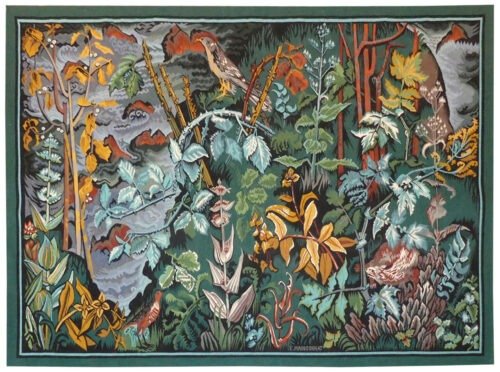
Aubusson tapestry woven by the Legoueix workshop. Label signed by the artist's right-holder, No. E.A.1 1942.Bibliography: Cat. Expo. Elie Maingonnat, Aubusson, Departmental Museum of Tapestry, 1986-1987, Ill.Elie Maingonnat directed the National School of Decorative Arts in Aubusson from 1930 to 1958, where he succeeded Marius Martin (who already advocated the limitation of colors and the use of hatching), of whom he was a student. In addition to his responsibilities, Maingonnat himself devoted himself to creating cartoons: dense plant motifs animated by a few animals, a testimony to the Limousin flora and fauna, revived the traditional theme of the verdures of the 17th-18th centuries. Our cartoon is typical of Maingonnat's work: the local fauna and flora (here, a small tiercel among the gentians, on the edge of a torrent) are illustrated in a reduced range of green-gray colors that respond to each other, and are highlighted by the browns of the river rocks. -
Serenade to the Moon
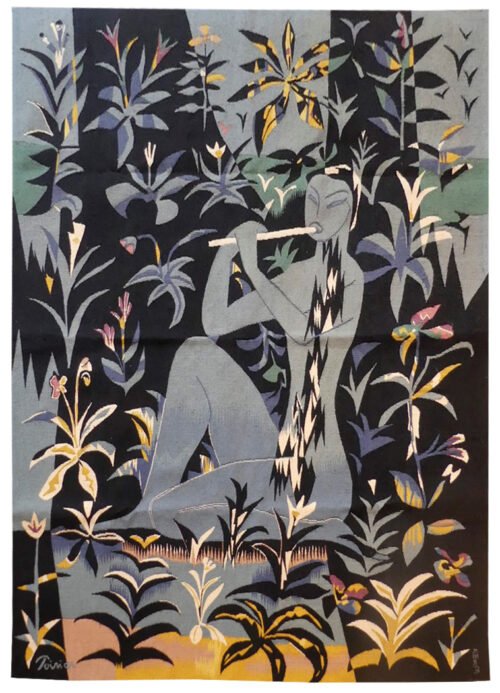
Introduced to tapestry by Jean Picart le Doux, Poirier designed his first cartoon in 1951: he would produce around twenty cartoons in the 1950s, to the point of being considered one of the great hopes of Tapestry. However, from the 1960s onwards, he returned to Painting. 'Serenade to the Moon' was originally a large-scale cartoon (190 x 285 cm) commissioned by Jacques Adnet in 1952. Our tapestry takes up the left side of the composition, reduced in height, and reversed, and the moon is absent from it. This fragmentation meets the needs of a clientele eager for small formats. Bibliography: J. Cassou, M. Damain, R. Moutard-Uldry, French tapestry and cartoon painters, Tel, 1957, reproduced p.182Aubusson tapestry woven by the Braquenié workshop. No. IV/VI. 1952. -
Modern Paris
Little is known about the artist, but she produced several cartoons, which were woven by the ART workshops of Antoine Behna. The panoramic topographical view was one of the specialities of the workshop, 'Modern Paris' echoing Bobot's 'Old Paris 1650'. A copy of each of these tapestries was also offered to President Truman. Bibliography: G. Janneau, A. Behna, Tapestries of our time, 1950, ill. no. 3 Catalogue Vente Millon-Robert, 3.10.1990, no. 1, 31Tapestry woven by the Colombes workshop for ART (Tapestry Renovation Workshop). 1945. -
Composition
Aubusson tapestry woven by the Picaud workshop. Circa 1960.Born in 1912, Farvèze is part of the second generation of cartoonists, which flourished from the late 1950s, with Grékoff, Ferréol, Petit, Potin,… Marked by his meeting with Gleizes and then by a stay in Senegal which earned him prestigious public commissions, he was selected to participate in the 2and Lausanne Biennale in 1965. A stylization high in colors characterizes this work; the absence of label, however, prevents any full understanding: we distinguish a few animal forms…. ? -
The land of France does not lie
The career of François Faureau is quite unique. Born in Aubusson, he attended the ENAD, then under the direction of Marius Martin who already promoted thick weaving and counted tones that Lurçat would later adopt. It is in this way that he participated in the ENAD stand at the International Exposition of Decorative Arts in 1925 as a painter-cartoonist with the tapestry "Solitude, verdure" or the screen "Canards", which oscillate between a classicizing style and the influence of Cubism. He later had his own workshop, but his work remained confidential and distant from the protagonists of the "Renaissance of Tapestry". If the Aubusson workshops (like the National Manufactures) continued their activity under occupation, the woven realizations subject to the injunctions of Art-Marshal remain rare, although this traditional know-how may have responded to the values of the National Revolution. The famous formula pronounced from June 25, 1940, by Pétain (Emmanuel Berl being the pen), and become a Vichy leitmotif, exalting rurality, rooting, and, more prosaically, agriculture, is illustrated here in a literal and synthetic way: variety of work, vegetation, architectures, animals, ... flourishing under the aegis of the Vichy regime. Provenance: Régine Deforges Collection Bibliography: Cat. Expo. Tapestries 1925, Aubusson, Cité de la tapisserie, 2012Aubusson tapestry. 1943. -
Birds
The career of François Faureau is quite unique. Born in Aubusson, he attended the ENAD courses, then under the direction of Marius Martin who already promotes thick weaving and counted tones that Lurçat will take up again. It is in this way that he participated in the ENAD stand at the International Exposition of Decorative Arts in 1925 as a cartoonist with the tapestry "Solitude, verdure" or the screen "Canards", which oscillate between a classicizing style and the influence of Cubism. He will subsequently have his own workshop, but his work will remain confidential and far removed from the protagonists of the "Tapestry Renaissance". Upon his return to Aubusson in 1962, after a long absence, Faureau devotes all his energy to tapestry, as a cartoonist and weaver. His aesthetic is then less radical than in the 1920s, and the traditional themes: one can feel the influence of Lurçat, as well as Perrot.Aubusson tapestry woven by the Faureau workshop. Circa 1950. -
Autumnal Fairyland
Tapestry woven in Aubusson by the Andraud workshop. With its ribbon, No. EA2. 1977.A student of Léon Detroy, Gaston Thiéry is one of the last representatives of the Crozant painting school. Established in Creuse, he approached tapestry in 1965 with the Andraud workshop, to whom he entrusted cartoons inspired by the local flora, in a decorative vein halfway between the work of Dom Robert and that of Maingonnat, far from his landscape paintings influenced by Impressionism. -
Wild Garden
Tapestry woven in Aubusson by the Andraud workshop. With its ribbon, no. 6/8. 1970.A student of Léon Detroy, Gaston Thiéry is one of the last representatives of the Crozant painting school. Established in Creuse, he approached tapestry in 1965 with the Andraud workshop, to whom he entrusted cartoons inspired by the local flora, in a decorative vein halfway between the work of Dom Robert and that of Maingonnat, far from his landscape paintings influenced by Impressionism. -
Concerto
Tapestry woven by the Saint-Cyr workshop. With its label signed by the artist, No. 1/6. Circa 1970. Unknown artist, whose inspiration is found in Music and solfege; the geometry of the keyboard, the lines of the score serve as a basis for the cartoon. -
Figure of three
Tapestry woven by the Saint-Cyr workshop. With its label signed by the artist, No. 1/6. Circa 1970. Unknown artist, whose inspiration is found in Music and solfege; the geometry of the keyboard, the lines of the score serve as a basis for the cartoon. -
The 3 Graces
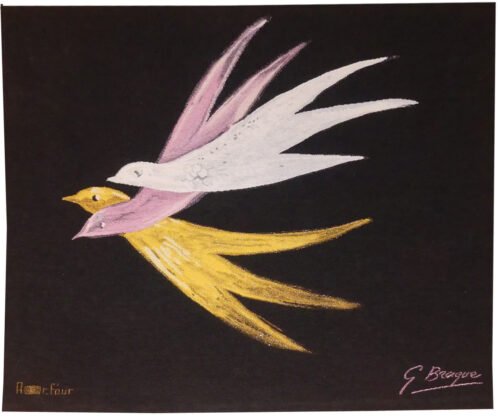
Aubusson tapestry woven by the Four workshop. No. 3/6. Woven circa 2000, after a gouache from 1962.Braque is one of the great artists of the 20th century who devoted themselves, even modestly, to tapestry. It was first at the request of Marie Cuttoli, from 1933, that he entrusted works to be reproduced in tapestry (Still Life with Guéridon, on deposit at the Museum of Fine Arts in Grenoble). In the 50s and 60s, it was Pierre Baudouin, in conjunction with the weavers of Aubusson and the National Manufactures, who was responsible for developing cartoon transcriptions from works by the artist. Simultaneously, shortly before his death in 1963, Braque produced a final series of gouaches on the theme of metamorphoses intended to be transcribed in different media. Tapestry will be one of them. "The Three Graces", from 1962, is one of these gouaches that will be transposed into sculpture or jewelry. We find the style both lyrical and synthetic of the last works of the artist that we find for example in the ceiling decoration of the Henri II room of the Louvre Museum, the Birds, 1953. -
Face
Chazaud, a Creuse native, expressed in tapestries all his empathy for the Limousin nature that he, like Gaston Thiéry (and Maingonnat before them), abundantly represented. Woman, however, is another theme of inspiration for Chazaud; with his women-flowers, his women-leaves, he reintroduces faces and profiles into tapestry.Tapestry probably woven in the Picaud workshop in Aubusson. Circa 1980. -
Pastoral Idyl
Georges Rougier, who taught drawing at the Aubusson college, provided numerous cartoons for the Aubusson workshops or the Mobilier National, and worked alongside Marius Martin when the latter directed the ENAD. Martin will make him, with Maingonnat and Faureau, one of the main protagonists of a pictorial aesthetic resolutely turned towards tapestry, which will be expressed in particular at the International Exposition of Decorative Arts in Paris in 1925 (Rougier will also have his own personal stand there!). Bibliography: Cat. Expo. "Tapestries 1925. Aubusson, Beauvais, les Gobelins at the International Exposition of Decorative Arts in Paris", Aubusson, Cité de la Tapisserie, 2012Aubusson tapestry. Circa 1930.
Galleryadmin78002026-03-03T16:12:10+01:00