
-
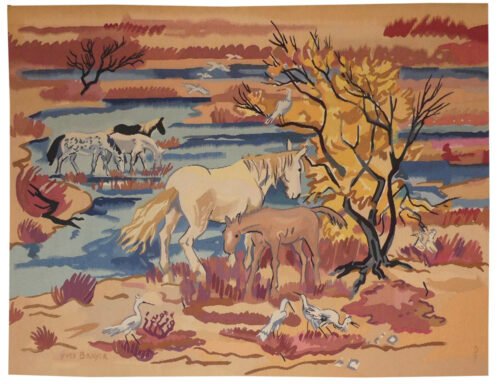
Horses in Camargue
Although he sometimes devoted himself to large-scale mural decoration (notably by designing sets for the Paris Opera), Brayer, on the other hand, was not very interested in tapestry: his achievements in this field take up earlier paintings with typical Provençal subjects.Aubusson tapestry woven by the Pinton workshop. No. 1/6. Circa 1980. -
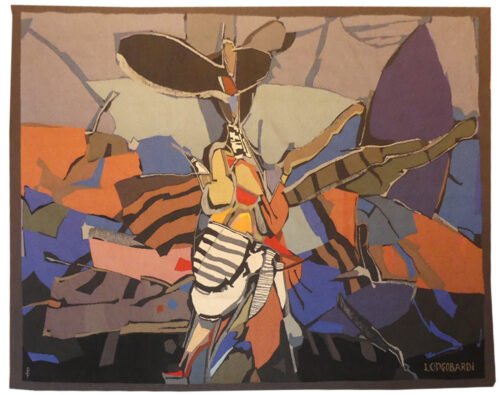
Composition
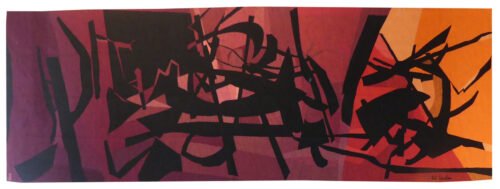
As a young painter moving towards abstraction from the late 1940s onwards, Longobardi was entrusted with large-scale mural decorations in France and abroad (Presidency of the Republic of Abidjan, rectorate of the Academy of Poitiers…), as well as numerous tapestry cartoons, particularly for the National Manufactures, with sometimes very modern subjects ("the autostrade", "the airport"…). Longobardi was, at the time, along with Singier and Springer, one of the very first abstract artists to receive public commissions: while his work is abstract, his aesthetic evolved over time, from sharp forms to a more lyrical style full of movement, until the calm of the 1960s. The acme of this meteoric official career lies in the commission of "la crique" for the private dining room on the starboard side of the liner "France". The artist then became much rarer. Our cartoon is stylistically close to the artist's latest weavings by the National Manufactures, notably "Plein feu" from 1963-1964. Bibliography: Cat. Expo. Le Mobilier National et les Manufactures Nationales des Gobelins et de Beauvais sous la IVe République, Beauvais, Galerie de la Tapisserie, 1997 Armelle Bouchet-Mazas, le paquebot France, éditions Norma, 2006 Cat. Expo. Le chic ! Arts décoratifs et mobilier de 1930 à 1960, Paris, galerie des Gobelins, 2022-23Aubusson tapestry woven by the Pinton workshop. With its label. Circa 1960. -
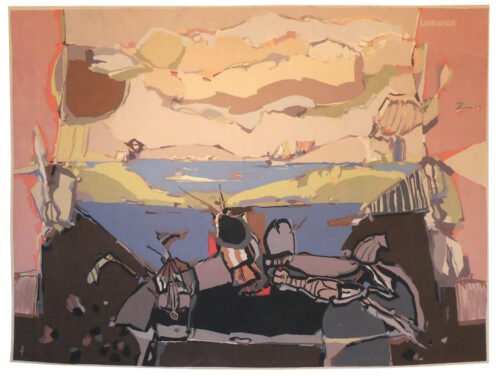
The cove
As a young painter moving towards abstraction from the end of the 1940s, Longobardi was entrusted with large-scale mural decorations in France and abroad (Presidency of the Republic of Abidjan, rectorate of the Academy of Poitiers...), as well as numerous tapestry cartoons, particularly for the National Manufactures, with sometimes very modern subjects ("the motorway", "the airport"...). Longobardi was, at the time, along with Singier and Springer, one of the first abstract artists to receive public commissions: while his work is abstract, his aesthetic evolved over time, from sharp forms to a more lyrical style full of movement, until the calm of the 1960s. The peak of this meteoric official career lies in the commission of "the cove" for the private dining room on the starboard side of the liner "France". The artist then became much rarer. Our tapestry testifies to a marine inspiration that is not so frequent on "Le France", for which Longobardi remained on the border between Abstraction (his usual mode of expression) and Figuration. It was sold under number 170 in the Loudmer sale on 10.7.1983, "Works of art from the France". Provenance: Liner "France" Bibliography: Cat. Expo. National Furniture and National Manufactures of Gobelins and Beauvais under the Fourth Republic, Beauvais, Tapestry Gallery, 1997 Armelle Bouchet-Mazas, the liner France, Norma editions, 2006, ill.p.170 Cat. Expo. Le chic ! Decorative arts and furniture from 1930 to 1960, Paris, Gobelins gallery, 2022-23Aubusson tapestry woven by the Pinton workshop. 1959. -
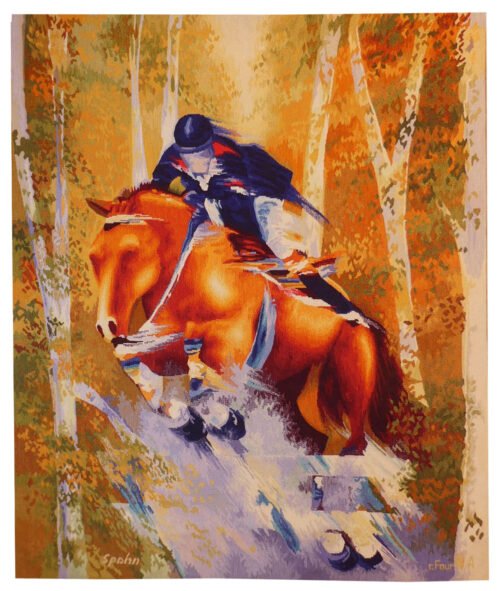
Jumping
Aubusson tapestry woven by the Four workshop. With its signed ribbon, No. EA 1/2. Circa 2000. The Four Manufactory commissioned various living artists (including Toffoli and Lartigaud) to weave them: a new dimension is thus given to the pictorial production of Spahn, the painter of movement and sports. -
To each his sun, to each his light
Essentially known for his drawings in Indian ink and his illustrations, Filozof demonstrates the variety of artists who have been woven in Aubusson over time, the naive vein (or in any case, close to popular arts) being nevertheless only slightly represented (one can nevertheless mention Mady de la Giraudière) : 8 cartoons will be woven at Tabard.Aubusson tapestry woven by the Tabard workshop. With its ribbon. Circa 1960. -
Allegory of the Trades
Aubusson tapestry woven by the Braquenié workshop. 1958.Curious cartoon where, on a star (vaguely hexagonal) are deployed family, traditional occupations (fisherman, farmer,…) in front of gasometers and other cranes, emblems of modernity: a hymn to reconstruction, a political allegory, a work of propaganda,…? -
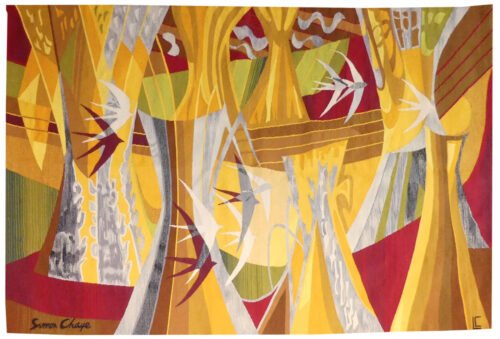
Sheaf
It was in 1953 that Jean Picart le Doux offered Chaye the opportunity to become his assistant and encouraged him to create tapestry cartoons: he then produced numerous bucolic cartoons, as well as views of Normandy (Mont Saint Michel, Honfleur, regattas,…), from which he originated. These "bird's-eye view" compositions are characteristic of the artist; here, the overflown fields, a very summery and geometric landscape, are, by magnifying effect (or metaphor), associated with the plants (wheat, corn,…) that compose them. Bibliography: Simon Chaye Contemporary Tapestries, Editions Librairie des musées, 2014, ill. p.80Aubusson tapestry woven by the Legoueix workshop. No. 4/6. 1985. -
Clear source
It was in 1953 that Jean Picart le Doux offered Chaye the opportunity to become his assistant and encouraged him to create tapestry cartoons: he then produced numerous bucolic cartoons, as well as views of Normandy (Mont Saint Michel, Honfleur, regattas,...), from where he originated. Classic cartoon in the naturalist vein of the artist, specializing in enclosures, hedges and other riverbanks, animated by animals. Bibliography: Simon Chaye contemporary tapestries, Editions Librairie des musées, 2014, ill. p.41Aubusson tapestry woven in the Bonjour workshop. With its label signed by the artist, no. 3/4. Circa 1960. -
October bouquet
It was in 1953 that Jean Picart le Doux offered Chaye to become his assistant and encouraged him to create tapestry cartoons: he then produced many bucolic cartoons, but also views of Normandy (Mont Saint Michel, Honfleur, regattas, ...), from which he is originally from. The theme of the bouquet is omnipresent in Chaye; it allows him, in a stylized register, very decorative seasonal or chromatic associations. Bibliography: Simon Chaye contemporary tapestries, Editions Librairie des musées, 2014, ill. p.77Aubusson tapestry woven in the Legoueix workshop. With its ribbon, n°5/6. 1974. -
Hatching
Bibliography: Simon Chaye Contemporary Tapestries, Editions Librairie des musées, 2014Aubusson tapestry woven by the Legoueix workshop. With its ribbon signed by the artist, No. 1/6. Circa 1970.It was in 1953 that Jean Picart le Doux offered Chaye the opportunity to become his assistant and encouraged him to create tapestry cartoons: he then produced numerous bucolic cartoons, as well as views of Normandy (Mont Saint Michel, Honfleur, regattas, ...), from where he originated. Classic cartoon in the naturalist vein of the artist, specializing in enclosures, hedges and other undergrowth, animated by animals. -
Overview
It was in 1953 that Jean Picart le Doux offered Chaye to become his assistant and encouraged him to create tapestry cartoons: he then produced numerous bucolic cartoons, as well as views of Normandy (Mont Saint Michel, Honfleur, regattas, ...), from which he originated. These "bird's-eye view" compositions are characteristic of the artist. Bibliography: Simon Chaye Contemporary Tapestries, Editions Librairie des musées, 2014, ill. p.83Aubusson tapestry woven by the Legoueix workshop. With its signed ribbon, No. 5/6. Circa 1980. -
Awakening
Aubusson tapestry woven by the Legoueix workshop. No. 4/6. 1969.Bibliography: Simon Chaye contemporary tapestries, Editions Librairie des musées, 2014, ill. p.30It was in 1953 that Jean Picart le Doux offered Chaye to become his assistant and encouraged him to create tapestry cartoons: he then produced numerous bucolic cartoons, but also views of Normandy (Mont Saint Michel, Honfleur, regattas,…), from which he originated. Birds and treillage coexist here in a vein very close to Picart le Doux. -
The enclosure
Aubusson tapestry woven by the Brivet workshop. With its label signed by the artist, No. 4/4. 1966.Bibliography: Simon Chaye contemporary tapestries, Editions Librairie des musées, 2014, ill. p.27It was in 1953 that Jean Picart le Doux offered Chaye to become his assistant and encouraged him to create tapestry cartoons: he then produced many bucolic cartoons, but also views of Normandy (Mont Saint Michel, Honfleur, regattas,…), from which he originated. Classic Cartoon of the artist's naturalistic vein, specializing in enclosures, hedges and other undergrowth. -
Calm water
Aubusson tapestry woven by the Hamot workshop. With its label, No.1/6. 1965. -
Red Sun
It was in 1953 that Jean Picart le Doux offered Chaye to become his assistant and encouraged him to create tapestry cartoons: he then produced many bucolic cartoons, but also views of Normandy (Mont Saint Michel, Honfleur, regattas, ...), from which he originated. Cartoon that combines two leitmotifs of Simon Chaye, the bouquet, and the flock of birds, here detached on a red sun background. Bibliography: Simon Chaye Contemporary Tapestries, Editions Librairie des Musées, 2014, ill. p. 120Aubusson tapestry woven in the Legoueix workshop. With its certificate signed by the artist, No. 1/6. 1989. -
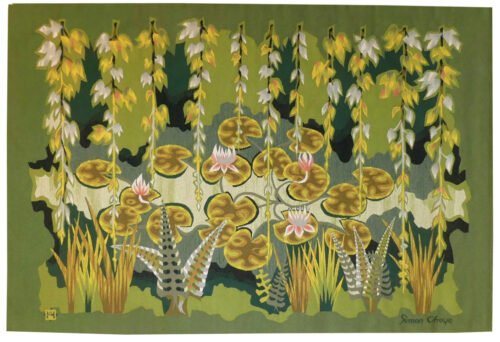
The Pond
It was in 1953 that Jean Picart le Doux offered Chaye to become his assistant and encouraged him to create tapestry cartoons: he then produced numerous bucolic cartoons, as well as views of Normandy (Mont Saint Michel, Honfleur, regattas, ...), from which he originated. Exact reproduction of the 'Water Lilies' cartoon, only the green background has been modified. Bibliography: Simon Chaye contemporary tapestries, Editions Librairie des musées, 2014Aubusson tapestry woven in the Legoueix workshop. With its certificate signed by the artist, no. 6/6. Circa 1965. -
Mill
Bibliography: Simon Chaye Contemporary Tapestries, Editions Librairie des musées, 2014, ill. p.40Aubusson tapestry woven by the Glaudin-Brivet workshop. With its label, No. 3/6. Circa 1970. -
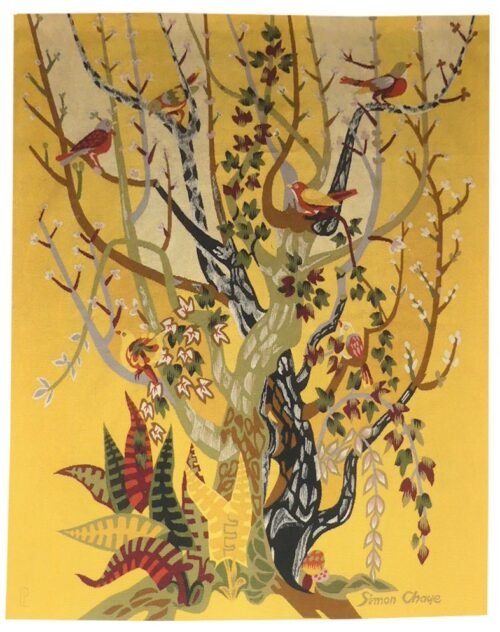
The silver river
Aubusson tapestry woven in the Hamot workshops after a cartoon by the artist. With its ribbon signed by the artist. 1965. It was in 1953 that Jean Picart le Doux offered Chaye to become his assistant and encouraged him to create tapestry cartoons: he then produced many bucolic cartoons, but also views of Normandy (Mont Saint Michel, Honfleur, regattas,…), from which he is originally from. Classic cartoon of the naturalist vein of the artist, specialist of enclosures, hedges and other riverbanks, animated by animals. Bibliography: Simon Chaye contemporary tapestries, Editions Librairie des musées, 2014, ill. p.32 -
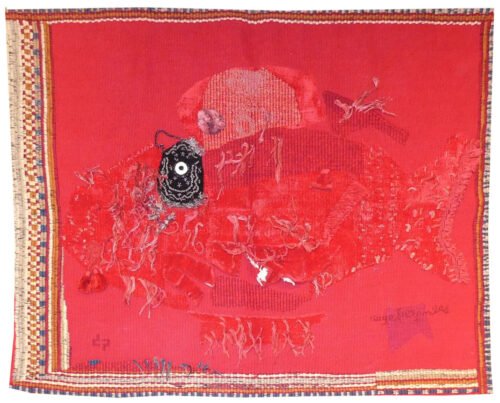
Cardinal fish
Tapestry woven by the Saint-Cyr workshop. With its signed label, no. EA/2. 1978.Roger Bezombes was interested in monumental art from his artistic beginnings. He received numerous commissions for state tapestries, first woven at the Gobelins and then at Aubusson, notably with the Hamot manufactory, whose dyers obtained wools for him in the exact tone of his cartoons (which he painted himself at full scale). In 1952-1953, he created a monumental ensemble (300 m2) for the Pavilion of Overseas France at the Cité Universitaire in Paris. He abandoned the high-warp technique at the end of the 1950s to create wall hangings made from assembled fabrics. Specifically, his 'murals' (one of the first, 'Music', 25 m long, was commissioned for the Maison de la Radio) are patchworks of assembled fabrics, sometimes joined with objects of various materials sewn, glued, or stapled. Nevertheless, as here, some murals were reproduced as high-warp tapestries by Pierre Daquin's Saint-Cyr workshop. The theme of the fish is omnipresent; Bezombes is not an ichthyologist, but a poet: it is the cardinal purple that interests him, not the homonymous species. -
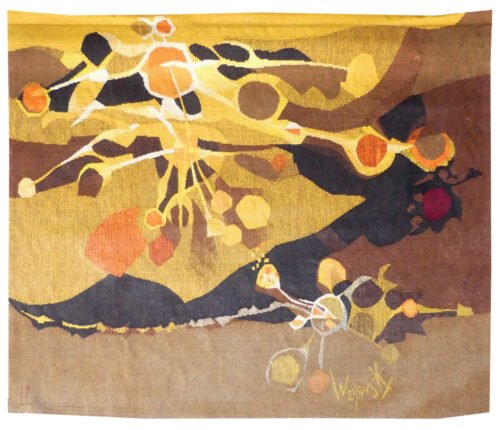
Serpent of stars
Aubusson tapestry woven by the Tabard workshop. With its ribbon signed by the artist. 1961.Member of the A.P.C.T. (Association of Cartoonists-Tapestry Artists), Wogensky is one of many artists who devoted themselves to tapestry following Lurçat, in the immediate post-war period. Initially influenced by Lurçat, Wogensky's work (159 cartoons according to the 1989 exhibition catalog) later evolved in the 1960s towards a lyrical abstraction that was not always fully assumed, from cosmic-astronomical themes to decomposed and moving bird forms, towards more refined and less dense cartoons. Although he always proclaimed himself a painter, the artist's reflection on tapestry is very accomplished: "Creating a mural cartoon... is thinking in terms of a space that no longer belongs to us, by its dimensions, its scale, it is also the requirement of a broad gesture that transforms and accentuates our presence". "Serpent of stars" refers to the eponymous constellation (but also to Giono's work), at a time (the 1960s) when his taste for lyrical absolute led Wogensky to treat stars, Space, galaxies, from "Cassiopeia" in 1961, "Song of the stars" in 1962 (presented at the Lausanne Biennale), to "Galaxy" (1970), preserved in the Senate. A similar tapestry is preserved by the Regional Council of Limousin. Bibliography: Cat. Expo. Robert Wogensky, tapestries, Galerie la Demeure, 1962, reproduced Cat. Expo. Robert Wogensky, l'oeuvre tissé, Aubusson, Musée départemental de la tapisserie, 1989 Cat. Expo. Robert Wogensky, Angers, Musée Jean Lurçat et de la Tapisserie Contemporaine, 1989-1990, reproduced p.20 Cat. Expo. Dialogues avec Lurçat, Musées de Basse-Normandie, 1992, reproduced p.73 Gérard Denizeau, Denise Majorel, une vie pour la tapisserie, Aubusson, Musée départemental de la tapisserie, reproduced p.67 -
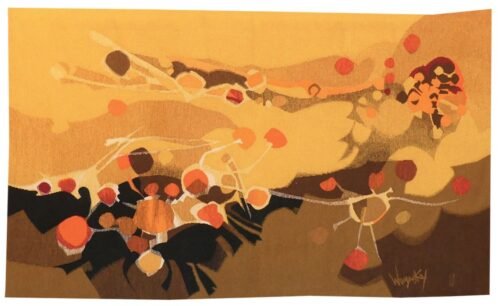
The Hyades
Aubusson tapestry woven by the Legoueix workshop. With its label signed by the artist, No. 5/6. 1968.Member of the A.P.C.T. (Association of Cartoonists for Tapestry), Wogensky is one of many artists who devoted themselves to tapestry following Lurçat, in the immediate post-war period. Initially influenced by him, Wogensky's work (159 cartoons according to the 1989 exhibition catalog) later evolved in the 1960s towards a lyrical abstraction that was not always fully assumed, from cosmic-astronomical themes to decomposed and moving bird forms, towards more refined and less dense cartoons. Although he always proclaimed himself a painter, the artist's reflection on tapestry is very accomplished: "Creating a mural cartoon... is thinking in terms of a space that no longer belongs to us, by its dimensions, its scale, it is also the requirement of a broad gesture that transforms and accentuates our presence". "The Hyades" belongs to Wogensky's "cosmic" vein (its title itself testifies to this), which runs throughout the 1960s, and of which "Cosmos" (1968, University of Strasbourg), and "Galaxy" (1970, Senate, Luxembourg Palace) will be the highlights. Picked (ubiquitous) and flat colours coexist in nuanced colour harmonies, in a curious, unknown world, as close to very small cells seen under a microscope as to the infinitely large. Bibliography: Cat. Expo. Robert Wogensky, l'oeuvre tissé, Aubusson, Departmental Museum of Tapestry, 1989 Cat. Expo. Robert Wogensky, Angers, Jean Lurçat Museum and Contemporary Tapestry, 1989-1990 -
Antiope
Member of l'A.P.C.T. (Association of Painter-Cartoonners of Tapestry), Wogensky is one of many artists who will devote themselves to tapestry following Lurçat, in l'immediate post‑war. D'abord influenced by him, l'oeuvre of Wogensky (159 cartoons d'après the exhibition catalogue of 1989) evolves thereafter in the 1960s towards a lyrical abstraction not always fully assumed, from cosmic‑astronomical themes to decomposed bird forms in motion, towards more refined and less dense cartoons. S'il s'est always proclaimed painter, the reflection of l'artist on tapestry is highly accomplished: "Creating an cartoon mural.... it is to think in terms of a space that no longer belongs to us, by its dimensions, its scale, it is also the demand of a broad gesture that transforms and accentuates our presence". More than ’ mythology, « Antiope » probably refers to astronomy: this asteroid then fits within Wogensky's dominant inspiration in the 1960s, and whose « Cosmos » (1968, University of Strasbourg), and « Galaxie » (1970, Senate, Luxembourg Palace) will be the culminating points. One observes that qu’ici, paradoxically, Wogensky tries to express the immensity of Space in a very small format. Bibliography: Cat. Expo. Robert Wogensky, l'oeuvre woven, Aubusson, Departmental Museum of Tapestry, 1989 Cat. Expo. Robert Wogensky, Angers, Jean Lurçat Museum and Contemporary Tapestry, 1989Aubusson tapestry woven by the Legoueix workshop. With its signed ribbon, no. 2/4. 1968. -
Pilot Bird
Member of the A.P.C.T. (Association of Painters-Cartonists of Tapestry), Wogensky is one of the many artists who devoted themselves to tapestry following Lurçat, in the immediate post-war period. Initially influenced by him, Wogensky's work (159 cartoons according to the 1989 exhibition catalog) later evolved in the 1960s towards a lyrical abstraction not always fully assumed, from cosmic-astronomical themes to decomposed and moving bird forms, towards more refined and less dense cartoons. Although he always proclaimed himself a painter, the artist's reflection on tapestry is very accomplished: "Creating a mural cartoon... is thinking in terms of a space that no longer belongs to us, by its dimensions, its scale, it is also the requirement of a broad gesture that transforms and accentuates our presence". « Pilot Bird », in the singular, like the « chronotissed » trajectory in a red azure (cf. « Birds of Midi », or « Takeoff », from the same year) of a form (a force even!) that guides and orients: to follow therefore… Bibliography: Cat. Expo. Robert Wogensky, l'oeuvre tissé, Aubusson, Departmental Museum of Tapestry, 1989 Cat. Expo. Robert Wogensky, Angers, Jean Lurçat Museum and Contemporary Tapestry, 1989 Cat. Expo. Weavings of artist-weavers' workshops, Angers, Jean Lurçat Museum and Contemporary Tapestry, 2004Aubusson tapestry woven by the Legoueix workshop. With its label signed by the artist, No. 1/6. 1969. -
Great blue flight
Member of the A.P.C.T. (Association of Painters-Cartonists of Tapestry), Wogensky is one of the many artists who will devote themselves to tapestry following Lurçat, in the immediate post-war period. Initially influenced by him, Wogensky's work (159 cartoons according to the 1989 exhibition catalog) later evolves in the 1960s towards a lyrical abstraction not always fully assumed, from cosmic-astronomical themes to decomposed and moving bird forms, towards more refined and less dense cartoons. Although he has always proclaimed himself a painter, the artist's reflection on tapestry is very accomplished: "Creating a mural cartoon... is thinking in terms of a space that no longer belongs to us, by its dimensions, its scale, it is also the requirement of a broad gesture that transforms and accentuates our presence". The theme of birds appears in Wogensky's work in the late 1960s. To tell the truth, often the representations remain very allusive, closer to chronophotographed trajectories than to ornithology treatises: it is the movement in space that matters, hence the titles "flight...". At this time, Wogensky pursued texture effects obtained by the weavers through the use of different point sizes; "Grand Blue Flight", the culmination of this theme and formal orientation, is presented in majesty in the catalog of the 1973 exhibition at the Galerie La Demeure. Bibliography: Cat. Expo. Robert Wogensky, 20 recent tapestries, Galerie La Demeure, 1973, ill. n°1 (and detail on cover and back) Cat. Expo. Robert Wogensky, l'oeuvre tissé, Aubusson, Musée départemental de la tapisserie, 1989, ill. on cover Cat. Expo. Robert Wogensky, Angers, Musée Jean Lurçat et de la Tapisserie Contemporaine, 1989, ill. p.1 Gérard Denizeau, Denise Majorel, une vie pour la tapisserie, Aubusson, Musée départemental de la tapisserie, 1989, ill. p.70Aubusson tapestry woven by the Legoueix workshop. No. EA1. 1973. -
Three white birds
Member of l’A.P.C.T. (Association of Painter-Cartoonners of Tapestry), Wogensky is one of many artists who will devote themselves to tapestry following Lurçat, in l’immediate post‑war period. D’abord influenced by him, l’oeuvre of Wogensky (159 cartoons d’après the 1989 exhibition catalogue) then evolves in the 1960s towards a lyrical abstraction not always fully embraced, from cosmic‑astronomical themes to decomposed bird forms in motion, towards cartoons that are more refined and less dense. S’il s’est always proclaimed a painter, the reflection of l’artist on tapestry is highly developed: “Creating an cartoon mural… c’est thinking in terms of a space that no longer belongs to us, by its dimensions, its scale, c’est also the demand for a broad gesture that transforms and accentuates our presence”. The bird theme, omnipresent, most often has an abstract, kinetic translation in Wogensky: lines, trajectories, forces, energies,… are the qualifiers used by critics and commentators. However, with his « Trois oiseaux blancs » (motif revisited with « Plein vol » in 1982), l’artist returns to a more figurative approach to the subject, where wings, beaks, tails are readable, albeit fleeting. Bibliography: Cat. Expo. Robert Wogensky, the woven work, Aubusson, Departmental Museum of Tapestry, 1989 Cat. Expo. Robert Wogensky, Angers, Jean Lurçat Museum and Contemporary Tapestry, 1989‑1990Tapestry of’Aubusson woven by the’workshop Legoueix. With its label signed, n°EA/1. 1968. -
Procyon
Aubusson tapestry woven by the Legoueix workshop. With its signed ribbon, no. 3/4. 1968.Member of the A.P.C.T. (Association of Cartoonists for Tapestry), Wogensky is one of the many artists who devoted themselves to tapestry following Lurçat, in the immediate post-war period. Initially influenced by him, Wogensky's work (159 cartoons according to the 1989 exhibition catalog) evolves later in the 1960s towards a lyrical abstraction not always fully assumed, from cosmic-astronomical themes to decomposed and moving bird forms, towards more refined and less dense cartoons. Although he has always proclaimed himself a painter, the artist's reflection on tapestry is very accomplished: "Creating a mural cartoon... is thinking in terms of a space that no longer belongs to us, by its dimensions, its scale, it is also the requirement of a broad gesture that transforms and accentuates our presence". "Procyon" belongs to Wogensky's "cosmic" vein (its title itself is evidence of this), which runs throughout the 1960s, and of which "Cosmos" (1968, University of Strasbourg), and "Galaxy" (1970, Senate, Luxembourg Palace) will be the highlights. Patterned weaves (ubiquitous) and flat areas coexist in nuanced color harmonies, in a curious, unknown world, as close to very small cells seen under a microscope as to the infinitely large. An identical tapestry is kept at the Jean Lurçat Museum and Contemporary Tapestry, in Angers.Bibliography: Cat. Expo. Robert Wogensky, woven work, Aubusson, Departmental Museum of Tapestry, 1989 Cat. Expo. Robert Wogensky, Angers, Jean Lurçat Museum and Contemporary Tapestry, 1989 Cat. Expo. Weavings from workshops, weavings from artists, 10 years of enrichment of Collections, Angers, Jean Lurçat Museum and Contemporary Tapestry, 2004, reproduced p.101 Cat. Expo. Collections! Collections!, Angers, Jean Lurçat Museum and Contemporary Tapestry, 2019-2020, reproduced p.11 -
The watchman
Member of the A.P.C.T. (Association of Cartoonists of Tapestry), Wogensky is one of the many artists who will devote themselves to tapestry following Lurçat, in the immediate post-war period. Initially influenced by him, Wogensky's work (159 cartoons according to the 1989 exhibition catalog) subsequently evolves in the 1960s towards a lyrical abstraction not always fully assumed, from cosmic-astronomical themes to decomposed and moving bird forms, towards more refined and less dense cartoons. Although he has always proclaimed himself a painter, the artist's reflection on tapestry is very accomplished: "Creating a mural cartoon... is thinking in terms of a space that no longer belongs to us, by its dimensions, its scale, it is also the requirement of a broad gesture that transforms and accentuates our presence". Symptomatic of the heroic era of the late 1940s, which also saw the blossoming of the budding talents of Tourlière, Lagrange, Matégot,..., all still young, inspired by Lurçat, and trying to distinguish themselves from him, but still remaining figurative, "the watchman" affirms, in a lyrical and colorful style, its proximity to everyday life (note the detail of the striped sweater), at the same time as a strong symbolic connotation: a whistleblower in uncertain times. Bibliography: J. Cassou, M. Damain, R. Moutard-Uldry, French tapestry and cartoonist painters, Tel, 1957, ill. p.131 Cat. Expo. Robert Wogensky, woven work, Aubusson, Departmental Museum of Tapestry, 1989, ill. p. 15 Cat. Expo. Robert Wogensky, Angers, Jean Lurçat Museum and Contemporary Tapestry, 1989 Cat. Expo. Jean Lurçat, companions on the road and considerable passers-by, Felletin, Church, 1992, ill. p.46Aubusson tapestry woven by the Legoueix workshop. With its ribbon. 1948. -
Vega
Aubusson tapestry woven by the Legoueix workshop. Label signed by the artist, No. 2/4. 1967.Member of the A.P.C.T. (Association of Cartoonists for Tapestry), Wogensky is one of many artists who devoted themselves to tapestry following Lurçat, in the immediate post-war period. Initially influenced by him, Wogensky's work (159 cartoons according to the 1989 exhibition catalog) later evolved in the 1960s towards a lyrical abstraction that was not always fully assumed, from cosmic-astronomical themes to decomposed and moving bird forms, towards more refined and less dense cartoons. Although he always proclaimed himself a painter, the artist's reflection on tapestry is very accomplished: "Creating a mural cartoon... is thinking in terms of a space that no longer belongs to us, by its dimensions, its scale, it is also the requirement of a broad gesture that transforms and accentuates our presence". "Vega" belongs to Wogensky's "cosmic" vein (its title itself is evidence of this), which runs throughout the 1960s, and of which "Cosmos" (1968, University of Strasbourg), and "Galaxie" (1970, Senate, Luxembourg Palace) will be the highlights. Patterned (ubiquitous) and flat areas coexist in nuanced color harmonies, in a curious, unknown world, as close to very small cells seen under a microscope as to the infinitely large. Bibliography: Cat. Expo. Robert Wogensky, l'oeuvre tissé, Aubusson, Departmental Museum of Tapestry, 1989 Cat. Expo. Robert Wogensky, Angers, Jean Lurçat Museum and Contemporary Tapestry, 1989 -
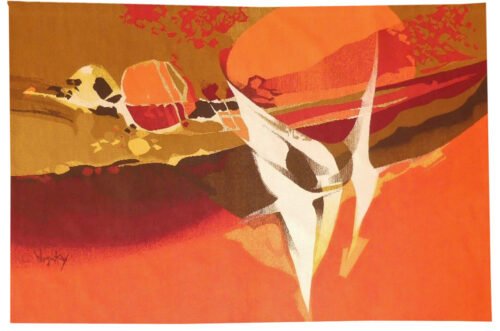
Midday Birds
Wogensky met Lurçat in 1939, but he only worked with him after the war, creating his first cartoon in 1945 (which was already titled "the birds"), and soon adhering to the A.P.C.T. (Association of Cartoonists-Tapestry Painters). Professor of mural art at the National School of Applied Arts in Paris, Wogensky will produce 159 cartoons until the 80s, most of which were woven by Legoueix. "Wool has warm blood like man. It gives us confidence and reassures us. A wool wall is a more human, more living wall" (words collected by Robert Guinot, "Tapestry of Aubusson and Felletin", Lucien Souny, 2009). It is this credo that will inspire Wogensky's creation, in lyrical flights (in the literal sense since the bird, often stylized, is one of his favorite subjects) (some cartoons, particularly from the late 1970s, are resolutely abstract), in his "Natural History" cartoons (title of one of his tapestries, in 1961), or "cosmic" ones, with subjects of constellations or natural elements. "I have always enjoyed working on large formats" he will confide again to Robert Guinot. If our cartoon appears modest relative to some official commissions by Wogensky (University of Strasbourg, Senate Conference Room, ...), its subject allows a spatial dilation, a surge of these elliptical bird motifs, enlivened by the chromatic energy of the bright red flat backgrounds. Bibliography: Cat. Expo. 25 years of French tapestry 1944, Paris, Gobelins manufactory, 1969, n°33 Cat. Expo. Tapestry and Space, Châteauroux, Cordeliers Convent, 1978, n°21 Cat. Expo. Robert Wogensky, the woven work, Aubusson, Departmental Museum of Tapestry, 1989, ill. p.34 Cat. Expo. Robert Wogensky, Angers, Jean Lurçat Museum and Contemporary Tapestry, 1989, ill. p.20Aubusson tapestry woven by the Legoueix workshop. With its signed ribbon, No. EA. 1969. -
Spring Garrigue
Aubusson tapestry woven by the Jean Laurent workshop. With its ribbon, No. 3/8. 1976.If Debiève designed numerous cartoons, in a typical aesthetic of the 40s (« the net reweaver », « the potter »,….), they were essentially printed on fabrics. More confidentially, it was woven in Aubusson, and its cartoons are close to its painting inspired by Provence. -
The 6 words of the secret
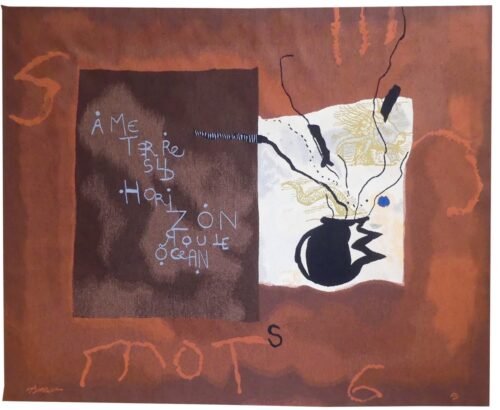
In 1987, Texier received the commission for the 'Droits de l'Homme' tapestry for the bicentennial of the Revolution. The choice was unexpected, the artist, still young, had never before provided tapisserie cartoons. It made it possible to federate the Aubusson workshops still in activity, the 7 tapestries of the hanging totaling more than 130 m² woven with literal quotations (the tables of the declaration are reproduced identically to the engraving of the revolutionary era), oscillating objects, signs, texts…. Subsequently, Texier continued to provide cartoons, both for the National Manufactures (a series of 3 tapestries, a carpet) and for Aubusson. Our cartoon reprises the plastic signs, the sparse texts, the traces specific to the graphic and plastic universe of the artist, which constitute, to quote him, 'maps where [he] introduces piloting elements', so that the eponymous 'secret' is revealed to us. Bibliography: La Suite des Droits de l'Homme, Niort, 1989Aubusson tapestry woven by the Pinton workshop. With its signed ribbon, No. 1/1. 2001. -
Saint-Mars (composition blue black yellow red white)
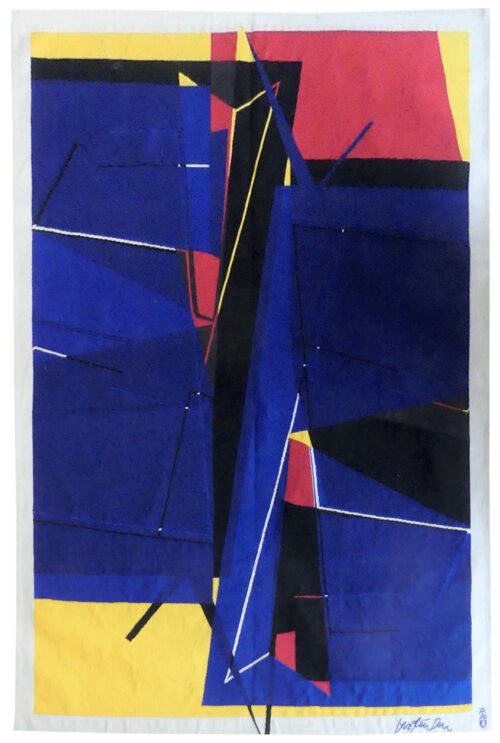
Aubusson tapestry woven by the Tabard workshop. With its label. 1963.Very quickly an abstract painter, Mortensen settled in Paris in 1947, and soon exhibited, with other proponents of geometric abstraction, at the Denise René gallery. And, in 1952, with the help of François Tabard and Vasarely, the gallery opened the exhibition "12 unpublished tapestries", featuring, alongside Le Corbusier or Léger, works by Deyrolle, Taueber-Arp or Mortensen, who were thus the first abstract painters to be woven: a new mode of expression was thus born (let's not forget that we were then in the outrageous domination of the "Lurçat style"), which would later be claimed by Gilioli, Matégot or Tourlière. Mortensen's participation in the "René-Tabard tapestries" lasted until 1968, although he returned to Denmark as early as 1964. The 14 tapestries of the artist that will be woven take up his large geometric compositions, with clear, bright and contrasting colors, with large colored flat areas, rendered with happiness by the weavers of the Tabard workshop. "One of the most beautiful" tapestries by Mortensen, according to Valentine Fougère (Tapestries of our time, Paris, 1969), "Saint-Mars", with an obscure title, is derived from a print of 1962. The style, very geometric, and surrounded by borders, with primary colors in flat areas, is characteristic of Mortensen's work in 1961-1962. This model, preserved both at the Mobilier National (a purchase from the Denise René gallery from 1963) and at the Cité de la Tapisserie d'Aubusson, was woven in 2 formats: the dimensions of our copy correspond to that of the Cité. Provenance: Denise René collectionBibliography: Madeleine Jarry, Tapestry, art of the 20th century, Fribourg, 1974, ill. no. 145 Cat. Expo. Aubusson, the abstract path, Aubusson, Departmental Tapestry Museum, 1993, ill. p. 14 (in situ in the Denise René gallery during an exhibition in 1964), and p. 32 Proceedings of the symposium, tapestry yesterday and today, Paris, 2011, ill. no. 6 p. 213 Visitor's guide, nave of the hangings, International Tapestry City, 2016, Aubusson, ill. p. 84 -
The Red and the Black
Protagonist of the revival of tapestry in Belgium following the collective “Forces murales”, Lucas provided some cartoons to the Braquenié de Malines manufacture around 1956-1957, in a style that is reminiscent of the work of Picart le Doux.Tapestry woven in Aubusson by the Braquenié workshop. With its border. Circa 1960. -
Flight
Aubusson’s tapestry woven by the Pinton workshop. With its label. 1963. -
The wheel
Aubusson tapestry woven by Pinton. With its label. Circa 1970.Perrot began his work as a cartoonist at the end of the war, producing nearly 500 cartoons, with many commissions from the State, most of which were woven in Aubusson. His highly decorative and shimmering style is very characteristic: a profusion of butterflies or birds, most often, stands out against a vegetal background, in the taste of mille-fleurs tapestries (which Dom Robert also drew inspiration from). Khaki background, inspiration from medieval mille-fleurs, swarming birds, all the elements specific to Perrot's cartoons are gathered here.Bibliography: Tapestry, drawings, paintings, engravings by René Perrot, Dessein et Tolra, 1982 -
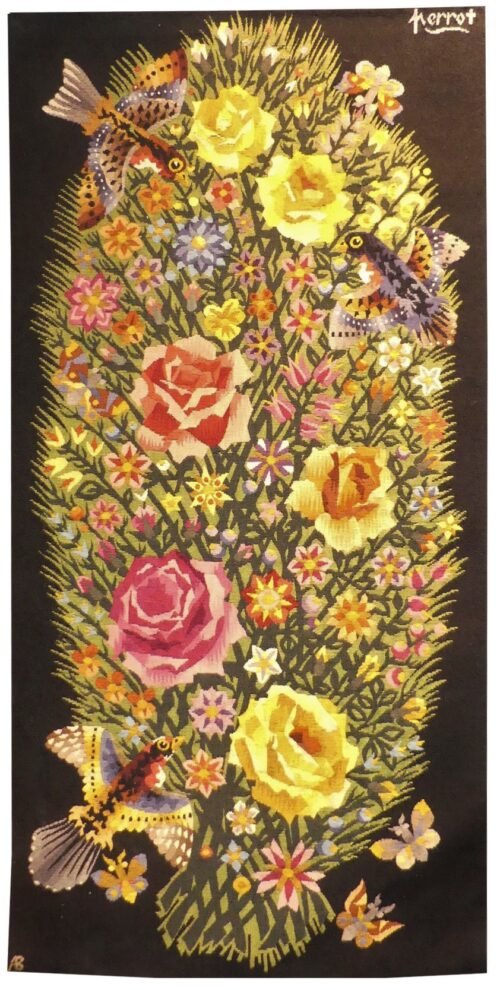
Bouquet of "flowerworks"
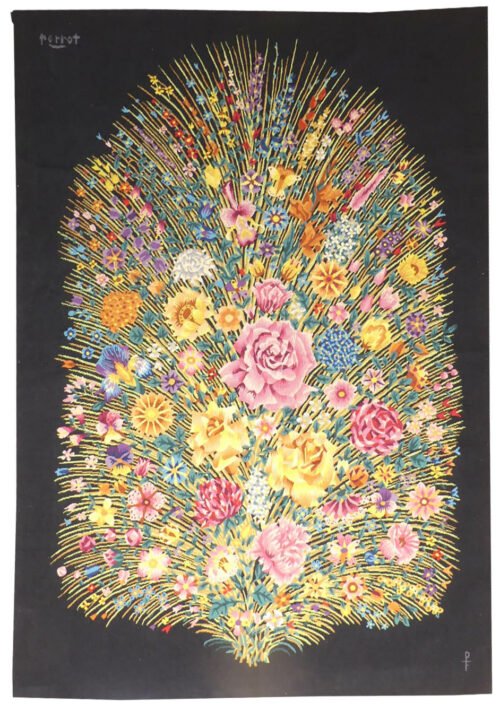
Aubusson tapestry woven by the Pinton workshop With its ribbon signed by the artist. Circa 1960.First a poster artist, then an artist-ethnographer during the war, Perrot began his work as a painter-designer at the end of it: he designed nearly 500 cartoons, obtaining numerous commissions from the State (33 cartoons, Perrot is the most represented designer of the 20th century in the collections of the Mobilier National!), most of which were woven in Aubusson. His highly decorative and shimmering style is very characteristic: treated in flat colors (without mottling, without stitching) a profusion of animals (mostly birds) stands out, without perspective, against a vegetal background, in the taste of medieval mille-fleurs tapestries. Like a floral pyrotechnics, 'Bouquet d'artifice' unfolds in a sheaf the different varieties, even slightly stylized, in a frenzy of colors accentuated by the black background: an ode to Nature. Bibliography: Tapestry, drawings, paintings, engravings by René Perrot, Dessein et Tolra, 1982 Cat. Expo. René Perrot, my poor heart is an owl, Aubusson, Cité Internationale de la Tapisserie, 2023 -
Pheasant
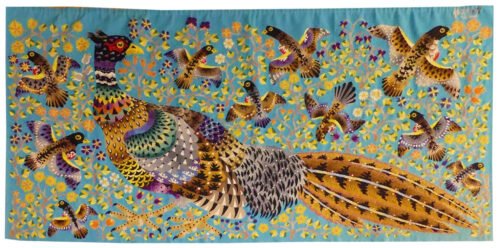
Perrot began his work as a cartoonist after the war, producing nearly 500 cartoons, with many commissions from the State, most of which were woven in Aubusson. His highly decorative and shimmering style is very characteristic: a profusion of butterflies or birds, most often, stands out against a vegetal background, in the taste of mille-fleurs tapestries (which Dom Robert also drew inspiration from). Ornithological subject, profusion of motifs inspired by medieval mille-fleurs, flat uniform background (in this case the famous "Perrot blue" as the Pinton workshops called it, used recurrently) make our cartoon a exemplary model of Perrot's art from the 1960s onwards. Bibliography: Tapestry, drawings, paintings, engravings by René Perrot, Dessein et Tolra, 1982 Cat. Expo. René Perrot, my poor heart is an owl, Aubusson, Cité de la Tapisserie, 2023Aubusson tapestry woven by the Pinton workshop. With its signed ribbon. Circa 1960. -
Bullfighting
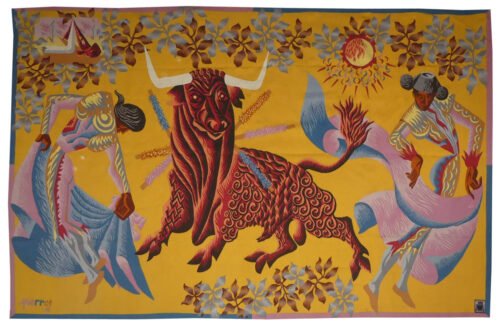
Aubusson tapestry woven by the Rivière des Borderies workshop. 1946.Perrot began his work as a cartoonist at the end of the war, producing nearly 500 cartoons, with many commissions from the State, most of which were woven in Aubusson. His highly decorative and shimmering style is very characteristic: a profusion of butterflies or birds, most often, stands out against a vegetal background, in the taste of mille-fleurs tapestries (which Dom Robert also drew inspiration from). Atypical tapestry in Perrot's work: bold chromatic range of stridency, unusually refined treatment, singular theme, as if choreographed, and involving the human figure; one is close to Saint-Saëns. But perhaps this is a commissioned cartoon? Bibliography: Tapestry, drawings, paintings, engravings by René Perrot, Dessein et Tolra, 1982 -
Tribute to Abbot Breuil
Aubusson tapestry woven by the Pinton workshop. With its label. Circa 1955.Perrot began his work as a cartoonist at the end of the war, producing nearly 500 cartoons, with many commissions from the State, most of which were woven in Aubusson. His highly decorative and shimmering style is very characteristic: a profusion of butterflies or birds, most often, stands out against a vegetal background, in the taste of mille-fleurs tapestries (which Dom Robert also drew inspiration from). An astonishing cartoon inspired by the paintings in the Lascaux cave, where tapestry has never more deserved its name of parietal art; Perrot's contribution is ultimately quite modest: saturation of colors (notably of the background, between mauve and pink), densification of motifs (more scattered in the cave), spread speckles,…If Perrot multiplied cartoon homages (to Pergaud, to Redouté, to Audubon,…), this one is especially noteworthy for the proven proximity of the artist and the dedicatee, "the pope of Prehistory": the homage does not rely solely on the artificiality of a public commission. Bibliography: Tapestry, drawings, paintings, engravings by René Perrot, Dessein et Tolra, 1982. -
Birds
Aubusson tapestry woven by the Tapisseries de France cooperative. 1952.Perrot began his work as a cartoonist at the end of the war, producing nearly 500 cartoons, with many commissions from the State, most of which were woven in Aubusson. His highly decorative and shimmering style is very characteristic: a profusion of butterflies or birds, most often, stands out against a vegetal background, in the taste of mille-fleurs tapestries (which Dom Robert also drew inspiration from). If, in tapestry, birds are recurrent in Perrot's work (like a hallmark!), the background with a landscape motif is rare. However, the artist produced many gouaches as he traveled (Doubs, Auvergne, Collioure, the Canaries...), a sensitive work that remained largely confidential. Bibliography: Tapestry, drawings, paintings, engravings by René Perrot, Dessein et Tolra, 1982 -
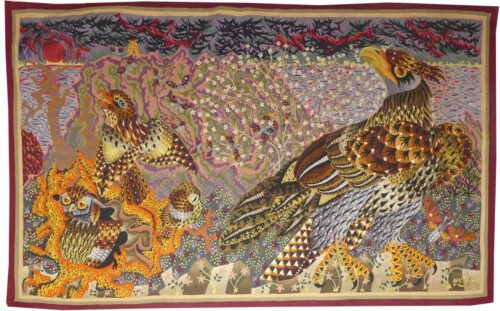
The law
Aubusson tapestry woven by the Rivière des Borderies workshop. With its ribbon. 1951.Perrot began his work as a cartoonist at the end of the war, producing nearly 500 cartoons, with many commissions from the State, most of which were woven in Aubusson. His highly decorative and shimmering style is very characteristic: a profusion of butterflies or birds, most often, stands out against a vegetal background, in the taste of mille-fleurs tapestries (which Dom Robert also drew inspiration from). The ornithological representations, which are infinitely varied in Perrot's work, are capable of an extraordinary variety of allegories: for example, with "discord" and "meditation" for the Palais de Justice in Paris, illustrated respectively by grouse and owls. Nothing like a majestic eagle with a severe eye, inspiring respect, to embody "the Law". Bibliography: Tapestry, drawings, paintings, engravings by René Perrot, Dessein et Tolra, 1982 -
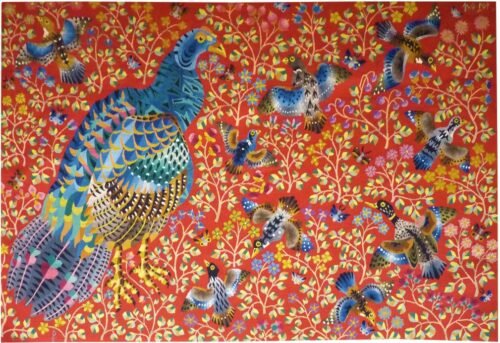
The turkey
Perrot began his work as a cartoonist at the end of the war, producing nearly 500 cartoons, with numerous commissions from the State, most of which were woven in Aubusson. His highly decorative and shimmering style is very characteristic: a profusion of butterflies or birds, most often, stands out against a vegetal background, in the taste of mille-fleurs tapestries (which Dom Robert also drew inspiration from). Our tapestry is exemplary of the artist's bird portraits; the turkey appears there, as often, associated with other birds, on a background inspired by medieval 'mille-fleurs'. Another copy was woven for the Ministry of Reconstruction. Bibliography: Tapestry, drawings, paintings, engravings by René Perrot, Dessein et Tolra, 1982 Aubusson tapestry, Association for the development of the Aubusson region, 1983, ill.p.40 Cat. Expo. René Perrot, my poor heart is an owl, Aubusson, Cité de la Tapisserie, 2023Aubusson tapestry woven by the Pinton workshop. With its ribbon. Circa 1960. -
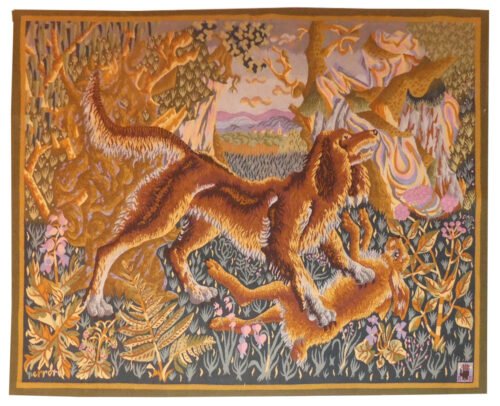
The death of the hare
Aubusson tapestry woven by the Rivière des Borderies workshop. 1946.Perrot begins his work as a cartoonist at the end of the war, producing nearly 500 cartoons, with many commissions from the State, most of which were woven in Aubusson. His highly decorative and shimmering style is very characteristic: a profusion of butterflies or birds, most often, stands out against a vegetal background, in the taste of mille-fleurs tapestries (which Dom Robert will also draw inspiration from). One of Perrot's oldest tapestries, contemporary with "the fox hunt" which was exhibited at the seminal exhibition of 1946, our cartoon testifies to Perrot's first inspiration: a taste for Nature, animals, interest in botany, geology, for inhabited landscapes (man is absent here, but he inhabits the village, he is a hunter)... The artist-ethnographer recycles into tapestry the observations carried out for the Museum of Arts and Popular Traditions during the war. Bibliography: Tapestry, drawings, paintings, engravings by René Perrot, Dessein et Tolra, 1982, ill. p.83 Cat. Expo. René Perrot, my poor heart is an owl, Aubusson, Cité de la Tapisserie, 2023 -
Rambouillet
Aubusson tapestry woven by the Pinton workshop With its label signed by the artist, No. 1/6. Circa 1970. Perrot began his work as a cartoonnier after the war, producing nearly 500 cartoons, with many commissions from the State, most of which were woven in Aubusson. His style is highly decorative and shimmering, very characteristic: a profusion of butterflies or birds, most often, stands out against a vegetal background, in the taste of mille-fleurs tapestries (which Dom Robert also drew inspiration from). René Perrot is essentially an animalier artist, who usually stylizes. His decorative vein is counterbalanced here by the extremely realistic treatment of the deer, unusual in post-war tapestry. The title of the cartoon refers to the great French hunts that he abundantly illustrated, for example in "Sologne", deposited at the Gien Hunting Museum by the Mobilier National. -
Slow approach
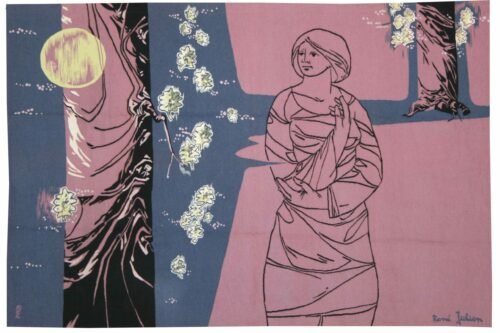
From a long artistic career, begun in the 50s (and which would later turn, especially towards sculpture), it is worth noting in Julien's work, from 1959 onwards, some twenty cartoons, essentially woven by the Braquenié manufacture, notably 'the foreign trade', a spectacular public commission of 12 m². His style is often characterized by drawn female figures (traced in black), sober in colors and motifs, of which our cartoon is exemplary. Bibliography: Léon-Louis Sosset, Contemporary Tapestry in Belgium, Perron, 1989Aubusson tapestry woven by the Braquenié workshop. With its label. Circa 1960. -
The Odyssey
Fumeron created his first cartoons (he would go on to create more than 500) from the 1940s onwards, collaborating with the Pinton workshops, then receiving numerous commissions from the State, before participating in the decoration of the 'France' ocean liner. Initially figurative and influenced by Lurçat, he evolved towards abstraction, before returning to a colourful and realistic figuration from the 1980s onwards. Fumeron, in the 1960s, thus evolved, like some of his peers (Matégot, Wogensky,…), towards abstraction. His compositions were then sometimes inspired by great texts (e.g. 'Hamlet') translated into a kaleidoscope of very personal colours.Aubusson tapestry woven in the Pinton workshops. With its signed label, No. 1/6. Circa 1965. -
Composition
Fumeron created his first cartoons (he would go on to create over 500) from the 1940s onwards, collaborating with the Pinton workshops, then receiving numerous commissions from the State, before participating in the decoration of the 'France' ocean liner. Initially figurative and influenced by Lurçat, he evolved towards abstraction, before returning to a colourful and realistic figuration from the 1980s onwards. A typical abstract cartoon by the artist, in a vein (and chromatic range!) that brings him close to Borderie or Wogensky, and whose achievements of the time, although forgotten, are in no way inferior to those of his peers.Aubusson tapestry woven by the Four workshop. No. EA. Circa 1960. -
Sumatra
Aubusson tapestry woven by the Four workshop. With its signed label, No. EA. Circa 1960.Fumeron created his first cartoons (he would go on to create more than 500) from the 1940s onwards, collaborating with the Pinton workshops, then receiving numerous commissions from the State, before participating in the decoration of the 'France' ocean liner. Initially figurative and influenced by Lurçat, he evolved towards abstraction, before returning to a colourful and realistic figuration from the 1980s onwards. The touch of exoticism recurs episodically in Fumeron's work in the 1960s: one thinks of his cartoons 'Osaka', 'Samurai' or 'the monsoon'. Yet there is no literal evocation: the partially obstructed circle (Sun?) remains a leitmotif, whatever the title. -
Coral Sun
Fumeron created his first cartoons (he would produce more than 500) from the 1940s, collaborating with the Pinton workshops, then receiving numerous commissions from the State, before participating in the decoration of the 'France' ocean liner. Initially figurative and influenced by Lurçat, he evolved towards abstraction, before returning to a colorful and realistic figuration from the 1980s. Vertical weft of branches in which chinoiserie fish swim, hiding a glowing sun: all of Fumeron's fantasy is gathered in this typical cartoon.Aubusson tapestry woven by the Pinton workshop. With its signed label by the artist. Circa 1960. -
Fish of the Moon
Aubusson tapestry woven by the Pinton workshop. With its ribbon. Circa 1970.Fumeron produced his first cartoons (he produced more than 500) from the 1940s onwards, collaborating with the Pinton workshops, then receiving numerous commissions from the State, before participating in the decoration of the liner 'France'. Initially figurative and influenced by Lurçat, he evolved towards abstraction, before returning to a colourful and realistic figuration from the 1980s onwards. Under the reddish moon, fish, butterflies and lobster frolic in a dreamlike composition typical of the artist: many of these motifs can be found in 'Before Man', woven by the Gobelins (see Cat. Expo. 'Le Mobilier National et les Manufactures Nationales des Gobelins et de Beauvais sous la IVe République', Beauvais, 1997) -
Composition
Fumeron created his first cartoons (he would go on to create more than 500) from the 1940s onwards, collaborating with the Pinton workshops, then receiving numerous commissions from the State, before participating in the decoration of the 'France' liner. Initially figurative and influenced by Lurçat, he evolved towards abstraction, before returning to a colourful and realistic figuration from the 1980s onwards. A typical abstract cartoon by the artist, in a vein that brings him close to Borderie or Wogensky, and which testifies to his constantly renewed invention.Aubusson tapestry woven by the Pinton workshop. No. 1/6 Circa 1960. -
Composition with Birds
Fumeron created his first cartoons (he went on to create more than 500) from the 1940s onwards, collaborating with the Pinton workshops, then receiving numerous commissions from the State, before participating in the decoration of the 'France' liner. Initially figurative and influenced by Lurçat, he evolved towards abstraction, before returning to a colourful and realistic figuration from the 1980s onwards. Birds perched on a tree in front of an orange sun, on a khaki background: a characteristic cartoon of the decorative and naturalistic vein of the artist (cf. 'Siennese sky' for example); only the scale of the cartoon sets our model apart.Aubusson tapestry woven by the Pinton workshop. With its signed ribbon. Circa 1960. -
The stump
Fumeron created his first cartoons (he would produce more than 500) from the 1940s onwards, collaborating with the Pinton workshops, then receiving numerous commissions from the State, before participating in the decoration of the 'France' liner. Initially figurative and influenced by Lurçat, he evolved towards abstraction, before returning to a colourful and realistic figuration from the 1980s onwards. Strangely, if the title is naturalistic, the cartoon leans towards abstraction, in a sort of distillation of Fumeron's figurative cartoons, where one can still recognise the characteristic yellow-sun circle of the artist.Aubusson tapestry woven by the Pinton workshop. With its bolduc. Circa 1960. -
Reflections
Fumeron produced his first cartoons (he would go on to produce more than 500) from the 1940s onwards, collaborating with the Pinton workshops, then receiving numerous commissions from the State, before participating in the decoration of the liner 'France'. Initially figurative and influenced by Lurçat, he evolved towards abstraction, before returning to a colourful and realistic figuration from the 1980s onwards. Under the red sun, fish, insects, and lobsters frolic in a typical oneiric composition by the artist: many of these motifs can be found in 'Before Man', woven by the Gobelins (see Cat. Expo. 'Le Mobilier National et les Manufactures Nationales des Gobelins et de Beauvais sous la IVe République', Beauvais, 1997)Aubusson tapestry woven by the Pinton workshop. With its bolduc, No. 6/6. Circa 1960. -
Orange composition
Aubusson tapestry woven by the Le mur du nomade workshop. No. 1/6. Circa 1970.Fumeron produced his first cartoons (he would go on to produce more than 500) from the 1940s onwards, collaborating with the Pinton workshops, then receiving numerous commissions from the State, before participating in the decoration of the liner 'France'. Initially figurative and influenced by Lurçat, he evolved towards abstraction, before returning to a colourful and realistic figuration from the 1980s onwards. The sunset, the orange chromatic range, the composition on the borderline between figuration and abstraction are characteristic of the artist's cartoons from this period. -
Mirage
Aubusson tapestry woven by the Pinton workshop With its ribbon. Circa 1965.Fumeron produced his first cartoons (he would produce more than 500) from the 1940s, collaborating with the Pinton workshops, then receiving numerous commissions from the State, before participating in the decoration of the liner 'France'. Initially figurative and influenced by Lurçat, he evolved towards abstraction, before returning to a colorful and realistic figuration from the 1980s. Interesting cartoon by Fumeron in his best abstract vein, which makes him the equal of Matégot -
Siena Sky
Fumeron created his first cartoons (he would go on to create more than 500) from the 1940s onwards, collaborating with the Pinton workshops, then receiving numerous commissions from the State, before participating in the decoration of the liner 'France'. Initially figurative and influenced by Lurçat, he evolved towards abstraction, before returning to a colourful and realistic figuration from the 1980s onwards. This cartoon plays on a play on words: 'earth' becomes 'sky of Siena' to allow the artist, on a gradated ochre background ('Siena earth'), to produce his birds and his sun-circle, in his characteristic decorative vein.Aubusson tapestry woven by the Pinton workshop. No. 4/6. Circa 1960. -
Sunset
Aubusson tapestry woven by the Four workshop. No. 2/6. Circa 1970.Fumeron created his first cartoons (he would go on to create over 500) as early as the 1940s, collaborating with the Pinton workshops, then receiving numerous commissions from the State, before participating in the decoration of the liner "France". Initially figurative and influenced by Lurçat, he evolved towards abstraction, before returning to a colourful and realistic figuration from the 1980s onwards. A recurring motif in Fumeron's work, the setting sun (orange or red) appears here veiled behind a curtain of trees, in a cartoon close to abstraction. -
Silver Reflections
Fumeron created his first cartoons (he would go on to create more than 500) from the 1940s onwards, collaborating with the Pinton workshops, then receiving numerous commissions from the State, before participating in the decoration of the 'France' liner. Initially figurative and influenced by Lurçat, he evolved towards abstraction, before returning to a colourful and realistic figuration from the 1980s onwards. Vertical weft of branches in which fish swim, hiding a glowing red sun: all of Fumeron's fantasy is brought together in this typical cartoon.Aubusson tapestry woven by the Pinton workshop. With its label signed by the artist. Circa 1960. -
Landscape with flamboyant
Like Toffoli, Raymond Poulet traveled the world, and his journeys served as themes for inspiration.Aubusson tapestry woven by the Jean Laurent workshop. No. 6/6. Circa 1990. -
Camel Market
Like Toffoli, Raymond Poulet traveled the world, and his journeys served as themes for inspiration; Orientalist inspiration had few precedents in tapestry except with Bezombes.Aubusson tapestry published by Jean Laurent. 1980. -
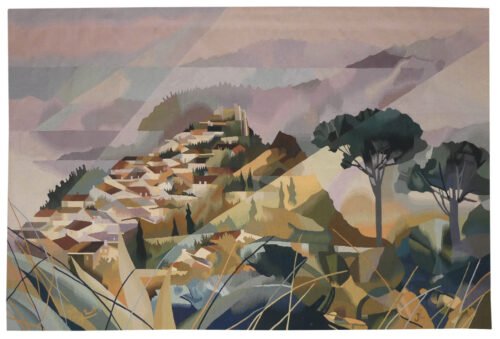
The village of Eze
In a decorative post-cubist style close to that of Toffoli, Raymond Poulet was able to translate one of the most spectacular sites on the Côte d'Azur.Aubusson tapestry woven by Jean Laurent workshop. No. 3/6. Circa 1980. -
Better known for its mechanical hangings close to the universe of Picart le Doux, Hurtu was able to design a few rare, more inspired cartoons, woven manually.
Scarecrow of moons
Aubusson tapestry woven by the Pérathon workshop. With its label, signed by the artist, No. 1. Circa 1970. -
South Mail
Aubusson tapestry, published by Jean Laurent. With its certificate, No. 1/6. 1976.Known for his geometric painting sometimes made of machinist elements, Gachon, of Aubusson origin, designed a few cartoons. Ours remains far from the usual vein of the artist. -
The joys of the evening
Known for his geometric paintings sometimes made up of machinist elements, Gachon drew a few tapestry cartoons, from a young age, as from the late 1960s, he was in contact with the Tabard workshop. Our cartoon shows the influence of lyrical abstraction on the young artist, an orientation that is ultimately quite rare in tapestry.Aubusson tapestry, woven by the Tabard workshop. With its border signed by the artist, No. 1. Circa 1968. -
Genetic couple
Aubusson tapestry woven by the Pinton workshop. With its ribbon. Circa 1970.Here, in this apparently unique cartoon, we find the surety of line and the purity of drawing of Trémois (known mainly as an engrever and illustrator, although Grand Prix de Rome de Peinture), and his taste for the treatment of the human body: amorous embraces and meditations on modern science are associated in an unusual shorthand typical of the artist. -
The seasons
Aubusson tapestry woven by the Bascoulergue workshop. With its signed label. Circa 1970. -
Exploded Flowers
Primarily a sculptor, Segeron provided a few cartoons, woven by Legoueix in Aubusson. Amidst the variety of titles and colors, the same motif-forms are always found, scattered and torn apart, like strange rhizomes or capillary networks.Aubusson tapestry woven by the Legoueix workshop. With its border, No. 1/6. Circa 1980. -
Gestation
Primarily a sculptor, Segeron provided a few cartoons, woven by Legoueix in Aubusson. Amidst the variety of titles and colors, the same motif-forms are always found, scattered and torn apart, like strange rhizomes or capillary networks.Aubusson tapestry woven by the Legoueix workshop. With its ribbon, No. 2/6. Circa 1980. -
Autumn bouquet
Aubusson tapestry. No. EA1. Circa 1975.A student of ENAD, Goffinet was a close collaborator of Dirk Holger, whose influence (as well as that of Prassinos) is notable in his rare woven cartoons. He sometimes wove his own cartoons, as here. -
Vendémiaire
The story is well-known: following the order of the "4 parts of the World" intended to be woven at the Gobelins, Dubreuil is one of the 3 artists, along with Gromaire and Lurçat, to have been sent by Guillaume Janneau, administrator of the National Manufactures, to Aubusson at the end of 1939, to renovate the local tapestry production (with the order of a hangings on the theme of Gardens). If he shares Lurçat's conceptions on the influence that medieval tapestry must produce to revitalize the medium, his cartoons, abundant and resolutely naturalistic (without the oneirism of a Coutaud for example), distance him from his colleague, in favor of a proximity with the work of Maingonnat. Our tapestry testifies to Dubreuil's collaboration with A.R.T. (tapestry renovation workshop) of Antoine Behna (of which Janneau, discredited for his role during the War, was the technical advisor). The register, allegorical, testifies to Dubreuil's classicism, between academic nudes and still lifes reflecting the History of Painting. This workshop wove in both high and low warp: the 1990 sales catalog included a copy woven in each of the techniques. Bibliography: G. Janneau, A. Behna, Tapestries of our time, 1950, ill. n°64 Catalog Sale Millon-Robert, 3.10.1990, n°29-29, 64Tapestry woven by Coffinet for Friend of Peace. Circa 1945.
Galleryadmin78002026-03-03T16:12:10+01:00